
AI search does not begin with a blank page.
Before a model retrieves current information, it may already have a shortlist of brands associated with the user’s question. New research suggests the names on that mental list receive a substantial advantage once the system starts searching the web.
For marketers, the finding changes the order of operations. Answer Engine Optimization cannot focus only on producing the best page for today’s query. Brands also need to become familiar enough that an AI model considers searching for them in the first place.
Brand Recall Is Becoming a Pre-Ranking System
Researchers at geoSurge examined whether a model’s existing memory of a brand predicted which companies it would later include in its web searches.
The difference was pronounced.
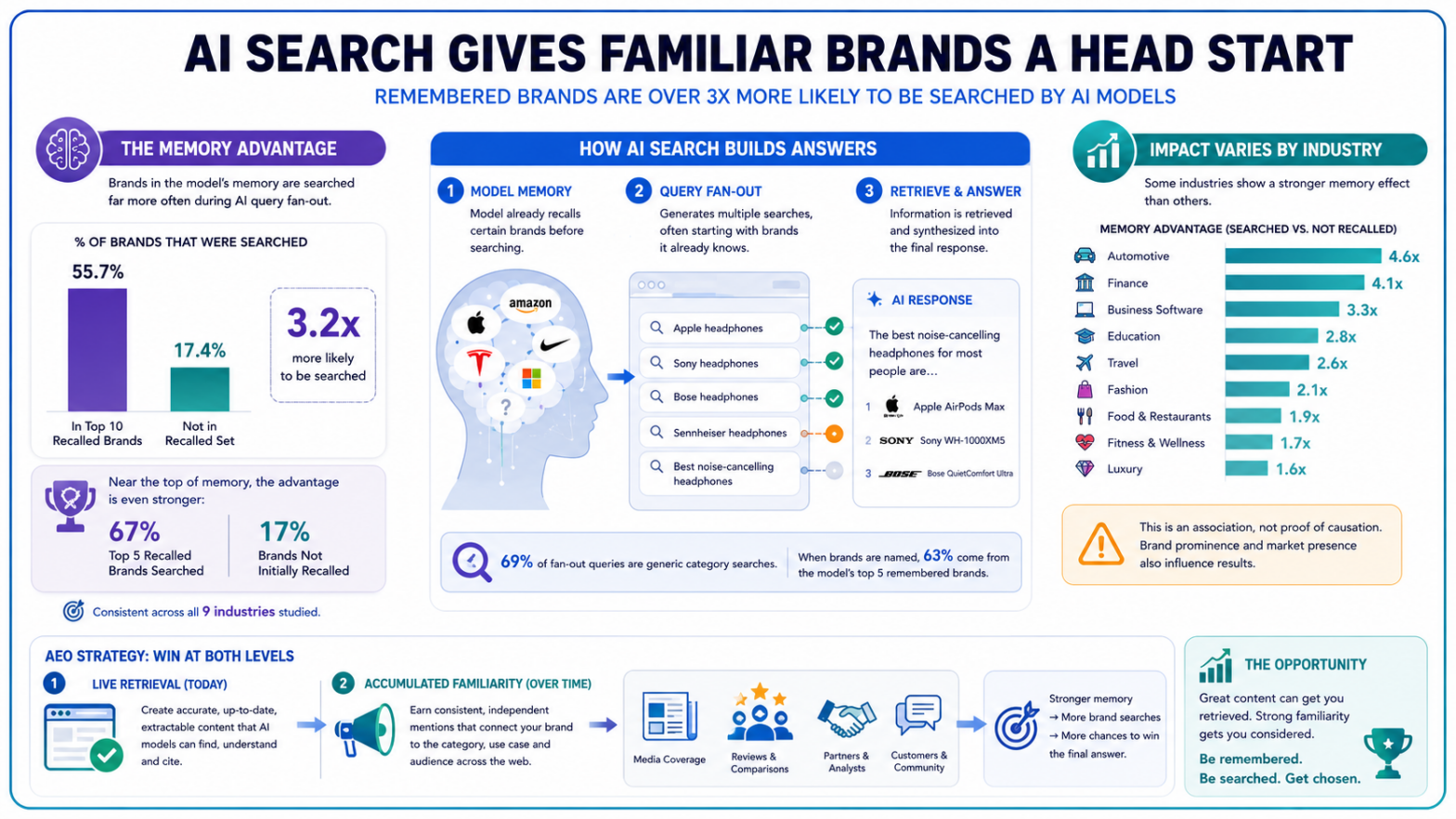
Brands appearing in the model’s top 10 recalled names were searched in 55.7% of the measured cases. Brands outside that remembered group were searched 17.4% of the time. Across the study cohort, a remembered brand was therefore 3.2 times more likely to appear in a fan-out query.
The effect grew stronger near the top of the model’s memory. Sixty-seven per cent of brands in the top five were searched, compared with 17% of brands the model did not initially recall. The gap appeared across all nine industries studied, although the size of the difference varied considerably by category.
That is not the same as a conventional Google ranking advantage.
A ranking system assesses documents after they enter the candidate set. Model memory may influence which brands receive that chance. When an AI system generates a brand-specific query, familiar companies arrive at the retrieval stage with their names already inserted.
The model is not merely choosing between available results. It may be choosing whom to investigate.
That makes brand authority part of the discovery mechanism rather than a supporting signal applied near the end.
Query Fan-Out Can Reinforce the Brands a Model Already Knows
AI search systems often break a complex prompt into several narrower searches, a process known as query fan-out.
Google says AI Mode can issue multiple related searches across subtopics and data sources before combining the information into one response. This process lets the system retrieve supporting pages beyond those that would appear for a single traditional query.
In theory, that broader search should create more room for unfamiliar brands.
The geoSurge data shows a more complicated pattern. Sixty-nine per cent of the observed fan-out queries were generic category searches. The remaining 31% named a specific brand. Within that brand-led group, 63% named one of the model’s five most strongly remembered companies.
The model frequently searched the open market. When it decided to investigate a company by name, however, it usually selected one it already recognized.
One study example asked which buy-now-pay-later provider an e-commerce store should offer. The model recalled Affirm, Klarna, Afterpay and PayPal, then generated a separate merchant-fee search for each of those four brands. Its remembered list effectively became its comparison set.
That sequence helps explain why AI search visibility cannot be measured through citations alone.
A citation shows which source helped support the final answer. It does not reveal which brands the model considered, which ones it searched by name or which competitors never entered the retrieval process.
By the time the final citations appear, an important selection decision may already have happened.
Strong Pages Can Still Break Into the Consideration Set
The study does not show that established brands automatically own AI answers.
In another payment-provider example, Gemini searched for Stripe, PayPal and Square, all of which appeared in measured model memory. It also searched for Lemon Squeezy, even though that brand was absent from the recalled group.
Live web content can still introduce an unfamiliar company.
That opening appears wider in categories where the model’s internal brand associations are less settled. Across the study, some industries showed a tighter relationship between memory and brand-specific searching than others. Automotive and finance were among the more memory-led categories, while fitness and wellness showed more searching beyond the model’s top recalled names.
For newer brands, this distinction matters.
A company outside model memory may still surface when its pages clearly answer the expanded queries generated during fan-out. Comparison pages, independent reviews, current product documentation and specific category content can all create retrieval opportunities.
Good Answer Engine Optimization therefore still needs accessible pages, direct answers, clear entity information and evidence that a model can verify.
What changes is the expected ceiling.
Strong query-level content can help a brand enter one response. Familiarity can place the brand into repeated consideration across many related prompts, including prompts where the company’s pages would not otherwise have been discovered immediately.
One earns retrieval. The other shapes recall.
AEO Now Has a Training-Time Problem
Traditional SEO work can respond relatively quickly to a weak ranking.
A team can revise a page, improve internal links, resolve technical problems or publish a stronger answer. Search engines crawl the changes, reassess the page and may adjust its position.
Model memory operates on a slower clock.
The geoSurge researchers argue that category memory is formed through the material models encounter during training. Repeated associations across media coverage, analyst reports, partnerships, comparisons and other third-party content can teach a system which brands belong in a market.
A company cannot publish one optimized article today and force that association into a model’s trained parameters tomorrow.
This gives AEO two different timelines.
The first is live retrieval. Brands need accurate, current and extractable pages that can appear when an AI system searches the web.
The second is accumulated familiarity. Brands need sustained evidence across the wider information environment connecting their name with a category, product type, audience and use case.
That is where AI brand mentions become more consequential than a simple awareness metric. A relevant mention can influence customers now, support branded search later and potentially contribute to the material future models use to understand the category.
Owned content remains necessary. It is not enough to build broad familiarity on its own.
A brand describing itself repeatedly creates a first-party claim. Independent publications, customers, partners, experts and industry databases repeating the same category association create corroboration.
The Study Shows an Advantage, Not a Closed Market
The findings need a careful reading.
The research covered 66 buyer-style prompts across travel, automotive, finance, business software, education, food and restaurants, luxury, fitness and wellness, and fashion. Each prompt was run 60 times over a 12-day period, producing 3,960 model responses and 13,281 fan-out queries. Memory and searching were measured using separate models, while the observed search behaviour came from Gemini 3.5 Flash.
The authors describe the result as an association rather than proof that memory directly caused the searches.
Brand prominence is also a major confounding factor. Well-known companies are more likely to exist in model memory, but they are also more likely to be searched because they have larger market footprints, more customers and more online coverage. The study used U.S. prompts, two specific models and a limited measurement window. Some industries contained as few as six prompts.
The precise 3.2-times advantage should not be treated as a universal benchmark for every model or market.
The direction is harder to dismiss. Across every industry examined, remembered brands were searched more often than brands outside the recalled set.
For marketers, the practical implication is to audit AI visibility at more than one stage. Teams should test whether models recall the brand without browsing, whether fan-out queries name it, whether its pages are retrieved and whether the final answer includes it accurately. Each stage identifies a different weakness.
A brand absent from the final response may not have a content-ranking problem. It may never have entered the model’s shortlist.
That is the new AEO pressure point. AI systems can search widely, but their first move may still favour the names they already know.