AI discovery is not replacing search cleanly. It is bending it.
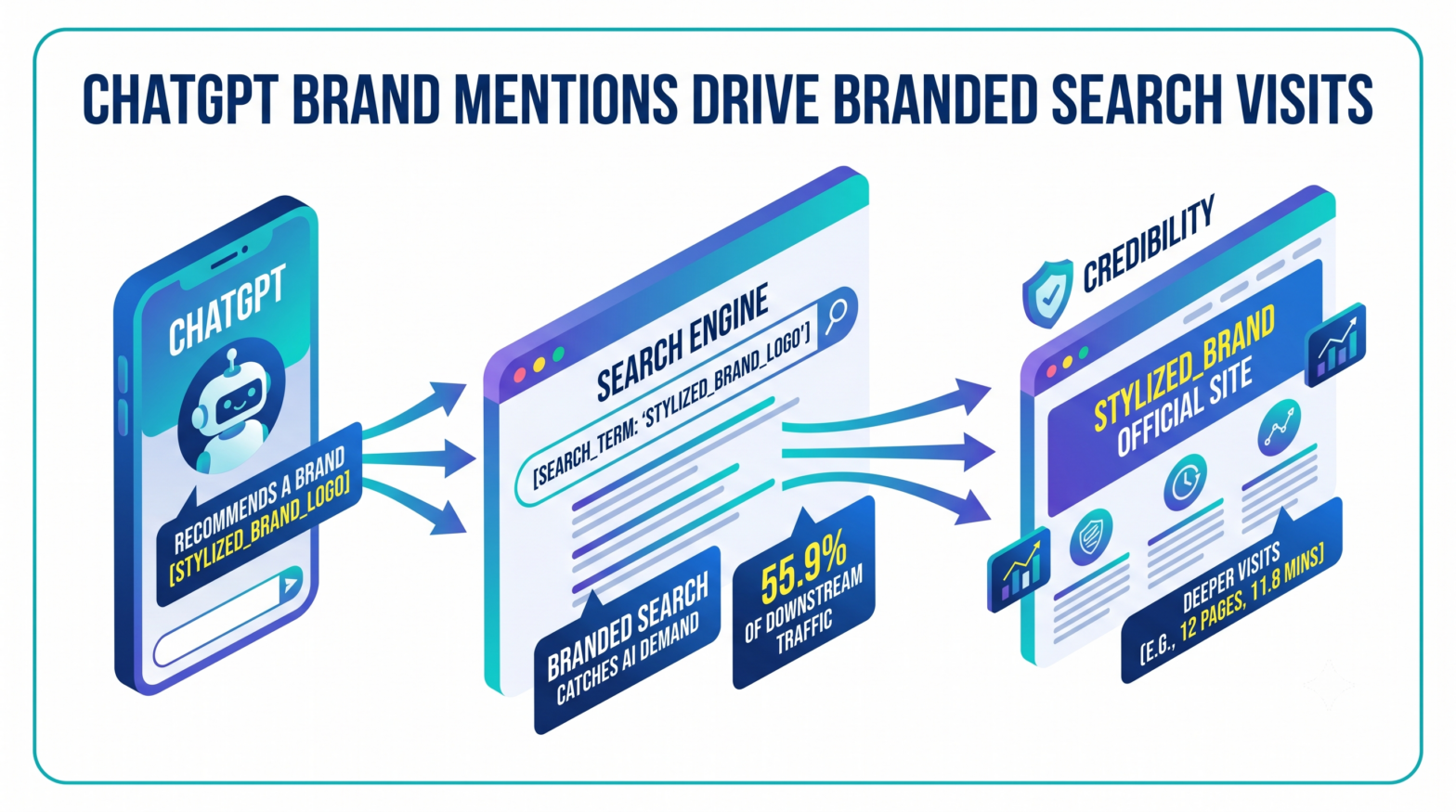
New Similarweb data suggests that when ChatGPT recommends a brand, many users do not click straight from the AI answer. They go back to search, type the brand name, and decide what to do next from there.
The AI Mention Is Only the First Move
Similarweb’s latest analysis connects ChatGPT recommendations with downstream website behaviour, giving marketers one of the clearest early views of what happens after a brand appears inside an AI-generated answer.
The finding is blunt: brands recommended by ChatGPT were 2.5 times more likely to receive a website visit within seven days than brands that were not recommended.
That does not prove ChatGPT caused every visit. Similarweb is measuring correlation across observed user journeys, not a controlled experiment. Still, the pattern is important because it shows AI visibility does not live only inside the chatbot interface. It can spill into other channels after the user leaves the AI session.
The study focused on U.S. desktop behaviour across finance, travel, and beauty, three categories where consumers often compare options before acting. Those categories make the data especially useful for marketers because the journey is rarely linear. A user may ask ChatGPT for recommendations, check reviews, run a branded search, compare competitors, and then visit the official site.
That messy path is the story.
AI answers may shape the shortlist before a website ever earns a click. For brands, the first measurable visit may appear in analytics as search traffic, even though the initial discovery moment happened somewhere else.
Branded Search Is Catching the Demand AI Creates
The strongest signal in Similarweb’s report is not just that users visited recommended brands. It is how they arrived.
Among users who visited a site after a ChatGPT recommendation, 55.9% of downstream traffic came through branded search. In plain terms, people saw or received a brand recommendation in ChatGPT, then searched for that brand later.
That changes how marketers should read branded search growth.
A spike in branded queries may not come from an ad campaign, a PR mention, or direct word of mouth. It may come from AI-assisted discovery that analytics tools do not label cleanly. The chatbot shapes interest. Google captures the next step.
For SEO teams already tracking Google AI Overviews, this matters because it shows two forms of AI search behaviour can overlap. A brand might appear in ChatGPT, then compete on a Google results page where ads, organic listings, review sites, comparison pages, map packs, and AI features all fight for the same user.
The brand recommendation does not end the journey.
It starts a more fragile one.
If branded search results are weak, incomplete, outdated, or crowded by competitors, the demand created upstream can leak before the user reaches the brand’s site. That makes owned search presence, brand SERP management, review visibility, and landing page clarity more important, not less.
Deeper Visits Point to Higher-Intent Users
Similarweb also found that users who arrived after a ChatGPT-influenced search engaged more deeply once they reached a website.
The report says this group viewed an average of 12 pages and spent about 11.8 minutes on site. Users who found the site another way viewed 6.5 pages and spent around 5.6 minutes.
That difference should be read carefully.
Longer sessions do not automatically mean better users. In some cases, more pageviews can signal confusion, comparison shopping, or friction. But in considered categories such as finance, travel, and beauty, deeper engagement often reflects research behaviour. Users may be comparing packages, checking credibility, reading terms, browsing products, or looking for proof before taking action.
For marketers, the useful point is not that AI traffic is magically superior.
It is that AI-influenced users may arrive with context already built. They have asked a question, received a recommendation, and chosen to investigate further. That can make their landing experience different from a user who clicked a generic informational result.
The site then has to carry the handoff.
A brand page, product page, or service page should answer the next logical questions a user may have after seeing an AI recommendation: Is this the right company? What makes it credible? What is the official site? How does it compare? What can I do next?
That is traditional conversion work with a new upstream source.
AI Visibility Is Becoming Harder to Attribute
The uncomfortable part is measurement.
If a user receives a ChatGPT recommendation but reaches the website through Google branded search, most analytics setups will credit Google organic search. If the user clicks a paid brand ad, paid search gets the credit. If the user later returns directly, direct traffic may absorb the value.
The AI touchpoint can disappear.
That creates a blind spot for teams trying to measure AI search performance. Referral traffic from AI platforms is only one piece of the channel. It captures users who click a link directly from ChatGPT, Perplexity, Gemini, Copilot, or another AI system. It misses users who use AI as a recommendation engine, then complete the next step somewhere else.
Search Console is also still catching up. Google has started rolling out AI Search Console reports for visibility in generative AI features, but those reports are built around Google’s own AI Overviews, AI Mode, and related Search surfaces. They do not explain what happens when a user begins in ChatGPT and later searches on Google.
That makes AI visibility a cross-channel measurement problem.
Marketers will need to compare branded search trends, direct traffic, referral traffic from AI platforms, assisted conversions, landing page behaviour, and brand mention tracking. No single report will carry the whole story.
Google Still Says SEO Fundamentals Apply
The Similarweb findings land in the middle of a larger debate over whether marketers need an entirely separate playbook for generative AI search.
Google’s own guidance is more conservative. It says generative AI features in Search are rooted in its existing ranking and quality systems, and that foundational SEO practices remain relevant. Pages need to be indexable, useful, technically accessible, and eligible to appear in Google Search with a snippet.
There is no special shortcut.
That point matters because AI visibility has already attracted a wave of new terminology, vendor claims, and speculative tactics. Some of that work may become useful over time. Some of it is packaging. Google has already pushed back on claims that files such as llms.txt provide ranking benefits for its AI systems.
The Similarweb data points to something more grounded: brand visibility in AI systems may be connected to the same signals marketers have been building for years. Authority. Recognition. Content depth. Search presence. Mentions across trusted sources. Clean branded results. Useful pages that answer real comparison questions.
AI can introduce the brand.
Search still has to validate it.
The Practical Shift for Marketers Is Attribution, Not Hype
For marketers, the practical implication is that AI visibility should be measured as an upstream discovery signal, not only as referral traffic. Teams should watch whether branded search demand changes after a brand appears more frequently in AI-generated answers, and then check whether branded results are strong enough to capture that demand. That includes the official website, local listings, review sites, paid search coverage, comparison pages, and high-intent landing pages.
This is especially relevant for categories with longer consideration cycles.
Finance, travel, and beauty users rarely act from one touchpoint. They gather options, compare language, validate credibility, and move between platforms. AI recommendations may affect which brands enter the set. Branded search may decide which brand earns the visit.
The report does not show that every brand mention in ChatGPT produces business value. It does show that AI visibility can have a downstream footprint outside the AI platform itself.
That is enough to change the reporting conversation.
The next fight is not whether AI tools send referral traffic. Some do. Some do not. The harder question is whether brands can detect the demand AI creates after the user leaves the chatbot and searches somewhere else.