

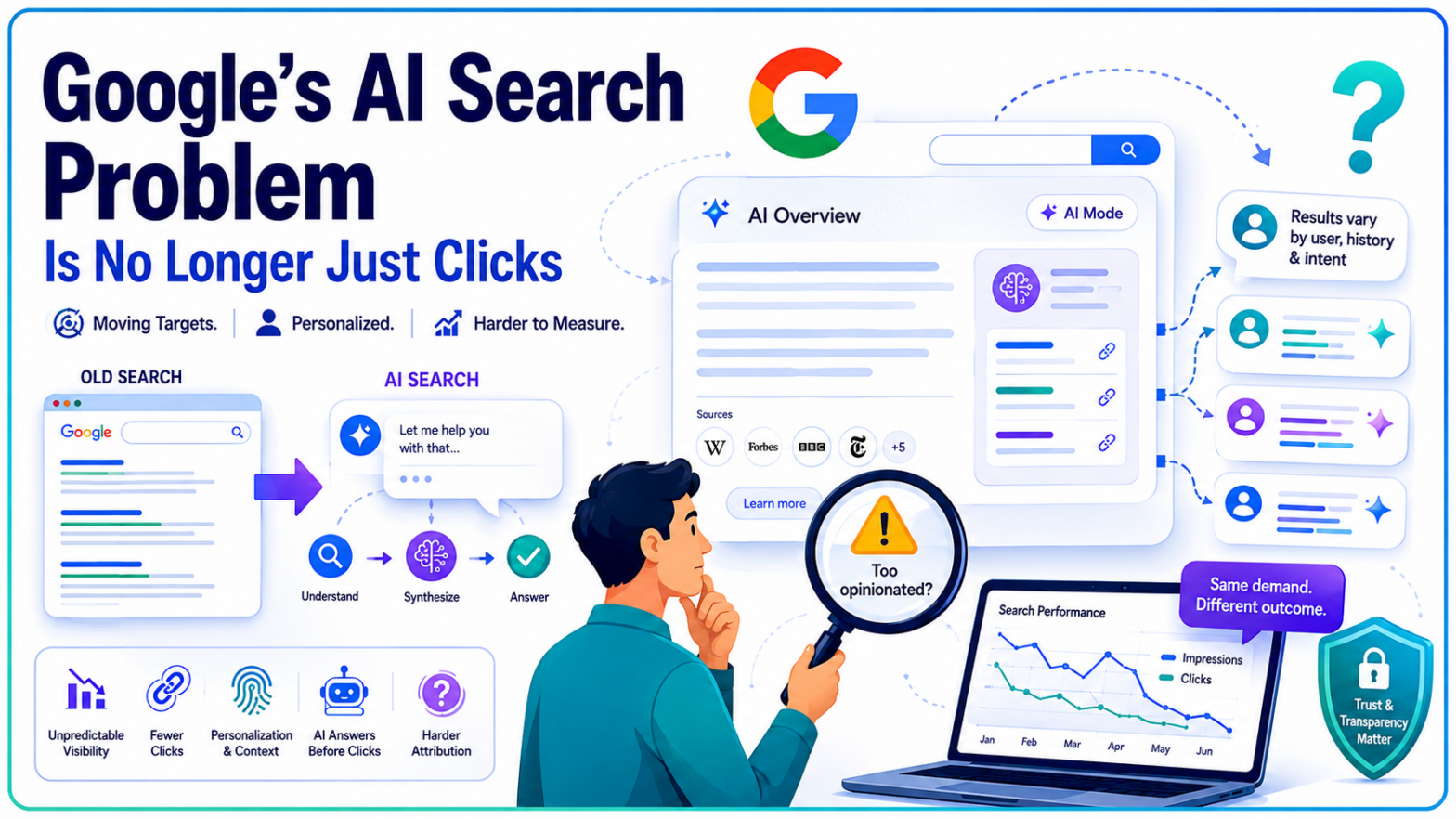
Google is not defending the old search results page anymore. It is defending a moving target.
AI Overviews, AI Mode, personalization, conversational answers, follow-up queries, and source links now sit inside the same broader system that publishers still rely on for visibility. That shift is creating a harder question for marketers and SEOs: how do you measure search performance when the result itself may change by user, query history, interface, and intent?
Google CEO Sundar Pichai addressed that tension in a recent interview, acknowledging that one AI-generated Search response shown to him appeared “more opinionated than it should be.”
That was not a small admission.
It put a spotlight on the gap between Google’s internal satisfaction metrics and what publishers, businesses, and search professionals are seeing from the outside: less predictable visibility, harder attribution, and growing concern that Google’s AI layer may be changing the economics of search faster than reporting tools can explain.
AI Search Is Becoming Less Like A Results Page
The old model was easier to understand, even when it was difficult to rank.
A user searched. Google returned links. A business measured impressions, rankings, clicks, landing pages, conversions, and revenue. The system was imperfect, but the flow was visible enough for SEOs to work with.
AI Search changes that sequence.
With AI Overviews, Google can synthesize information before the user clicks. With AI Mode, users can continue a search as a conversation. With follow-up prompts and personalized context, one query can lead to several answer paths instead of one ranked page of results.
Google has publicly said that its long-standing Search advice still applies to AI experiences. In a May 2025 Search Central post, the company said publishers should focus on unique, valuable content, strong page experience, crawlable pages, preview controls, accurate structured data, and multimodal assets. Google also said AI Overviews and AI Mode show links in different ways and surface a wider range of sources.
That is Google’s official position: AI Search is still connected to the open web.
The publisher concern is different. Being connected to the web is not the same as sending traffic in a measurable, dependable way.
Pichai Called One AI Result Too Opinionated
During the interview, Pichai was shown an AI Search result and asked whether the experience was good. His response was blunt enough to matter.
“I think it’s probably more opinionated than it should be for the particular query you showed me,” Pichai said.
He described AI Search as a “fast evolving space” and said he would expect imperfect results to appear while the product continues to change. He added: “Like my intuition there is, oh, that’s way more opinionated.”
For marketers, the important part is not only the specific answer. It is the operating reality behind it.
AI-generated Search does not simply rank documents. It decides what to summarize, what sources to cite, how strongly to phrase an answer, and whether a follow-up interaction should continue the same line of reasoning. A traditional blue-link result could be biased by ranking systems. An AI answer can be biased by retrieval, summarization, source selection, prompt context, and wording.
That makes quality measurement harder.
Google has spent years using large-scale user behaviour signals to evaluate Search quality. Click patterns, long clicks, bounce behaviour, satisfaction surveys, and repeat interactions can reveal broad performance trends. But AI Search adds another layer between the user and the source. The user may be satisfied enough to stay on Google while the publisher receives less traffic. Or the user may dislike the AI framing while still interacting with the page.
Both outcomes can show engagement.
They do not tell the same story.
Personalization Creates Results SEOs Cannot Reproduce
Pichai also suggested the example he was shown may have been shaped by personalization.
“There is some chance that’s personalized to you may be testing it in a way that you’re uniquely personalizing,” he said. “You are the reason that query might not be exactly representative.”
That line should get the attention of every SEO team tracking AI Search visibility.
Personalized AI responses can create outliers that do not appear in standard rank tracking, manual spot checks, or clean-browser tests. A brand may appear in one user’s AI Overview, disappear for another, and show up differently after a follow-up query. The variation may be small in aggregate and large in the moment that matters.
Classic SEO already had localization, device differences, logged-in behaviour, search history, and test buckets. AI Search adds a conversational layer that can reshape the query itself. A user does not just search once. They refine, challenge, narrow, and ask for recommendations.
That can create a visibility environment where keyword ownership becomes less stable.
Keyword strategy still matters because queries still express demand. But AI systems interpret that demand through context. A page optimized around a high-value term may not win visibility if the AI answer favours a source with clearer entity signals, stronger topical authority, more recent supporting content, or a format better suited to synthesis.
The practical problem is reporting. Search Console data does not cleanly separate every AI Search interaction from classic Search behaviour. Marketers can see impressions and clicks, but they cannot always see when an AI answer satisfied the user before the click happened.
Publisher Traffic Is Now A Boardroom Issue
The interview also moved into “Google Zero,” the scenario where publishers plan for search referrals to fall close to nothing. Pichai did not tell publishers to make that assumption. He also did not promise that historic referral patterns would return.
Instead, he argued that the content ecosystem has become broader, with users consuming podcasts, user-generated content, video, forums, and other formats. He said Google remains committed to connecting people with what is on the web and noted that the company has added more links to AI features.
“We’ve gone back, we’ve added more links,” Pichai said.
That matters, but it does not fully settle the traffic question.
A link inside an AI answer is not the same asset as a traditional organic ranking. The answer may satisfy the query before the user reaches the source. The cited page may receive a higher-intent visitor, but fewer total visitors. Google has argued that clicks from AI experiences can be higher quality because users arrive with more context. Publishers are asking whether better click quality offsets lower click volume.
Those are different metrics.
For businesses dependent on Google Search traffic, the risk is not only fewer visits. It is less certainty around where demand is being intercepted, how AI answers are influencing brand choice, and whether organic search remains a scalable acquisition channel for informational content.
That is why the “Google Zero” debate has moved beyond publishers. SaaS brands, ecommerce sites, local businesses, affiliate sites, media companies, and B2B marketers all face some version of the same issue: visibility may still exist, but the click path is changing.
Trust In AI Is Not The Same As Usage
Pichai was also asked about the gap between AI product usage and public anxiety about AI. He did not dismiss the concern.
“I think it is a very profound topic,” he said, adding that AI is “the most profound technology humanity is going to deal with” and that people are trying to understand what it means for their lives and the economy.
That distinction matters for Search.
High usage does not automatically equal trust. A user may rely on Google because it is default, fast, familiar, or embedded into daily behaviour. That does not mean they trust every AI-generated response. It also does not mean publishers accept the traffic trade-off created by answer-first interfaces.
Search satisfaction metrics can show whether people keep using a product. They are less clear on whether users understand how an answer was produced, whether they noticed source links, whether they believe the sources were fairly represented, or whether they would have preferred a traditional result set for certain queries.
For marketers, the near-term implication is practical: AI Search visibility should be treated as a measurement challenge, not only a ranking challenge. Teams need to monitor brand mentions in AI answers, compare AI Overview appearances across query types, strengthen content that demonstrates first-hand expertise, and evaluate organic performance through conversions and assisted value rather than clicks alone.
The old SEO dashboard is not useless.
It is incomplete.
The New Search Risk Is Variability
Google’s current position is consistent: AI Search is an evolution of Search, not a replacement for the web. Its guidance still points site owners toward original content, strong technical access, good user experience, and clear page signals.
The market is reacting to something else.
AI Search can answer before the click. It can personalize more aggressively than a static results page. It can cite sources without sending much traffic. It can change how users compare brands, products, publishers, and advice. And when an answer is too opinionated, even Google’s CEO can see the problem.
For SEOs and marketers, the work now sits in the gap between those realities. Search is still a discovery channel. It is also becoming an AI-mediated decision layer, where visibility, attribution, and trust no longer move together as cleanly as they once did.