The llms.txt debate got an answer many SEOs were already starting to suspect. Google says the file does nothing for Search.
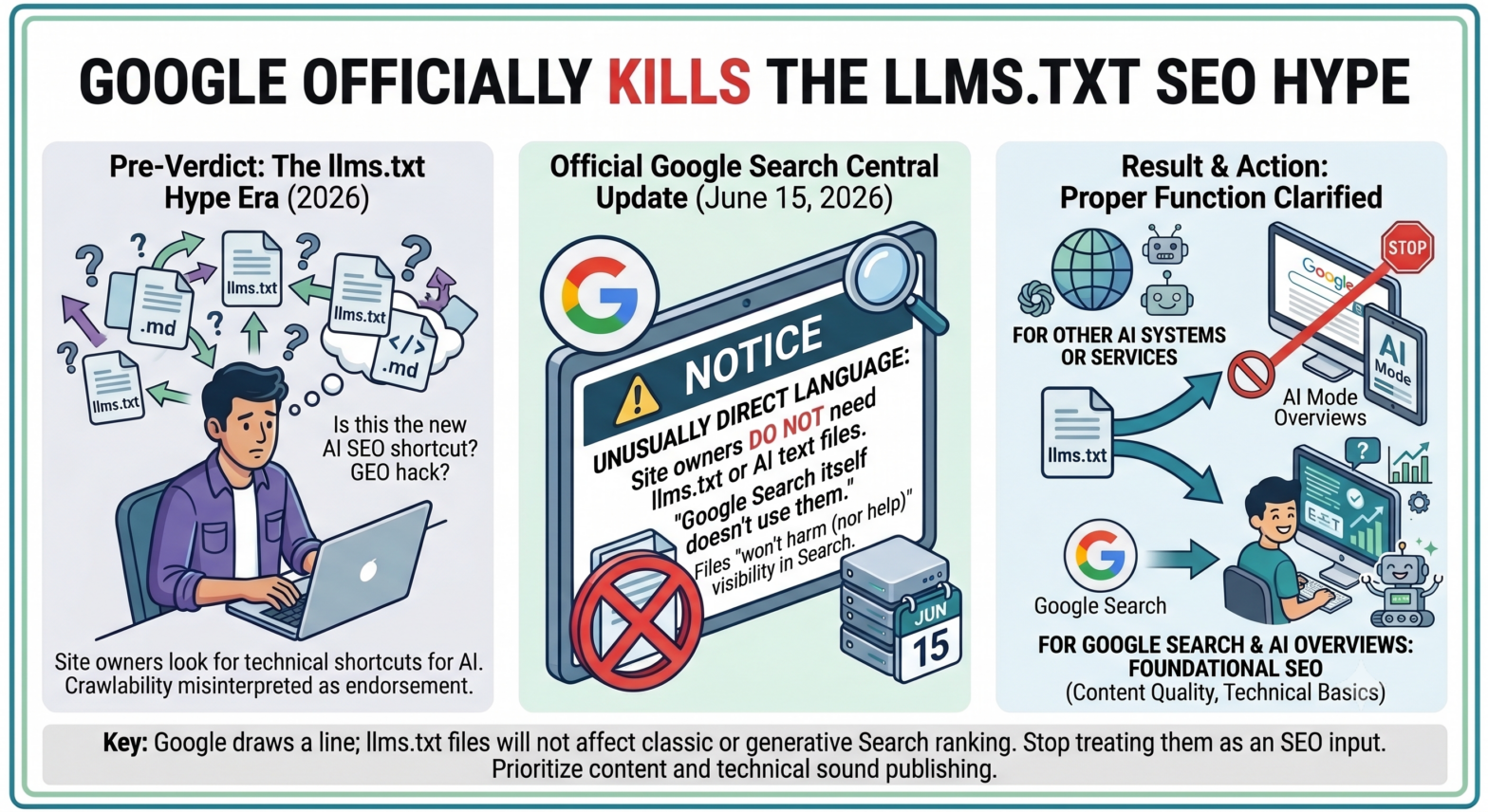
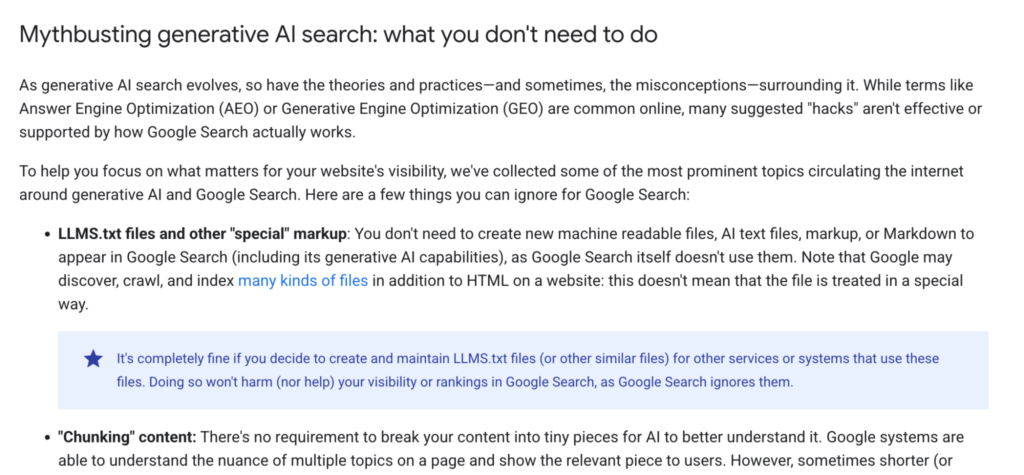
In an update published June 15 to its Search Central documentation, Google added unusually direct language around llms.txt and similar AI-facing files. The company now says site owners do not need to create “machine readable files, AI text files, markup, or Markdown” to appear in Google Search, including generative AI features, because “Google Search itself doesn’t use them.” It also added a second line that leaves little room for interpretation: maintaining llms.txt files “won’t harm (nor help)” visibility or rankings in Google Search.
That matters because llms.txt had started to pick up the familiar energy of a technical shortcut. A small file. A new acronym. A growing pile of claims about AI visibility. Google has now stepped in to say this is not one of the levers that moves Search.
Google Is Drawing A Line Between Search And Everything Else
The most important part of the update is not just that Google ignores llms.txt. It is that Google chose to spell out the distinction.
According to the revised AI optimization guide, site owners are free to create and maintain llms.txt files “for other services or systems that use these files.” Google’s point is narrower: if the goal is better performance in Google Search, including AI-driven search experiences, this is not a ranking input and not a visibility signal.
That is a useful clarification in a market crowded with new labels like AEO and GEO, where technical recommendations are often packaged before the platform itself has endorsed them. Google had already been signaling this direction in its broader guidance on AI search. Its documentation for AI features says there is no special markup required to appear in those experiences, and the company’s AI optimization guide repeatedly pushes site owners back toward foundational SEO rather than AI-specific hacks.
TechWyse covered that earlier shift in Google AI Search Guide Rejects GEO Hacks, where Google’s message was already moving toward restraint. The June 15 addition makes the same point with sharper edges.
Why llms.txt Caught On In The First Place
The appeal was easy to understand.
As AI crawlers, answer engines, and retrieval systems spread across the web, site owners started looking for a cleaner way to explain their content to models. llms.txt was pitched in some circles as a machine-friendly map: a concise file that could summarize important pages, document structure, or preferred source material for language models.
That idea landed at a moment when technical teams were already juggling robots.txt, XML sitemaps, schema markup, indexation controls, and AI scraping questions. So the temptation was obvious. If a new file might shape how models understand a site, why not ship it now and sort out the impact later?
Google’s update does not argue with the existence of that broader ecosystem. It simply says Google Search is not part of it.
That separation is important because it cuts through a category error that has been creeping into SEO discussions for months. Not every file that may be useful to an LLM-powered system is automatically relevant to Google rankings. Google even notes that it may “discover, crawl, and index many kinds of files in addition to HTML on a website,” but adds that this does not mean those files receive special treatment.
In other words, crawlability is not endorsement.
The Timing Tells Its Own Story
This was not a buried wording tweak. Google listed the change in its official June 2026 Search Central documentation updates under the heading “Clarifying guidance on llms.txt files.” The company said it added the note “to address questions from the community” and clarify that these files are not needed for Google Search and do not create either a positive or negative visibility effect.
That phrasing suggests the confusion had become large enough to warrant cleanup.
It also fits a wider pattern in Google’s recent documentation changes. The company has been spending more time drawing boundaries around what does and does not matter in AI search. Some of those updates have focused on preferred sources, others on spam policies, Search Console reporting, and third-party SEO advice. The common theme is less glamorous than the vendor pitch cycle. Google keeps pulling attention back to content quality, crawl accessibility, and technically sound publishing rather than speculative AI formatting tricks.
That broader reset showed up again in Google Updates SEO Hiring Guide, Warns on Third-Party Tools, where the company pushed site owners to scrutinize SEO claims against official documentation instead of accepting AI-era sales language at face value.
What This Means For AI Overviews And AI Mode
Google’s wording matters here because it explicitly covers more than classic blue-link Search.
The updated guide says site owners do not need these files to appear in Google Search “including its generative AI capabilities.” That brings AI Overviews and AI Mode into scope. The takeaway is straightforward: adding llms.txt will not improve eligibility, prominence, or ranking inside those search experiences.
For teams trying to influence Google’s AI surfaces, the practical direction remains familiar. Publish original, useful content. Keep pages crawlable. Maintain clear structure. Use standard SEO best practices that already help Google understand and trust a site.
That is consistent with Google’s recent product and reporting moves around generative search. TechWyse has already tracked the measurement side in Google Adds AI Search Reports & Opt-Out to Search Console, where the emphasis stayed on visibility and control mechanisms that Google actually acknowledges.
The gap between those confirmed systems and llms.txt is the whole story. One is in Google’s own workflow. The other is not.
What This Changes In Practice
In practical terms, SEO and content teams can stop treating llms.txt as a Google Search project. If an organization wants to maintain the file for other AI services, internal retrieval systems, or external platforms that recognize it, Google says that is fine. But it should be handled as a separate interoperability decision, not as a Google ranking tactic. For Search performance, the work stays where it has been: technical accessibility, high-value content, sound internal linking, and credible signals that help pages compete on their actual merits.
That also makes prioritization easier. When resources are tight, the teams that win are usually the ones that separate confirmed inputs from fashionable theory.
Google did not ban llms.txt. It did something more useful. It told the industry to stop confusing it with SEO.