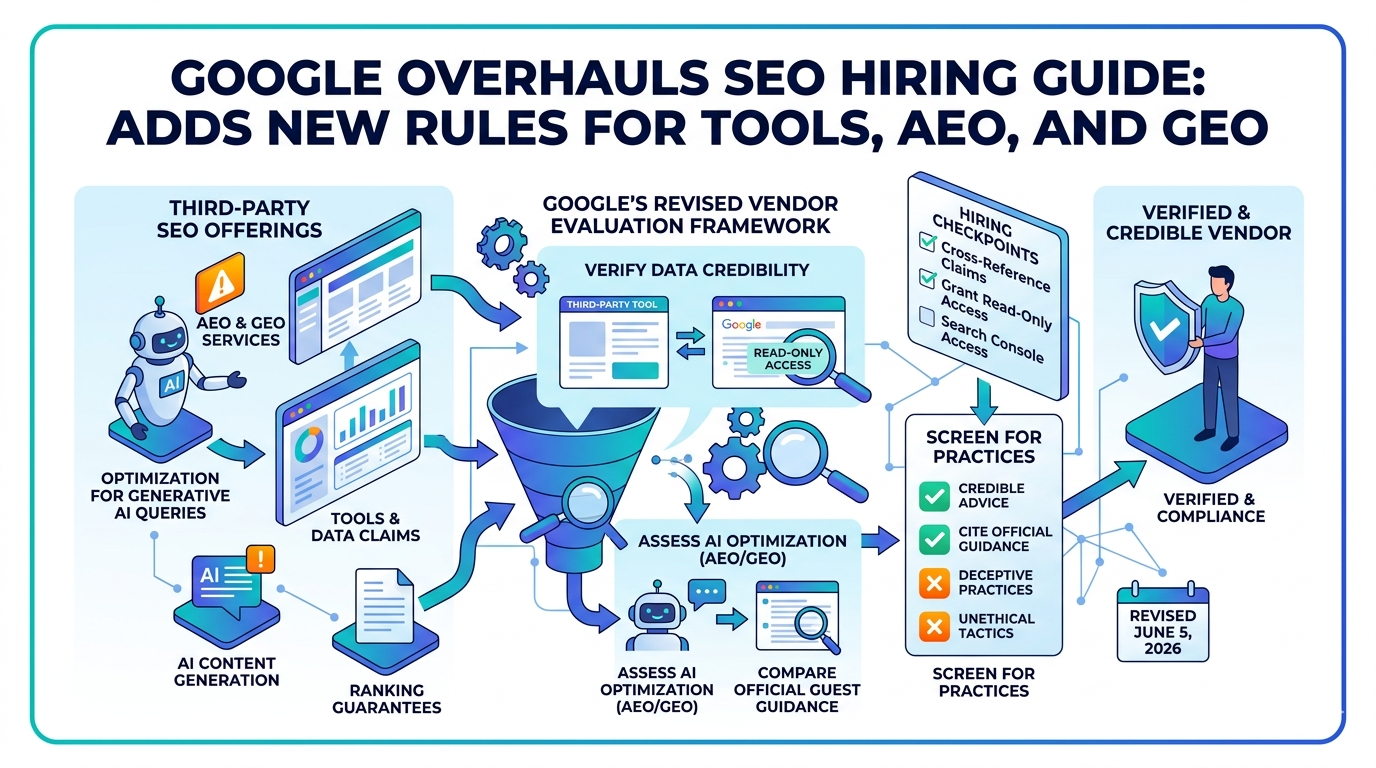
Businesses hiring SEO agencies or evaluating third-party SEO tools now have new official guidance from Google to measure those vendors against. Google Search Central added a new document titled "Google Search's guidance on using third-party SEO tools, services, and advice" and updated the existing "Do you need an SEO?" page, with both documents last revised on June 5, 2026. Google stated the changes were made "to highlight important considerations when evaluating third-party SEO tools and advice, and to simplify some sections and remove outdated examples in existing documentation."
What the New Document Covers
The new guidance is directed at website owners who are considering advice from third parties or using third-party SEO services and tools, and frames itself as a resource for evaluating whether those external sources align with official Google Search guidance.
The document acknowledges that third-party SEO advice exists in large volume across the internet, including content related to AEO (Answer Engine Optimization) and GEO (Generative Engine Optimization), but notes that some of it misrepresents how Google ranking systems work, and states that credible advice should either qualify claims as opinion based on data and experience or back them up by citing official Google Search guidance.
Google lists the types of third-party SEO services the guidance covers, including sitemap tools, indexing tools, content generation services, ranking advice services, and tools that promise improvements for AEO and GEO. For services that claim their offerings are "acceptable" or "approved" by Google Search, the document states plainly that Google does not evaluate third-party services, and warns users to be skeptical of such claims.
Google also states directly that "using a service or tool doesn't guarantee ranking success."
Google's Position on Third-Party SEO Data
One of the more pointed sections in the new documentation addresses the data that third-party SEO platforms provide. Google states that some third-party services provide data that users misinterpret as coming from Google, and makes clear that third-party tools do not have access to Google's internal ranking data and cannot guarantee performance. The document adds that any predictions those tools make are their own and may not materialize.
Despite the cautions around external tools, Google stops short of discouraging their use altogether, framing the guidance instead as a framework for evaluating what external resources actually align with official documentation. Google does, however, make an explicit recommendation for its own platform: the document, last updated June 5, 2026, directs users to Google Search Console as the preferred tool, describing it as one that provides "key information and data directly from Google Search itself."
Changes to the "Do You Need an SEO?" Page
Google also made substantive changes to the longstanding "Do you need an SEO?" help document, adding new content around optimizing for generative AI.
A new passage added to that page states:
"If your SEO uses a third-party tool, keep in mind that Google doesn't evaluate or endorse third-party SEO tools, and these tools don't have access to Google's internal ranking data."
It follows with a warning to be wary of "tools that claim to be 'acceptable' or 'approved' by Google Search."
The updated page also introduces new guidance on how to handle SEO audits. Google advises that when an SEO offers to conduct an audit, site owners should grant only read access to Search Console, not write access, and that the audit should produce realistic estimates of improvement rather than guarantees of first-place rankings.
Google also added a checklist for evaluating an SEO provider's recommendations, asking whether those recommendations are checked against official Google guidance, whether any AI optimization advice aligns with Google's own generative AI guidance, and whether the tools used are aligned with Google's guidance.
AEO and GEO Services Addressed Directly
Google's broader documentation suite now explicitly addresses AEO and GEO as terms used to describe work focused on improving visibility in AI search experiences, and states that from Google Search's perspective, optimizing for generative AI search remains a form of SEO. The AI optimization guide cross-references the new third-party guidance directly, directing users who are considering third-party AEO or GEO advice to review the new documentation.
Protections Against Deceptive SEO Practices
The updated "Do you need an SEO?" page retains and reinforces its guidance on recognizing and reporting deceptive practices. Google warns that while many SEOs provide valuable services, unethical providers using aggressive marketing or techniques that violate Google's spam policies may cause a negative adjustment to a site's presence in Google, or result in the site being removed from the index entirely.
For U.S.-based complaints about deceptive SEO practices, the guidance points to the Federal Trade Commission, which handles complaints about unfair or deceptive business practices and can be reached at ftc.gov or 1-877-FTC-HELP. For complaints against companies in other countries, Google directs users to econsumer.gov.
What This Means for Businesses Evaluating SEO Vendors
For businesses actively vetting SEO agencies or selecting tools, the practical implication of this documentation update is that Google has now formalized a set of evaluation criteria against which any SEO provider or tool can be measured. Marketers and site owners who cross-reference vendor claims against official Google Search Central documentation, particularly the updated hiring guide and the new third-party tools page, will have a documented, primary-source basis for accepting or rejecting those claims. The guidance is especially relevant for vendors offering AI-specific optimization services under the AEO or GEO labels, where Google has now stated its own documentation as the benchmark for what constitutes sound advice in that space.
The "Do you need an SEO?" document on Google Search Central carries a last updated date of June 5, 2026.