LinkedIn has shared rare, first‑party data showing what actually influences visibility inside AI-powered search systems, including Google AI Overviews and large language models (LLMs).
After analyzing how its own content performs across generative search experiences, LinkedIn says traditional SEO fundamentals still matter, but structure, authorship signals, and machine readability now play a bigger role in whether content gets cited or summarized by AI tools.
For marketers adapting to AI search, the findings point to a shift from ranking pages to becoming a trusted, extractable source that AI systems choose to quote.
Content Structure Directly Impacts AI Search Visibility
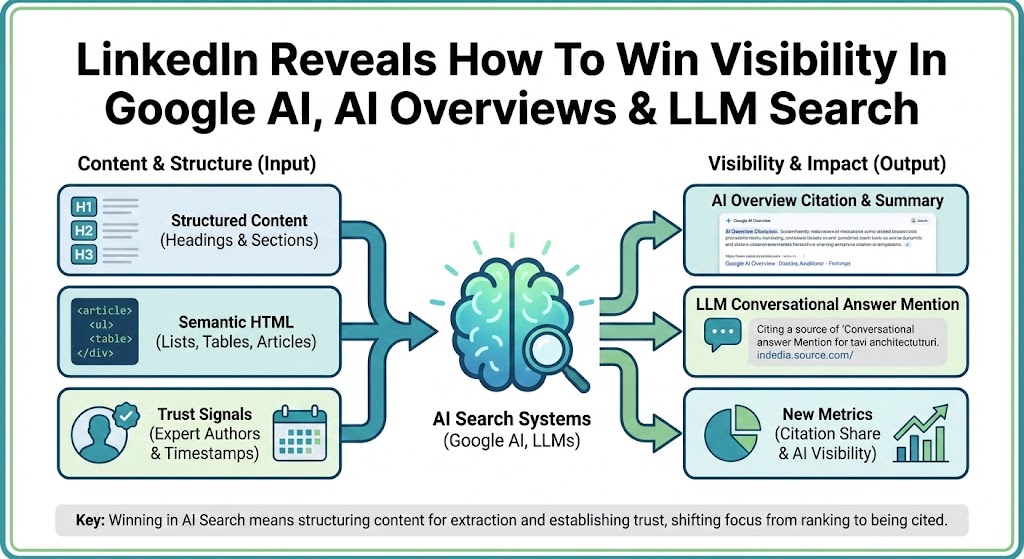
LinkedIn found that how content is organized has a measurable effect on whether LLMs can parse and surface it.
Pages that used clear heading hierarchies, logical sectioning, and clean formatting were easier for AI systems to interpret. That increased the likelihood those pages were cited inside AI Overviews and conversational answers.
In practice, this means:
-
Proper H2 and H3 structure
-
Clear topical sections
-
Concise paragraphs
-
Logical information flow
LinkedIn described this concept as improving “AI readability.”
Instead of optimizing only for humans or crawlers, content must now be structured for extraction, since AI systems often pull fragments rather than evaluating entire pages.
Semantic HTML Helps LLMs Understand Your Content
Beyond headings, LinkedIn emphasized the importance of semantic markup.
Using elements like article, section, header, lists, and tables helps AI systems classify what each part of a page represents. When structure is explicit, LLMs can more confidently extract summaries, definitions, and key facts.
For teams targeting Google AI Overviews or generative search features, semantic HTML is becoming a technical SEO requirement rather than a nice-to-have.
Cleaner markup reduces ambiguity and increases the odds of being selected as a source.
Expert Authors And Timestamps Increase Trust Signals
Credibility signals had a clear impact in LinkedIn’s testing.
Content attributed to named experts with visible credentials performed better than anonymous material. Pages that displayed clear publication or update dates were also more likely to appear in AI-generated answers.
LinkedIn says LLMs appear to favor content that shows:
-
Recognizable authors
-
Demonstrated expertise
-
Transparent timestamps
-
Insight-driven writing
These signals align closely with Google’s broader trust and quality systems. In AI search environments, they help models determine which sources are safe to reference.
Measuring Success Beyond Traffic
LinkedIn also revealed it has expanded how it measures organic performance.
Instead of focusing only on clicks, the company now tracks:
-
Citation share n- LLM mentions
-
AI visibility rate
-
Bot retrieval behavior
This reflects a larger shift happening across SEO. As more answers are consumed directly inside AI summaries, traditional traffic metrics may undercount actual brand exposure.
In other words, being cited inside an AI answer may matter as much as earning a click.
What This Means For SEO And Google News Publishers
The findings suggest that success in AI search is less about keyword targeting and more about becoming the most understandable and trustworthy source.
Publishers and brands should prioritize:
-
Structured, scannable content
-
Semantic markup
-
Clear authorship
-
Regular updates
-
Topic depth and authority
These fundamentals increase the likelihood that Google AI, AI Overviews, and other LLM-powered tools pull content directly into their answers.
For news and thought leadership sites especially, visibility is shifting from “rank and click” to “be cited and referenced.”
The Bottom Line
LinkedIn’s data reinforces a growing reality in SEO.
AI systems don’t just rank pages. They extract information.
The sites that win will be the ones that make their content easy to parse, easy to trust, and easy to quote.
Structure, authority, and clarity are now competitive advantages in both Google AI search and traditional rankings.