
Google is trying to calm the SEO industry down.
Not because AI Search is small. Because the scramble around GEO, AEO, LLM SEO, and bot-first content has started to pull brands away from the work Google says still determines visibility: useful content, technical access, strong web experiences, and clear authority.
In a June 2026 Think with Google article, Brendon Kraham, Google’s VP of Search & Commerce Global Ads Solutions, said brands are asking how to reach customers as AI Mode and AI Overviews reshape search behaviour. His answer was blunt by Google standards: “Good SEO is good GEO.”
That line is the news.
Google is not telling brands to create a separate AI Search playbook. It is telling them to stop treating generative AI search as a different internet.
AI Search Did Not Break Google’s Ranking Foundation
Google’s public position is consistent across its Search and Ads teams: AI Mode and AI Overviews are built on top of Google’s existing ranking and quality systems.
That matters because it rejects the idea that brands need a parallel optimization strategy built only for generative answers. Google’s Search Central guide to generative AI features says SEO best practices remain relevant because Google’s AI search experiences use systems connected to the Search index.
The technical mechanics are different. The foundation is not.
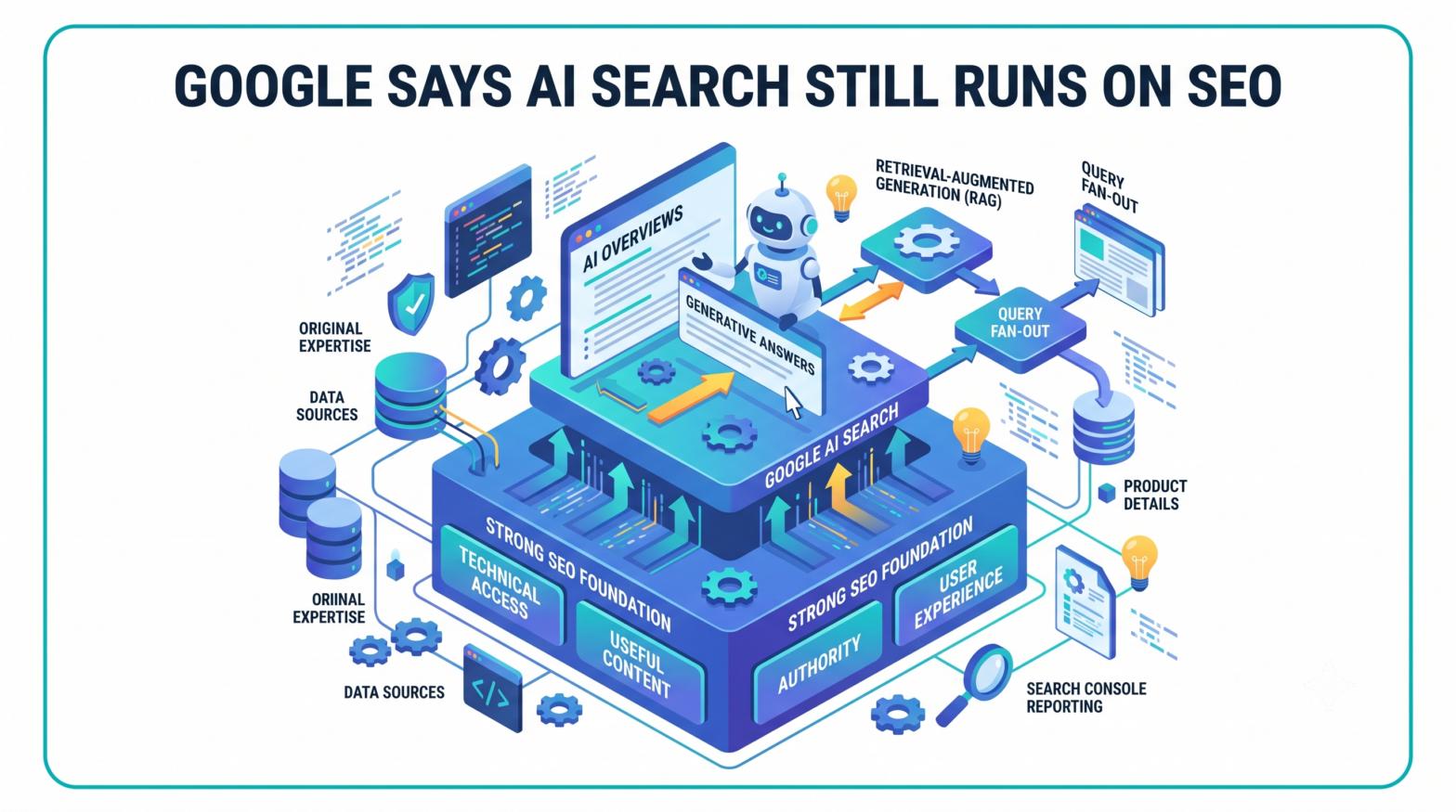
Google describes two important AI Search processes: retrieval-augmented generation and query fan-out. Retrieval-augmented generation helps ground AI responses in relevant, current web pages from Google’s index. Query fan-out allows Google’s systems to run related searches in parallel, pulling in broader context than a single traditional query might surface.
For brands, the practical message is uncomfortable but clarifying. You cannot optimize only for the final AI answer. You have to earn eligibility across the broader web of related questions, supporting evidence, product information, and trusted content that Google may retrieve.
That is why TechWyse has been tracking AI Search as a visibility system, not just a traffic source. Google’s recent changes to AI Mode link surfaces, covered in Google Adds Five New Link Features to AI Search, point in the same direction: source visibility is still being negotiated inside the interface.
The New Target Is Non-Commodity Content
Google’s strongest warning is aimed at generic content.
The company says brands should prioritize unique perspective, first-hand experience, expert input, and content that only the brand can credibly produce. That is a direct challenge to the scaled-content habits that grew during the earlier SEO era: producing dozens of safe, interchangeable articles around similar keywords, each one optimized enough to rank but not distinct enough to be remembered.
AI has made that model weaker.
If a page sounds like it could have been generated by any brand, contractor, or language model, it gives Google fewer reasons to treat it as authoritative. Google’s Search Central documentation uses the term “non-commodity content” to describe material with original expertise, lived experience, or a perspective that is not already available everywhere else.
That does not mean every brand needs a research department.
It does mean ordinary content angles are becoming less defensible. A local retailer explaining why a product failed in a specific real-world scenario may be more useful than a generic buyer’s guide. A B2B company publishing technical implementation lessons from its own client work may carry more authority than another “top trends” article assembled from public summaries.
Brand authority in AI Search is being tied to evidence.
Names, experience, data, product details, original visuals, video, examples, and clear authorship all help create a stronger footprint. Thin commentary does not.
Google Is Telling Brands To Ignore Bot-First SEO Theatre
Google also addressed one of the louder debates in AI optimization: whether brands need special files, snippet structures, or bot-targeted copy to appear in AI-generated results.
Its answer is no.
Kraham wrote that brands do not need to optimize content for bots, stuff copy with awkward keywords, break pages into artificial fragments, chase inauthentic mentions, or rely on special AI text files such as llms.txt for Google Search visibility.
That is a significant statement because llms.txt has become a recurring topic in AI visibility circles. Some marketers have treated it as a possible future control layer for large language model access. Google’s message is narrower but important: at least for Google Search, it is not needed.
TechWyse covered the same issue in Google Says llms.txt Will Not Help Rankings. The core distinction remains the same. Google is asking site owners to focus on systems it already uses: crawling, indexing, snippets, structured data, page experience, product feeds, and helpful content.
The temptation to game AI answers will not disappear. AI Search feels opaque, and opaque systems attract shortcuts.
Google is drawing a line between optimization and performance theatre. If a tactic does not improve user value, technical clarity, or business outcomes, Google is signalling that it should not be treated as a serious AI Search strategy.
Websites Still Matter After The AI Answer
The website is not dead in Google’s version of AI Search.
Google’s guidance specifically says site owners should keep investing in web experience: mobile usability, reduced latency, clear main content, strong images, useful video, and pages that help visitors act once they arrive. AI surfaces may send users who are already more informed, closer to comparison, or ready to convert.
That changes the job of the landing page.
A visitor coming from an AI Overview may not need the same introductory explanation as a visitor from a short keyword query. They may arrive with sharper questions, more context, and less patience for vague copy. The page has to confirm the answer, deepen trust, and make the next step obvious without forcing the user through clutter.
For ecommerce and local businesses, Google also pointed to Merchant Center and Google Business Profile as visibility inputs for AI responses and traditional Search results. Product feeds, local business details, images, pricing, availability, and service information are no longer just operational data. They are part of how Google understands what a brand can offer inside AI Search.
That connects directly to Google’s paid search and commerce roadmap. At Google Marketing Live 2026, Google expanded AI-driven advertising and commerce surfaces, which TechWyse covered in Google Marketing Live 2026: AI Ads, Ask Advisor & UCP. Organic, paid, local, shopping, and AI interfaces are becoming harder to separate.
The site is still the trust anchor.
Search Console Reporting Is Becoming The Baseline
Measurement is where Google’s message becomes more cautious.
Kraham said brands should not get distracted by noisy metrics and added that Google does not evaluate third-party SEO tools or vendors directly, nor do those tools have access to Google’s internal metrics. That is a pointed reminder for an industry now full of AI visibility dashboards, LLM citation trackers, and proprietary brand mention scores.
Google is not saying measurement does not matter.
It is saying the durable measurement strategy still has to connect back to business goals: leads, sales, signups, revenue, and other concrete outcomes. Visibility for its own sake is not enough if it cannot be connected to commercial impact.
There is also a new layer of official reporting. Google has begun rolling out generative AI performance reports in Search Console that show impressions from AI features on Google Search. Merchant Center is also adding reporting for product listings across generative AI Search experiences.
TechWyse covered those changes in Google Adds AI Search Reports & Opt-Out to Search Console. The reporting is still early, but it gives site owners a Google-native baseline for AI Search visibility instead of forcing them to depend entirely on third-party estimates.
That baseline will matter as AI Mode expands.
Practical Implications for Marketers
For marketers and SEOs, Google’s guidance narrows the AI Search priority list. The practical work is not building a separate GEO department around speculative tactics. It is strengthening crawlable, well-structured pages; publishing expert content with original value; maintaining strong product and local data; improving landing page experience; and measuring AI Search visibility against leads, sales, signups, and qualified engagement.
The AI Search Strategy Is Less Exotic Than The Acronyms
Google’s latest guidance does not make AI Search simple. It makes the serious work less mysterious.
Brands still have to adapt to longer queries, AI-generated summaries, richer source displays, multimodal results, and shifting click behaviour. They still need to understand how visibility changes when Google answers more of the question on the results page.
But Google is not endorsing a new optimization arms race built around bots, synthetic mentions, or special AI files.
The confirmed path is narrower: create material worth retrieving, make it technically accessible, support it with real product and business data, and measure whether it contributes to outcomes that matter.
Google’s AI Search era may be new. The brands most likely to benefit are still the ones with something specific to say.