Google advertisers now have access to a unified AI agent that spans their campaign, analytics, and commerce platforms, and four new ad formats designed specifically for conversational search. Google introduced Ask Advisor, a unified AI agent built on Gemini that connects Google Ads, Google Analytics, Google Marketing Platform, and Merchant Center into a single interface, at Google Marketing Live 2026, held on May 20, 2026.
Ask Advisor: A Single Agent Across Google's Ad Stack
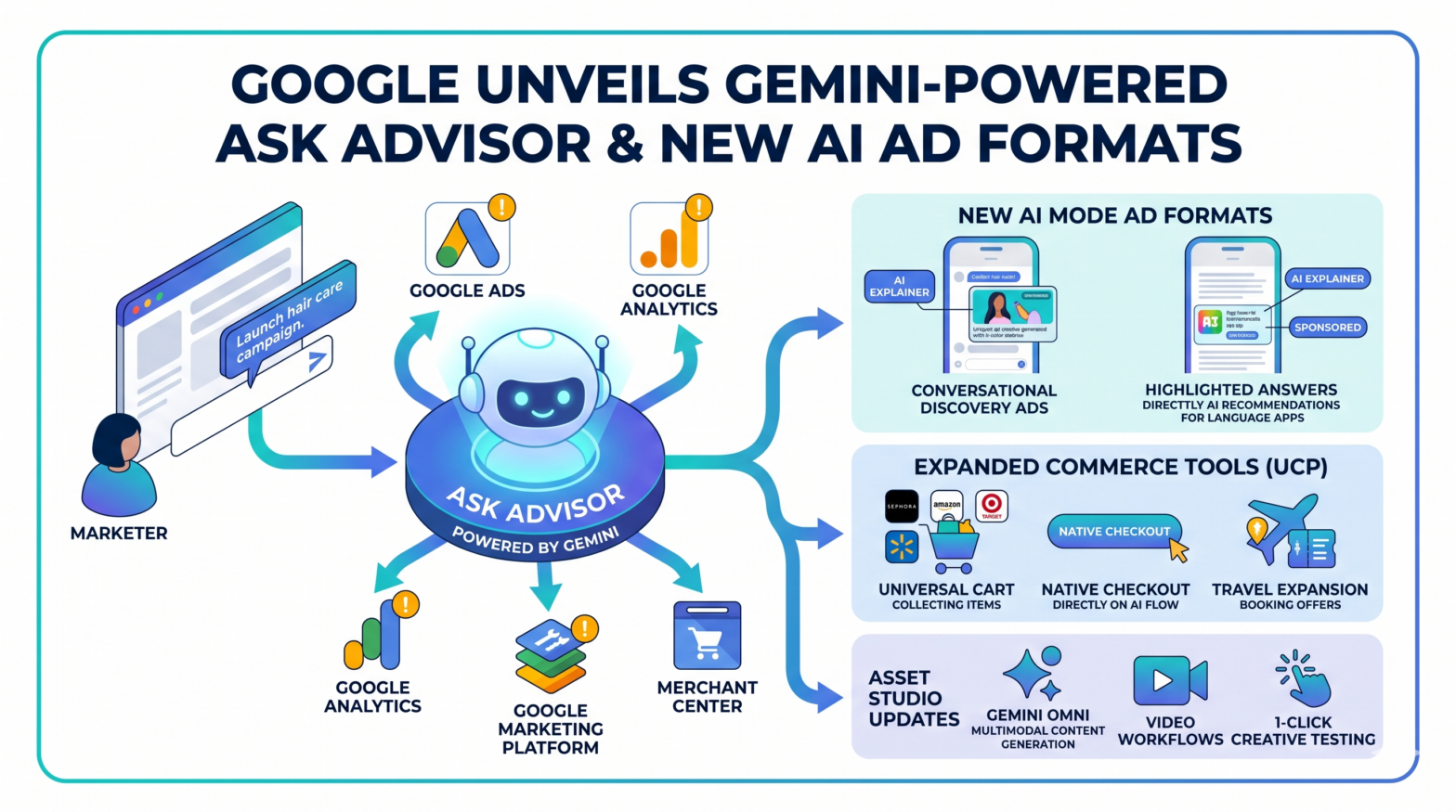
Ask Advisor acts as a unified agent that connects insights, workflows, and recommendations across Google's marketing ecosystem. According to Google, the tool can help marketers launch campaigns, analyze performance, and surface optimization recommendations without needing to switch between platforms. For example, a marketer could ask Ask Advisor to "find new customers for my hair care products," and the system would automatically pull product details from Merchant Center and help build a campaign in Google Ads.
Ask Advisor connects Google Ads, Analytics, Merchant Center, and Marketing Platform through a shared Gemini-powered interface. The system can access campaign, audience, and product data across products to generate recommendations, automate setup tasks, and surface insights based on a marketer's goals. Ask Advisor also integrates reporting insights from both Google Ads and Google Analytics to explain campaign performance and recommend next steps.
The product represents a structural consolidation in how Google organizes its in-product AI tools. Until now, Google has maintained distinct advisory tools across its advertising and analytics products. Ads Advisor, which reached all English-language Google Ads accounts in December 2025 after a staged rollout beginning at Think Week in September 2025, handled campaign-level diagnostics and optimization. Google said Ask Advisor is available globally for English-language accounts and is currently in beta.
Dan Taylor, vice president for global ads at Google, described the system's architecture in a virtual press briefing ahead of the event.
"On the back end, our agents talk to one another and carry each other's content, creating a continuous thread of intelligence."
New Ad Formats Built for AI Mode
Google provided its most detailed public description yet of how advertising works inside AI Mode, announcing four new ad formats at Marketing Live. The announcements cover two formats currently in testing within AI Mode, Conversational Discovery ads and Highlighted Answers, and two formats coming to standard Search in the months ahead: AI-powered Shopping ads and Business Agent for Leads.
As the Search experience becomes smarter and more conversational, Google is using Gemini models to experiment with new ad experiences designed to provide engaging, helpful answers that connect people with businesses.
Conversational Discovery ads are the first of the two AI Mode formats. According to Google, this format generates ad creative in direct response to a user's specific query. Rather than serving a pre-built ad, the Gemini model builds a creative tailored to the search, highlighting specific relevant features of the advertised product or service.
The second format, Highlighted Answers, places ads directly inside recommendation lists generated by AI Mode. Google used the example of someone researching language learning apps before a trip. Advertisers with highly relevant ads may appear directly within those recommendations.
To help people evaluate their choices, both formats will feature an independent AI explainer as part of the ad. Google's Gemini model evaluates and synthesizes information about a product or service and displays that context alongside the advertiser's creative. This independent response is intended to ensure transparency and build trust. Ads will continue to carry sponsored labels.
Conversational Discovery ads and Highlighted Answers are currently being tested in the U.S. on mobile and desktop. AI-powered Shopping ads are expected to roll out later this year in the U.S. Business Agent for Leads is launching in open beta for U.S. advertisers.
AI-Powered Shopping Ads and Business Agent for Leads
Outside of AI Mode, Google is introducing two additional formats for standard Search. Google is launching AI-powered Shopping ads for high-consideration purchases like TVs and appliances. Gemini will generate custom explainers highlighting why a product may fit a shopper's needs.
Business Agent for Leads introduces an AI-powered chat experience directly within lead generation ads. Instead of filling out static forms, users can interact with a Gemini-powered brand agent trained on an advertiser's website.
Direct Offers Expand to Travel and Gain Native Checkout
Direct Offers, the promotions pilot Google launched in January 2026 with Chewy, Gap, and L'Oréal, is gaining promotion bundling, where Gemini constructs a deal per query using AI Brief for audience targeting, native checkout for UCP merchants, and a travel expansion with Booking.com and Expedia surfacing offers inside AI-assisted trip planning.
With these updates, Direct Offers will now naturally surface in the AI Mode response as shoppers explore options, making deals more instantly discoverable.
Google is also adding a native checkout experience within AI Mode. Native checkout means users do not have to leave AI Mode to complete a purchase. This feature is available to merchants using Google's Universal Commerce Protocol, its open standard for agentic commerce that was unveiled at the start of the year in collaboration with partners like Walmart, Target, and Shopify.
Ashish Gupta, vice president and general manager of merchant shopping at Google, attributed the rationale for the protocol to a foundational challenge in scaled commerce.
"UCP solves a very core challenge of scaling agent e-commerce across the entire web by defining a common language which allows agents to connect to businesses securely and seamlessly."
Universal Commerce Protocol Extends to New Retailers and Verticals
A key update is the expansion of Universal Cart, which allows shoppers to save products across retailers and complete purchases using Google Pay or retailer checkout experiences. Google says the experience will soon support brands including Nike, Sephora, Target, Walmart, Wayfair, and Shopify merchants such as Fenty and Steve Madden.
Google additionally announced buy-now-pay-later integrations with Affirm and Klarna directly inside Google Pay. Retailers remain the seller of record, with the ability to customize the integration to their specific needs.
Google is also expanding UCP into additional verticals, including hotel booking and food delivery. Future experiences will allow users to book hotels directly from AI Mode or order food from conversations inside Google Maps. Many UCP-powered features are rolling out in the U.S. first, with expansions planned for Canada, Australia, and, later, the U.K.
Asset Studio Updated with Gemini Omni
Google upgraded Asset Studio with multimodal Gemini-powered creative generation capabilities. Advertisers can now use natural language prompts to generate creative assets, and Google integrated Gemini Omni into Asset Studio to support video workflows and introduced 1-Click Creative Testing for asset optimization.
Taylor described the scope of the update.
"We're launching new features in Asset Studio to remove the friction from the process. By centralizing your workflow and connecting your favourite design tools to our latest Gemini models, you can now turn brand guidelines into high-performing creative, faster."
Implications for Advertisers and Marketers
The concentration of Gemini across campaign creation, ad delivery, and checkout in a single event signals a structural shift in how Google expects campaigns to be managed. Marketers running campaigns across Search, YouTube, and Merchant Center may increasingly need to structure product feeds, creative briefs, and conversion data in formats that AI agents can interpret and act on, particularly as Business Agent for Leads, Conversational Discovery ads, and UCP-native checkout each rely on well-organized advertiser-side data for the Gemini model to generate contextually relevant outputs. Campaign measurement practices may also need to account for new impression types and AI-generated creative variants that differ from traditional keyword-matched formats.
According to Google, AI Overviews surpassed 2.5 billion monthly users as of Google I/O 2026, and AI Mode has surpassed 1 billion monthly users. AI Mode queries have more than doubled every quarter since launch, and searches in AI Mode are on average three times as long as traditional searches.