
Visibility inside AI search has been messy to measure. A citation count could tell publishers they were showing up, but not why, not where the pattern was forming, and not whether the signal meant anything durable.
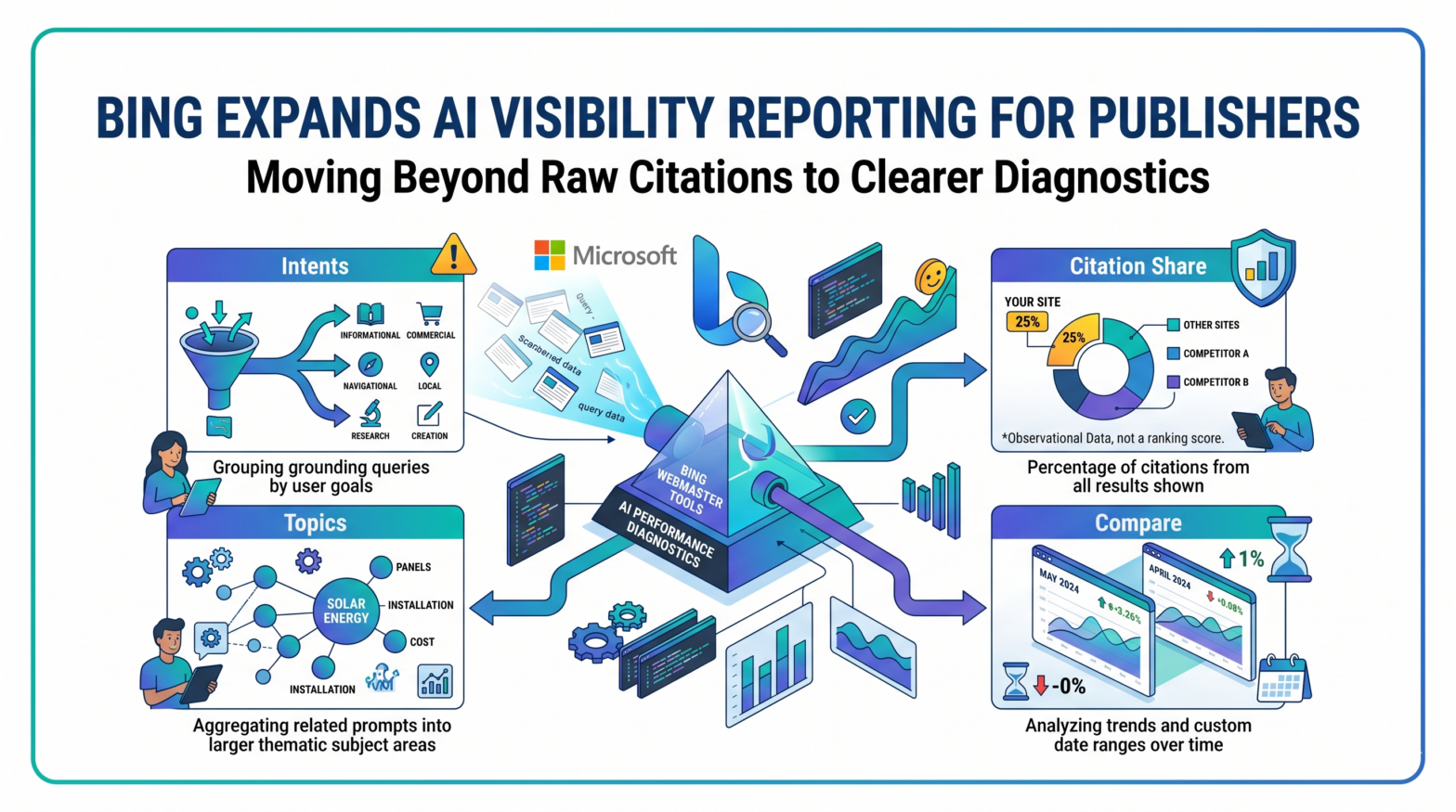
Microsoft is now trying to close that gap. On June 16, the company said Bing Webmaster Tools is adding four new preview features to its AI Performance reporting: Intents, Topics, Citation Share, and Compare. The update expands the dashboard Microsoft introduced in February to track how publisher content appears in AI-generated answers across Bing, Microsoft Copilot, and selected partner experiences.
The change matters because it shifts AI reporting away from a simple appearance metric and toward something closer to search diagnostics. For publishers, SEOs, and content teams working through the realities of AI search visibility, that is a more useful direction than another surface-level dashboard.
Bing Is Moving Beyond The Raw Citation Count
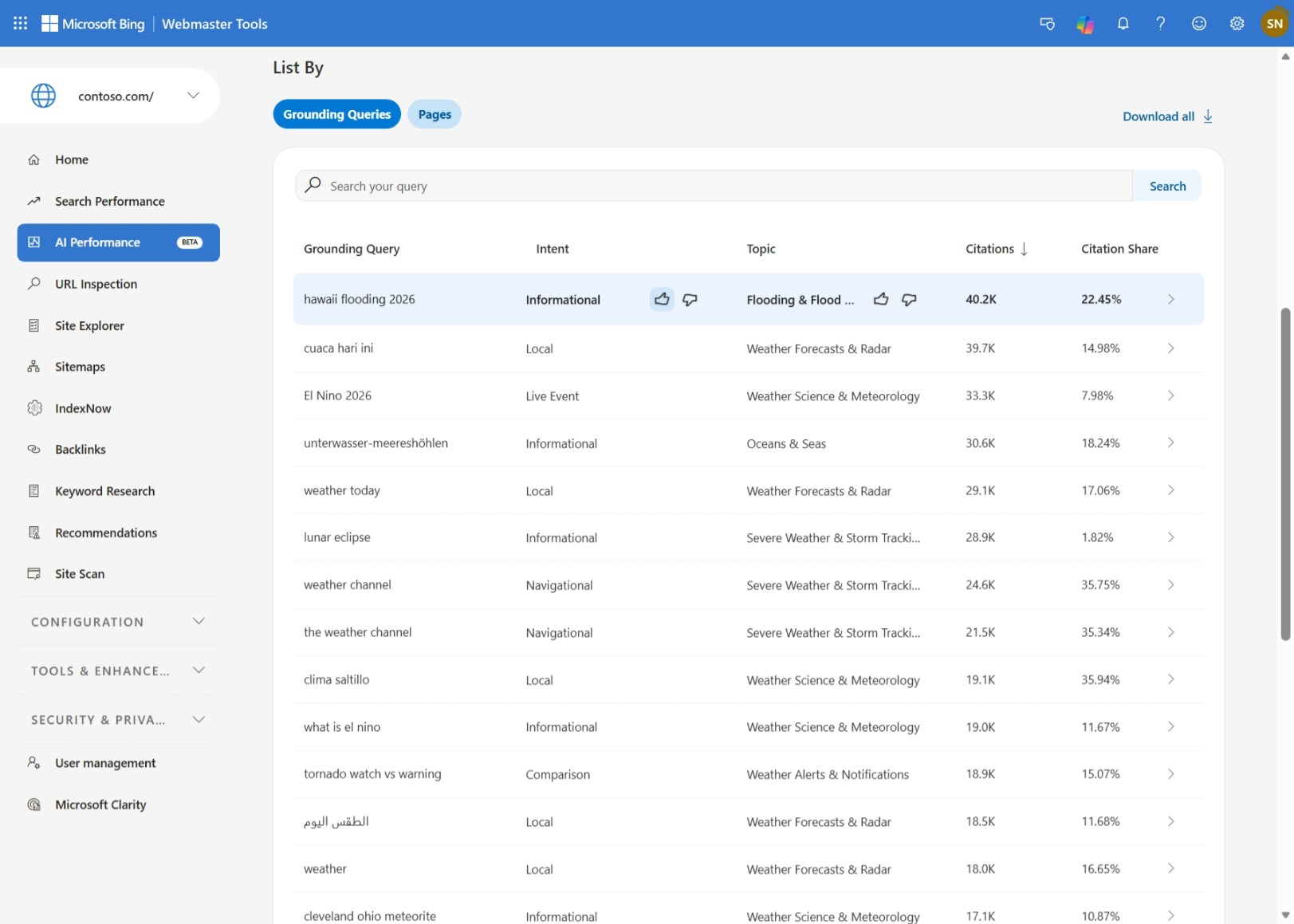
When Microsoft launched AI Performance in Bing Webmaster Tools on February 10, it gave site owners a first-party view of how often their pages were cited in AI answers, which URLs were referenced, and which grounding queries were associated with those citations. That first release established a baseline. It showed that AI discovery could be reported at all.
It also left big gaps.
A list of cited pages and sampled queries can help identify whether a domain is appearing in generative answers, but it does not explain the shape of that visibility. A publisher might know that a page is being cited more often, yet still have no clear sense of whether those appearances are tied to commercial research, local discovery, product comparison, or broader educational intent.
That is what this release is trying to solve. Microsoft is effectively saying that AI citation data becomes more useful when it is clustered, contextualized, and trended over time rather than treated like a flat report.
The move also fits the company’s broader argument that AI search should be understood through grounding, not just rankings. In a February post about the role of grounding on the AI web, Microsoft described grounding as the layer that connects generative systems to current, authoritative information. This new reporting package extends that idea into publisher analytics.
For teams already tracking how generative platforms surface and reuse web content, the update lands alongside a broader market push toward more structured reporting. TechWyse recently covered how Google added AI search reports and an opt-out control in Search Console, underscoring how quickly AI visibility is becoming a measurable search channel.
The New Reporting Is Built Around Intent And Themes
The most practical additions may be Intents and Topics.
Microsoft says Intents classifies grounding queries into broader buckets such as informational, commercial, navigational, local, research, and creation-oriented behavior. That matters because AI-generated answers do not behave like a traditional list of keywords. They often collapse multiple steps of research into one interaction. A publisher that looks strong on citation volume may actually be overexposed to one narrow query class and underrepresented everywhere else.
Intent labels give marketers a cleaner way to read that distribution. An ecommerce brand might find its content appears heavily in comparison and shopping-oriented prompts. A B2B publisher might discover stronger visibility in research-style interactions. A local business may start seeing whether its citations are tied to geographically framed requests rather than general informational discovery.
Topics adds a second layer. Instead of reviewing grounding queries one by one, publishers can see how Bing groups related prompts into larger thematic clusters. That is a meaningful shift for editorial and SEO teams because real content planning does not happen one exact-match keyword at a time. It happens around subject areas, authority gaps, and recurring audience needs.
Microsoft’s own example groups several solar-related prompts into a broader solar energy topic. The specific example is simple, but the underlying logic is bigger than that. Topic clustering could help publishers identify where AI systems already treat them as credible, where visibility is fragmented, and where deeper coverage might support stronger citation consistency.
That puts Bing’s reporting closer to how modern content teams already think. It also overlaps with the same strategic questions raised in TechWyse’s coverage of Google’s AI search guide rejecting shortcut-style GEO tactics: not how to game one answer, but how to build clearer, more structured, more trustworthy coverage across a subject.
Citation Share Is Useful, But Only If Teams Read It Carefully
Citation Share is likely to get the most attention, partly because it sounds the most like competitive reporting.
Microsoft defines it as the percentage of citations attributed to a site out of all citations shown across all sites for the same grounding query. On paper, that gives publishers a way to see how much of the citation footprint they occupy for a query rather than merely whether they appeared at all.
That is a more nuanced metric than total citations. A site could have growing citation volume while still losing relative presence in the answers that matter most. Citation Share can help expose that difference.
Still, Microsoft is drawing a hard boundary around how the number should be interpreted. The company says the metric is observational, not a ranking system, does not expose competitor domains, does not represent traffic share, and should not be read as a quality score.
That caveat is important. AI-generated answers are unstable by design. Citation patterns can move because of model changes, freshness signals, query reformulations, partner refresh cycles, or shifts in user demand. A stronger share number may indicate deeper representation, but it is not the same thing as owning a SERP position.
For publishers and search teams, that distinction matters. The temptation will be to turn Citation Share into a scoreboard. Microsoft is plainly telling users not to do that.
TechWyse’s recent reporting on Microsoft Web IQ and Bing’s grounding infrastructure already pointed to this broader pattern: the AI retrieval layer is becoming more visible, but it still does not behave like conventional search rank tracking.
Compare May End Up Being The Feature Teams Use The Most
The most quietly valuable feature in the update may be Compare.
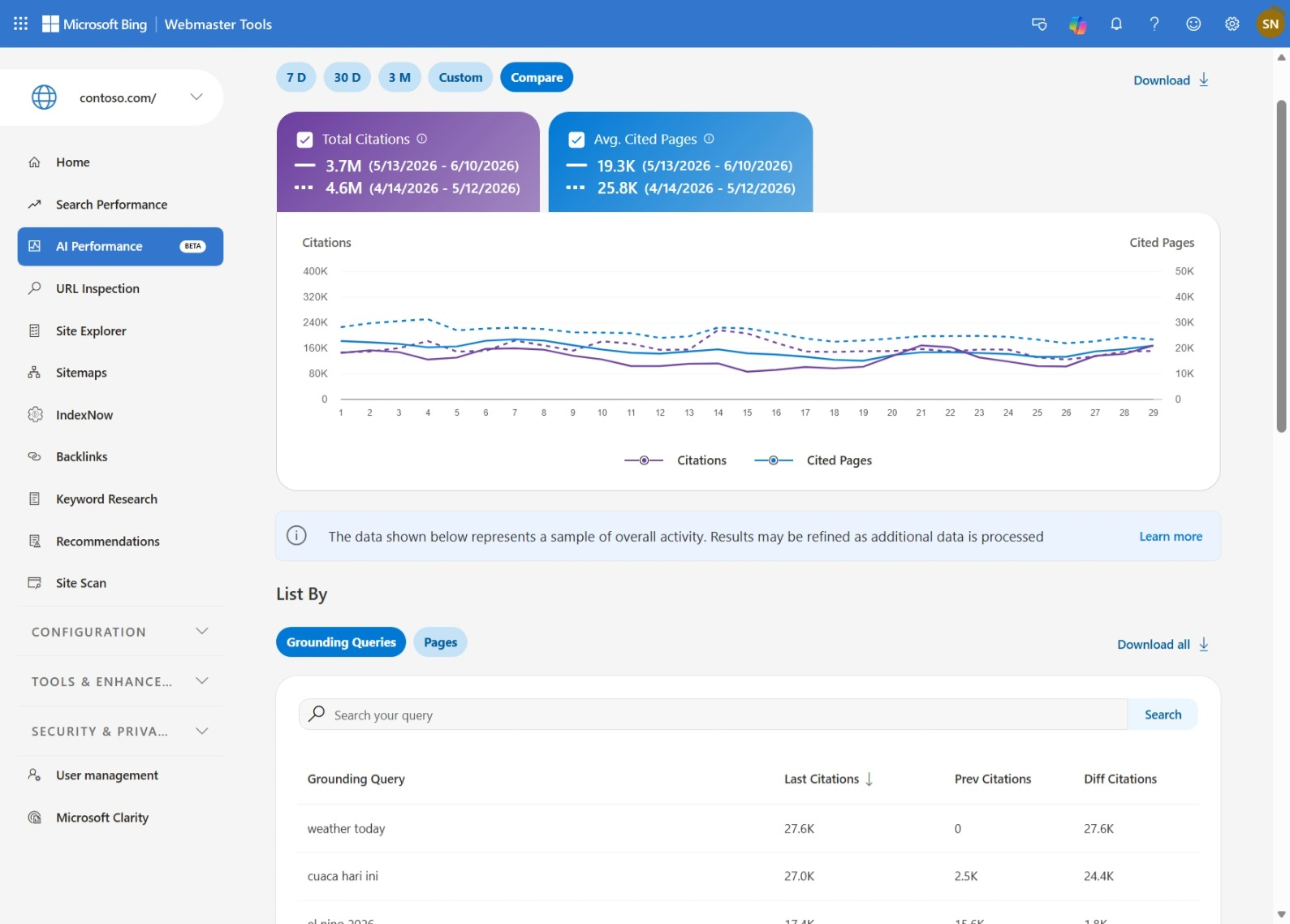
Microsoft says publishers can overlay a previous reporting period on the current view, including standard 30-day comparisons or custom date ranges. That sounds modest, but it answers one of the biggest practical problems in AI reporting right now: volatility without context.
A rise or drop in AI citations means very little in isolation. Teams need to know whether a shift followed a content refresh, seasonal demand, publishing cadence, product launches, or changes in the underlying AI ecosystem. Compare gives them a way to look at movement instead of snapshots.
That should make the dashboard more operational. Content teams can test whether updates to structure, freshness, depth, or evidence correlate with stronger citation visibility over time. SEO teams can look for patterns across topics instead of reacting to one week of noise. News publishers can see whether short-lived surges fade as attention moves elsewhere.
Microsoft also says the four new features are rolling out globally in preview and warns that the AI and machine learning systems behind the labels are still evolving. In other words, publishers should expect broad categorizations, incomplete coverage in some verticals, and improving precision rather than polished final-state reporting.
What This Changes For Marketers In Practice
In practical terms, the update gives marketers and SEOs a better way to separate meaningful AI visibility from vanity metrics. Instead of asking only whether a page was cited, teams can start asking which intent classes are driving those citations, which topics are clustering around the brand, whether representation is strengthening or thinning out over time, and where visibility remains scattered. That does not replace traditional SEO reporting. It adds a second layer for generative search behaviour that is becoming harder to ignore.
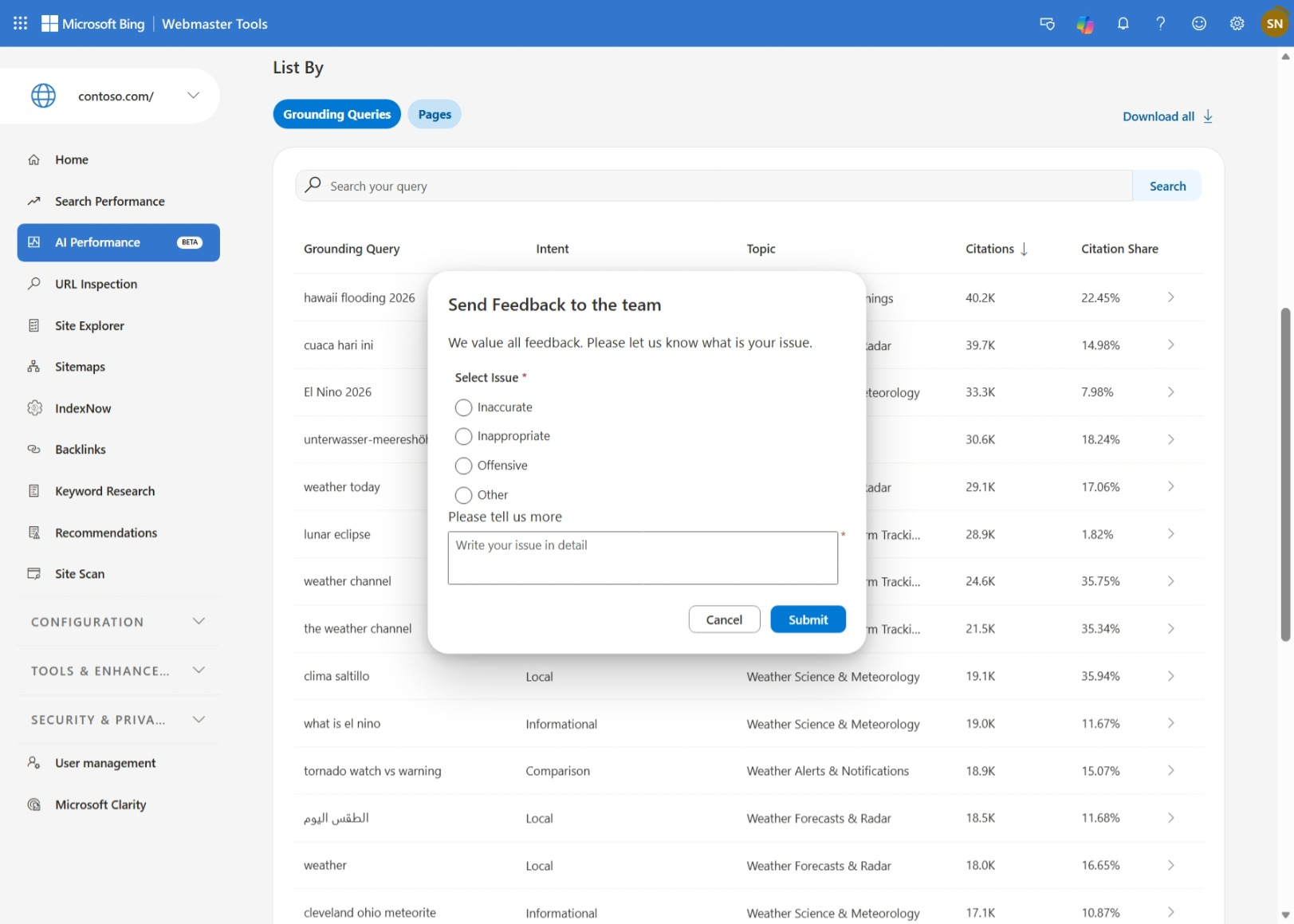
Microsoft is also adding an in-dashboard feedback feature for the AI Performance experience, a sign that the company still sees this reporting layer as early infrastructure rather than a finished product. For now, the most important part of the rollout is not that Bing has perfected AI measurement. It is that publisher reporting is moving closer to the real shape of how AI systems surface web content.