
AI agents now have a dedicated search infrastructure separate from the one built for human users. Microsoft confirmed on June 2, 2026, in a post on the Bing Search Blog authored by Knut Risvik, Distinguished Engineer for Search and AI, that the company has launched Web IQ, a suite of AI-native grounding APIs built for the agentic era, connecting AI systems and agents to fresh, real-world intelligence from across the web, including web pages, news, images, and videos.
What Web IQ Is and How It Differs From Bing
Web IQ is described by Microsoft as a search engine for AI systems. Where Bing was built to help people search the web, Web IQ is built to help AI agents find the right information, turn it into useful evidence, and use it in reasoning.
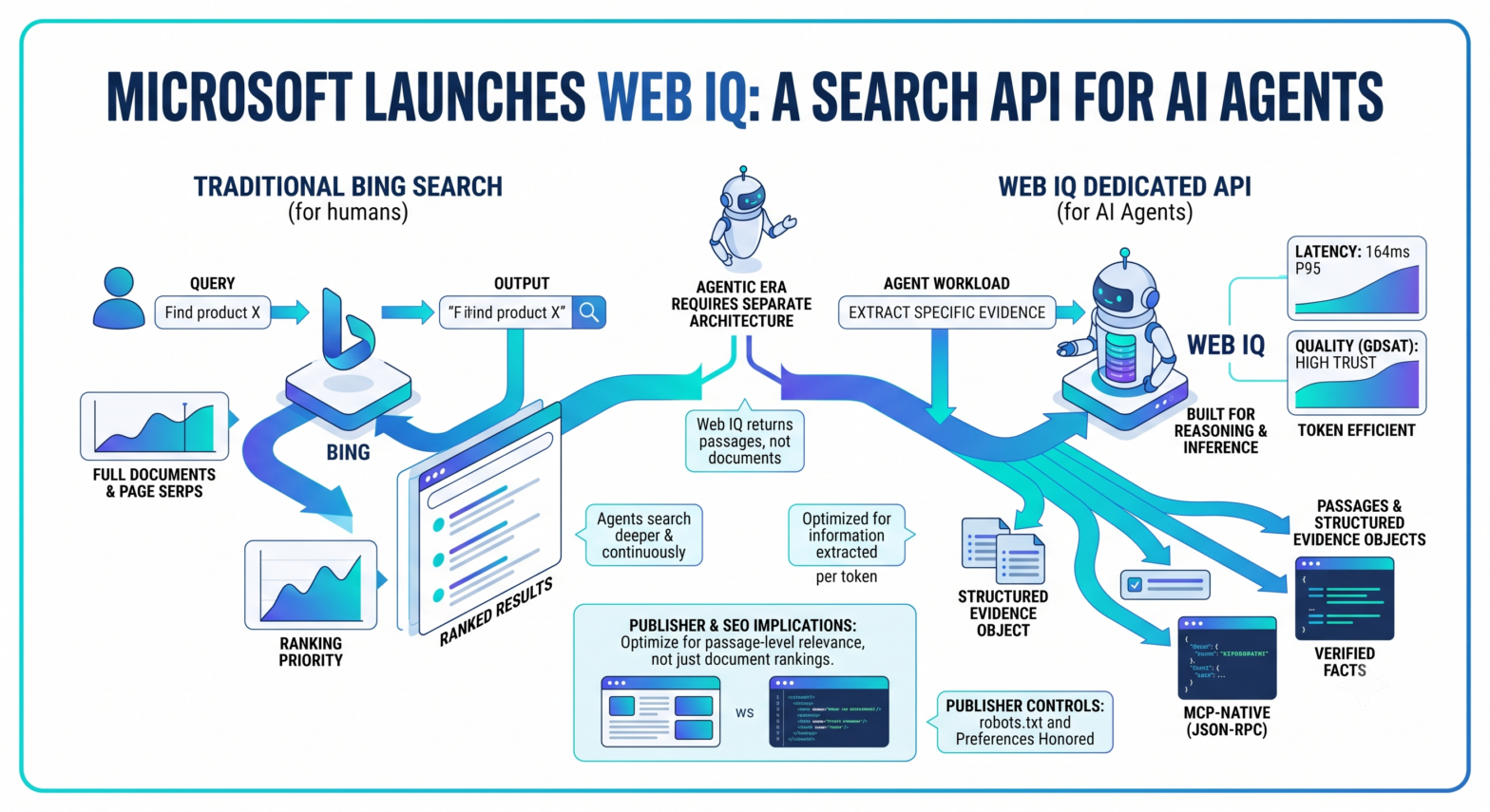
The distinction matters because agents do not behave like human users. While Bing Search for humans prioritizes ranking, ranking is less important for agents, Jordi Ribas, President of Search & AI at Microsoft, told reporters. Agents want to extract the right information from documents, package it, and deliver it quickly. Agents do not just enter a single query and stop searching. They go deeper and continue to search.
According to Microsoft, Web IQ already supports grounding capabilities in Microsoft Copilot and ChatGPT, and is being made available in limited access to selected Azure customers. Ribas noted it is rebuilt from the ground up to be efficient, fast, and relevant, and is not the same API infrastructure that Copilot and ChatGPT used when those products initially launched.
A Rebuilt Stack on Top of Bing's Index
The system builds on years of learning from Bing, but requires a major ground-up re-architecture to meet the demands of agentic workloads. Web IQ starts from the foundation Microsoft has been building for decades, the Bing global index and ecosystem, where grounding quality depends on the breadth, freshness, and trustworthiness of the underlying world representation.
Meeting those requirements could not be solved by tuning a single component. It required re-architecting the system from the ground up, from indexing and retrieval to ranking, passage selection, and orchestration, so every layer is aligned around the needs of inference-time grounding.
One of the most consequential design choices concerns the unit of information the system returns. Traditional search APIs return documents. Web IQ returns passages and what Microsoft calls "structured evidence objects." According to the announcement, "Models do not need documents; they need information and documents are often a poor proxy for that." Operating at the passage level concentrates useful signal while eliminating irrelevant context, producing a much higher ratio of information to tokens.
Web IQ uses Microsoft's open-sourced embedding model to find relevant content, with additional models trained to rank and select passages. According to the announcement, these models are trained for how they will be used inside AI reasoning, not for standalone benchmark scores. For fast search at scale, the system extends DiskANN, Microsoft's technology for searching large indexes without loading everything into memory.
Performance Claims
Microsoft has published three performance claims for Web IQ. On latency, the company reports 164ms P95 response time, which it describes as nearly 2.5 times faster than today's best alternative.
On quality, Microsoft uses GDSAT, grounding satisfaction, to measure whether returned information is fresh and trustworthy, and claims Web IQ scores higher than competitors based on 3,000 sample queries.
On token efficiency, the system prioritizes the most relevant passages and minimizes unnecessary context, cutting token usage per query. These gains compound across high-volume workloads, making AI systems more accurate and cost-effective in production.
Publisher Controls and Open Web Standards
Web IQ follows the same robots exclusion rules and publisher preferences that Bing already honours. Microsoft is also working with the IETF and other industry groups on standards for how AI systems access web content.
The company describes the system as model-agnostic and MCP-native via JSON-RPC 2.0, with no inference lock-in, and says content supply combines licensed sources, structured data sources, and the open web, not SERP scraping.
Access and Availability
Web IQ is currently available in limited access to select enterprise customers building AI agents and applications at scale. Microsoft is accepting expressions of interest, but pricing, API documentation, and general availability timing remain unclear.
The launch comes after a series of related infrastructure moves. In February 2025, Microsoft integrated Grounding with Bing Search into the Azure AI Agent Service, enabling real-time web data access for AI applications as an early step toward what Web IQ now formalizes. Three months later, Microsoft announced the retirement of the traditional Bing Search APIs, effective August 11, 2025, a decision that forced developers toward Grounding with Bing Search as the recommended alternative.
Implications for Marketers and SEOs
Web IQ introduces a practical divide between optimizing for human search and optimizing for agent-driven retrieval. Because the system returns passages rather than full pages, content that ranks well in traditional search does not automatically surface well in agent grounding. Structured, factually dense, passage-level content, where a single excerpt can answer a discrete question, is more likely to be selected as a structured evidence object than content optimized around broad keyword coverage or page-level authority signals alone. Marketers and SEOs should assess how their existing content performs at the passage level, not just at the document level, as that is the unit Web IQ is built to evaluate.
Bing Webmaster Tools added AI citation data in February, mapped grounding queries to cited pages in March, and previewed Citation Share at SEO Week. Those tools show publishers how AI systems use their content, and Web IQ represents the retrieval side of that relationship; it is what AI systems use to pull the content in the first place.