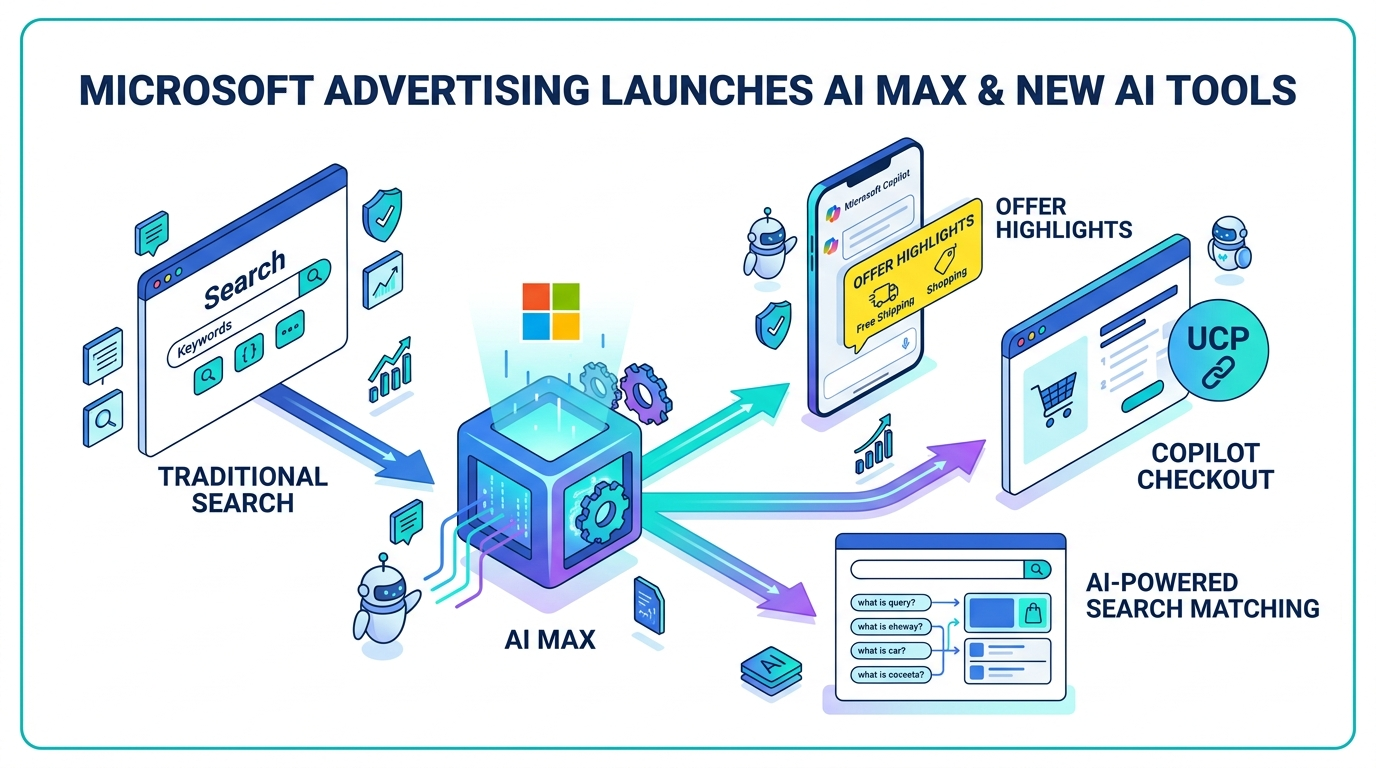
Microsoft Advertising has added a new set of tools designed to keep brands visible inside AI-generated answers and agent-driven transactions, not only in traditional search results. Microsoft confirmed the changes in an April 22 blog post published to about.ads.microsoft.com, covering three product areas: an expansion of AI Visibility in Microsoft Clarity; Universal Commerce Protocol feed support and Copilot Checkout enhancements in Microsoft Merchant Center; and the introduction of AI Max for Search campaigns, Offer Highlights, and an Audience Generation tool across the Microsoft Advertising platform.
The announcement was framed around what Microsoft described as three simultaneous "eras" of web behaviour, traditional search, AI-assisted discovery, and fully automated agentic transactions. The April 22 blog post cited third-party data indicating automated traffic is growing eight times faster than human traffic, that AI-driven sessions nearly tripled in 2025, and that agentic browser traffic is up roughly 8,000% year over year. The underlying data was attributed to HUMAN Security's 2026 State of AI Traffic & Cyberthreat Benchmark Report.
Expanded AI Visibility in Microsoft Clarity
Microsoft Clarity's AI Citations dashboard unifies signals from Bing Webmaster Tools and Clarity to show end-to-end visibility across the AI ecosystem, from bot crawling and indexing to how content is cited in AI-generated answers. Microsoft describes the release as an early step toward generative engine optimization tooling within Clarity.
AI Citations is currently in limited preview by invitation, and interested brands and publishers can request access. The April 22 announcement confirmed that access to the broader AI Visibility feature set in Clarity is being expanded from its earlier select-customer rollout. Microsoft acknowledged in the same blog post that traditional web metrics such as rankings and clicks no longer capture the full picture as AI agents become more central to consumer discovery.
The AI Citations dashboard provides a consolidated view of when a brand's content is cited in AI-generated answers, surfacing grounding and citation activity across supported AI experiences and showing how content contributes to AI-driven responses. Metrics include queries cited, citation rate, and a page-level view identifying which URLs are cited most frequently. Microsoft has stated explicitly that the bot activity data represents an upstream signal; it indicates requests were made to a site, but does not confirm that content was retrieved, grounded, cited, or surfaced in AI responses. The company describes it as measuring access, not attribution.
Microsoft has also confirmed that additional insight layers are coming to Clarity AI Visibility, including tools that will show brands where competitor content is cited instead of theirs and which topics they are underrepresented in, along with content recommendations. No general availability date was provided for these forthcoming features.
UCP Feed Support and Copilot Checkout Updates
Microsoft has added support for the Universal Commerce Protocol, a shared product data standard, to its Copilot AI assistant, with the update now live in the U.S. through Microsoft Merchant Center. The UCP standard was co-developed by Google and Shopify and is backed by Walmart, Target, Etsy, Wayfair, and more than 20 other retailers. By adopting UCP, Microsoft allows merchants who have already structured their product data for the protocol to surface in Copilot without building a separate integration.
Microsoft says the UCP feeds are now generally available in the U.S. Separately, the Shopify Catalogue integration syncs product data to Copilot in real time through Microsoft's commerce API, pulling current pricing, inventory, and product attributes directly from Shopify without requiring merchants to build custom feeds, giving Shopify merchants automatic access to Copilot shopping queries.
Microsoft's internal data, covering a February 26 to March 26 comparison period among the top 100,000 Shopify merchants by GMV in the U.S. and Canada, showed approximately 90% relative growth in impression share within Copilot Shopping, attributed to real-time feeds from Shopify Catalogue.
Copilot Checkout, which lets users complete purchases directly inside Copilot, now covers more than 500,000 merchants in the U.S. and has expanded from desktop to mobile apps. Microsoft is also launching customer loyalty experiences within Copilot. Target is an early launch partner, enabling account linking in Copilot so that Target Circle program members can see exclusive discounts and free shipping benefits at checkout. These experiences are live in the U.S. as of the April 22 announcement.
Microsoft's Brand Agents, conversational assistants that merchants can embed on their own websites, now support WooCommerce in addition to Shopify, with the update including access to brand and policy materials and added reporting features.
AI Max for Search Campaigns
Microsoft is opening AI Max for Search campaigns in a pilot beginning in May 2026, expanding AI-powered query matching across Copilot Search, Copilot Answers, and Bing. The pilot moves Microsoft's search advertising beyond traditional keyword targeting, using AI to expand query matching and personalize ad assets for the conversational, multi-intent queries users increasingly bring to AI-powered search surfaces.
Microsoft says the system includes brand inclusions and exclusions, term exclusions, and messaging constraints as guardrails, with search term and asset reporting available from launch. Term exclusions will launch first, followed by messaging constraints, which will give advertisers the ability to specify how a product's message should appear within AI-generated ad contexts.
The update mirrors Google's own AI Max for Search product. Both companies are rebuilding their search ad products around the premise that manual keyword targeting cannot keep pace with how users now search through AI assistants.
Offer Highlights and Audience Generation
Offer Highlights is a new ad format that surfaces product differentiators such as free shipping, in-store pickup, and product specifications inside Copilot conversations, available for retail use cases in English-speaking markets on product detail pages in Copilot, Edge, and Bing. The callouts appear within the flow of a Copilot response rather than as standalone ad units. Best Buy was named in the April 22 blog post as among the first advertisers to activate the format. Advertisers provide the differentiators they want highlighted via Microsoft Merchant Center.
Microsoft is also introducing an AI-powered Audience Generation tool that lets advertisers describe their ideal customer in natural language. Microsoft says the system translates plain-language descriptions into demographics, locations, and in-market signals without manual segment assembly. The tool is currently in a closed pilot in the U.S. and Canada.
The approach competes with Meta's Advantage+ audience automation and Google's optimized targeting, both of which reduce manual audience configuration. Microsoft's version adds a natural-language interface layer on top of the automated targeting.
Practical Considerations for Advertisers
For advertisers managing Search campaigns, AI Max introduces expanded query matching that may reach queries beyond existing keyword lists. Enabling it requires opting in, and Microsoft's advertiser controls, including term exclusions and brand guardrails, are designed to limit unwanted reach. Structured product data through UCP-ready feeds in Merchant Center is required to participate in agentic Copilot shopping experiences; merchants who have not yet structured catalogue data for the protocol would need to do so to benefit from Copilot product surfacing.
James Murray, global product marketing lead for generative AI at Microsoft, stated during an online presentation tied to the announcement that all of the tools are aimed at helping advertisers remain visible and competitive as AI agents increasingly drive discovery and purchasing decisions.