AI-generated ad creative is no longer just a production shortcut. On Google and Meta, it is becoming a declared property of the asset itself.
Google is introducing new controls that let advertisers identify AI-created or edited assets across its advertising products, while Meta is expanding the “AI info” labels attached to ads produced or materially changed with generative AI. Together, the changes put creative provenance directly inside campaign workflows spanning Search, YouTube, Discover, Facebook and Instagram.
The platforms are not enforcing identical rules. Nor have they announced a universal policy under which every unlabelled commercial AI ad will be rejected. The shift is still consequential: advertisers now need to know how every creative was produced, which tools touched it and where it will run.
AI Ad Disclosure Is Moving Inside the Campaign Dashboard
Until recently, AI disclosure was largely treated as a content policy issue. Platforms asked creators to identify synthetic media, particularly when realistic people, places or events could mislead viewers.
Paid media is entering a more operational phase.
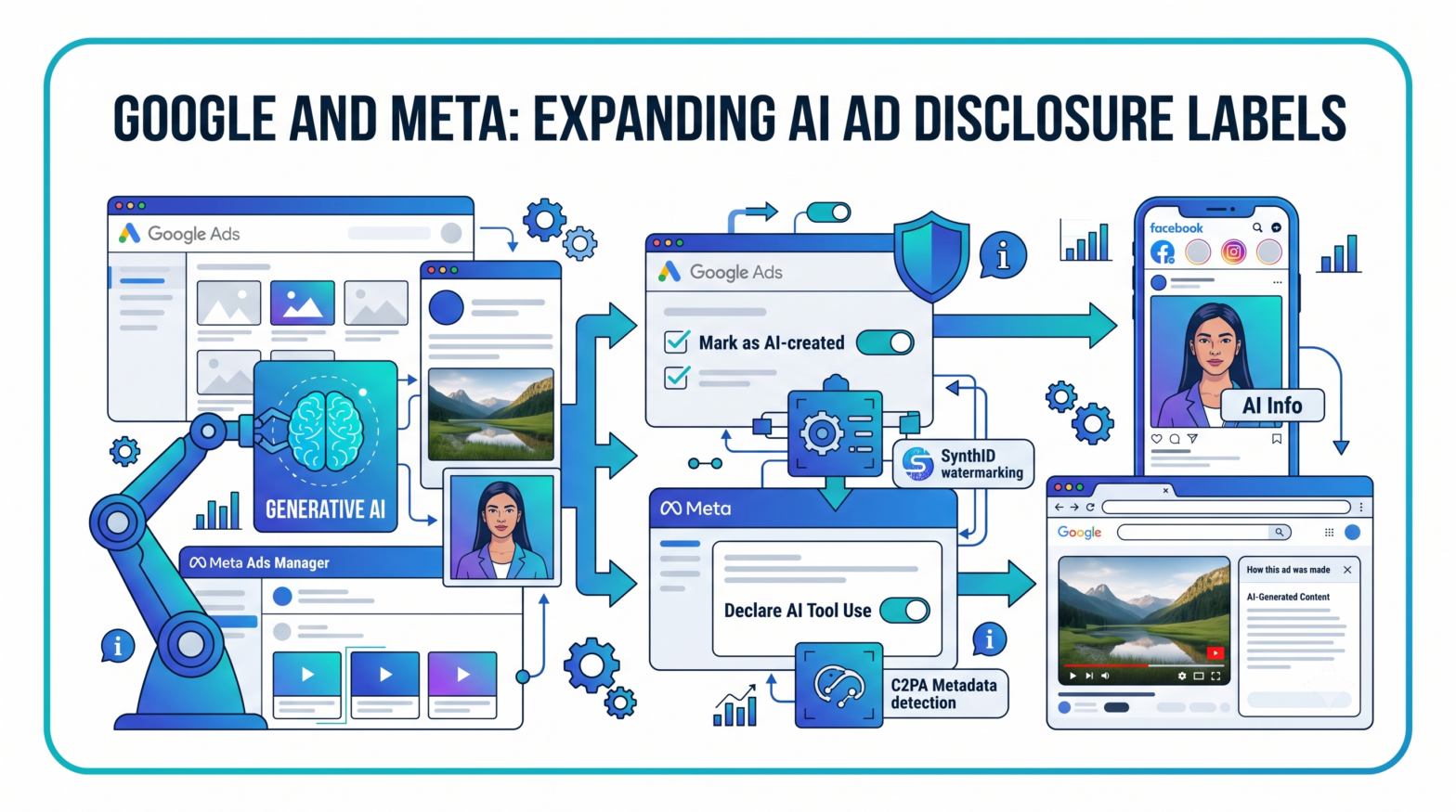
Google’s new AI label setting allows an advertiser to mark an asset as created or edited with AI during campaign creation, through the Asset Library or while generating new creative. The setting is rolling out gradually throughout July across Google Ads, Display & Video 360, Campaign Manager 360, Merchant Center and Ads Editor.
Once designated, the asset receives disclosure information inside a new “How this ad was made” section in My Ad Center. That panel can be opened through the three-dot menu or information icon on ads appearing across Search, YouTube and Discover.
Creative built with Google’s own generative AI advertising tools will generally be labelled automatically. Assets created through outside platforms can be declared manually using the new campaign control, according to Google’s announcement and its accompanying Google Ads Help documentation.
The addition extends the role of Google Ads beyond distributing and optimizing creative. The platform is also becoming a record of how that creative was made.
Google’s Labels Change Depending on Where the Ad Runs
Google is making the “How this ad was made” panel available globally, but the visible treatment of AI-generated ads will not be uniform in every market.
For campaigns targeting the European Union, India or New York, assets designated as AI-created or edited can also receive a visible disclosure overlay directly on the ad. Google says those jurisdictions have regulations requiring labels or disclosures for certain forms of AI-generated advertising.
That regional distinction matters. A campaign using the same image across Canada, India and an EU market could display different disclosure treatments even when its targeting, message and landing page remain unchanged.
Google may also apply an AI label independently when it detects relevant signals, receives provenance information from another platform or is legally required to identify the asset. Labels applied through these routes cannot be overwritten by the advertiser. Creative generated by fully automated Google features may be labelled on the advertiser’s behalf.
The company embeds SynthID watermarks and C2PA provenance metadata into images and videos generated through its advertising tools. Those signals can travel with the asset after export, giving platforms another way to recognize AI involvement without relying exclusively on self-reporting.
The rules do not make every use of artificial intelligence equivalent. Google acknowledges that AI can support copywriting, personalization, cropping and other production tasks, but also states that not all AI-created content requires a label. Requirements vary by asset type, jurisdiction and the extent of the alteration.
An AI-assisted spelling correction is not being treated like a synthetic product demonstration or a photorealistic person who never existed.
Meta Ads Will Carry AI Information From More Creative Tools

Meta is taking a similar approach, but its current guidance focuses primarily on images used in ads.
The company says it will label ad images created or significantly edited using Meta’s generative AI creative features. It is also applying “AI info” labels to eligible images produced or altered through third-party AI tools.
The label will normally appear in the “About this ad” screen available through the three-dot menu. In some cases, it will be placed beside the Sponsored label at the top of the Facebook or Instagram ad, making the disclosure visible before a user opens the additional information panel.
Meta distinguishes significant generative changes from routine production adjustments. Background generation and image generation can trigger an AI label. Minor resizing, colour correction and similar enhancements generally do not.
That line is particularly important as Meta’s AI advertising stack absorbs more automated image production and editing features. A marketer may begin with an approved photograph, use Meta to build a new background and publish several variations without leaving Ads Manager. The final asset is no longer simply an uploaded brand image. It contains a generated visual environment that Meta may identify for users.
Meta’s current Help Center guidance says labels may be applied to ads made with third-party tools. Its broader ad transparency documentation explains that the platform uses industry-standard technical signals to detect those assets.
Social issue, election and political ads remain subject to stricter rules. Advertisers in those categories are already required to disclose certain digitally created or altered images, videos and audio.
The Platforms Have Not Announced Blanket AI Ad Rejections
The compliance risk is real. The claim that any advertiser who fails to label an AI-created commercial asset will automatically have the ad disapproved is not supported by the platforms’ current public documentation.
Google presents its new label control as a way for advertisers to meet evolving disclosure requirements. It also warns that using the control does not, by itself, guarantee legal compliance. Advertisers are responsible for determining whether additional disclosures are required in each jurisdiction.
Google’s existing advertising policies continue to prohibit misleading and deceptive ads regardless of how they were produced. An unlabelled asset that violates a regional disclosure law, misrepresents a product or fabricates a material claim could face enforcement. Google has not described non-disclosure as a universal, automatic disapproval trigger for every commercial AI asset worldwide.
Meta similarly says it will preserve and label AI-generated material unless the content violates another platform rule. Its public guidance explicitly ties rejection to policy violations such as debunked claims and imposes separate disclosure obligations on political and social issue advertising.
An “AI info” label is therefore not a penalty. It is contextual information.
The distinction also matches Google’s treatment of YouTube AI labels, where disclosure alone does not automatically affect recommendations or monetization. The risk comes from misleading content, non-compliance with applicable rules or a separate advertising policy violation, not simply from the presence of AI.
Creative Provenance Is Now Part of Paid Media Operations
For marketers, the practical change is procedural. Campaign teams need an asset-level record showing whether an image, video or other creative was generated, materially edited or only lightly enhanced with AI. That record has to survive agency handoffs, design revisions, localization and cross-platform uploads.
The growing use of AI-generated ad creative makes that harder than it sounds. One asset might start in a brand photography library, receive a generated background in an external design tool, gain text variations inside an ad platform and then be reformatted for several markets.
The disclosure decision can no longer be left until the campaign is ready to launch.
Advertisers should expect platform labels to become more automated as SynthID, C2PA and other provenance standards become easier to read across advertising systems. Self-declaration remains part of the process, but it is no longer the only signal available to Google or Meta.
Google’s controls begin rolling out across its advertising products in July 2026. Meta says its AI labelling experience is still being introduced gradually, which means not every eligible ad or user will see the same treatment immediately.
For campaign teams, that creates a transition period in which two identical AI-generated ads may display different labels depending on the platform, market, creative tool and technical metadata attached to the file.