
Google Ads advertisers now have two new tools that change how recommendations are evaluated and how AI-generated copy is governed across campaigns. Google launched a new Results tab inside its Recommendations section that shows advertisers the measured performance impact after they apply bid and budget suggestions. Separately, on February 26, 2026, Google announced that beta access to text guidelines is now open to all advertisers worldwide, across both AI Max for Search campaigns and Performance Max campaigns, with full language and vertical support.
Results Tab Added to Google Ads Recommendations Section
Advertisers can find the impact of their applied recommendations in the Recommendations section of their Google Ads account. A summary of recent impact appears in a callout on the main Recommendations page. For a detailed breakdown, they can navigate to the new Results tab.
The feature attributes performance changes to specific recommendations, helping advertisers understand what effect adjustments like budget increases or bid strategy shifts had on results.
How the Results Tab Measures Performance Impact
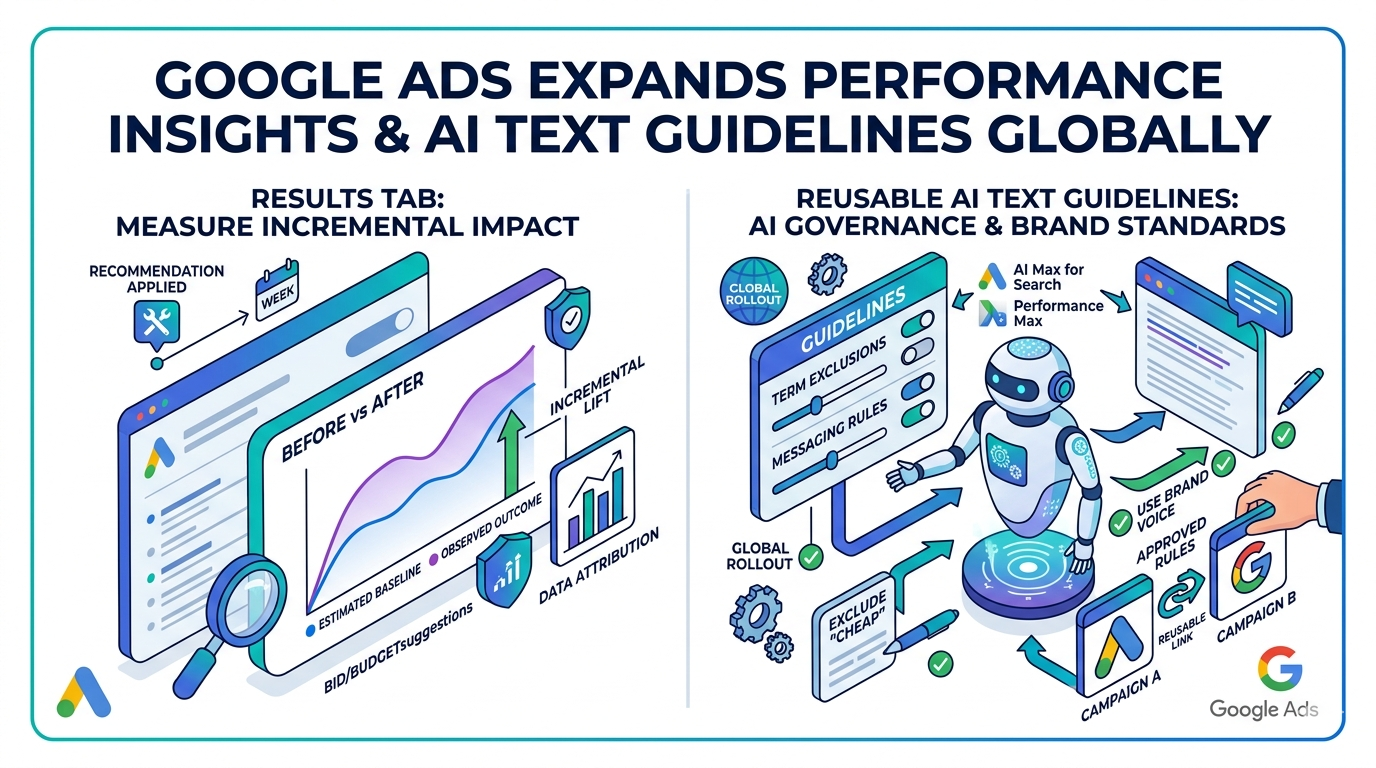
After an advertiser applies a bid or budget recommendation, Google analyzes campaign performance one week later and compares it to an estimated baseline of what would have happened without the change. The system then highlights the incremental lift, such as additional conversions generated by raising a budget or adjusting targets.
Google groups the impact by recommendation type, specifically, Budget and Targets, and allows filtering so users can focus on one type or the other. Advertisers should note that the Results tab compares observed outcomes to an estimated baseline, not to a perfect controlled holdout. That distinction matters when interpreting reported gains.
Why Google Added Transparency to Its Recommendation Engine
For years, advertisers have been urged to apply recommendations, sometimes with persistent nudges and notifications, but have had limited visibility into whether those changes actually improved performance or simply increased spend.
Recommendations are designed to help improve performance with customized suggestions based on performance history, campaign settings, and trends across Google. However, Google acknowledged feedback from advertisers that it has been hard to understand the actual impact of applying a recommendation to an account.
Industry voices have frequently pointed out that Google's optimization score, the metric that rates how closely an account follows Google's recommendations, can be misleading. A high optimization score does not necessarily correlate with strong return on ad spend. Some recommendations, such as raising budgets or expanding keyword match types, may increase impressions and clicks without proportionally increasing conversions or revenue.
Text Guidelines Beta Now Available to All Advertisers Worldwide
AI-powered creatives are essential for staying relevant in today's complex search landscape, but above all they must meet brand standards. Google expanded beta access for text guidelines to all advertisers globally across AI Max for Search and Performance Max campaigns, now with full language and vertical support. As text customization matches creatives with intent, text guidelines ensure they remain precisely on-brand.
The announcement came directly from Google's Ads & Commerce Blog and was confirmed via the official @AdsLiaison account on X. A limited beta rollout had begun in October 2025, giving a subset of advertisers early access to test the feature across AI Max for Search and Performance Max campaigns.
How Reusable Text Guidelines Work Across Campaigns
Google Ads is rolling out a beta feature that allows marketers to copy text guidelines from existing campaigns and apply them to new ones, eliminating the need to rewrite brand rules from scratch.
Text guidelines offer two options to refine Google-optimized text assets: term exclusions and messaging restrictions. Advertisers can steer Google AI by defining specific terms to exclude or concepts to avoid, in their own words, with rules like "don't imply our products are cheap" or "don't use language like 'only for'." Term exclusions operate as exact matches and do not support partial word blocking or complex pattern matching. Messaging restrictions rely on natural language processing to interpret intent, requiring clear and specific instruction formatting for optimal effectiveness.
Text guidelines remain an experimental beta, and there may be some limitations to its capabilities. Advertisers must have text customization set to 'ON' to use text guidelines.
What the Feature Solves for Agencies and Enterprise Accounts
Teams previously had to re-enter the same restrictions campaign by campaign. That may not seem serious in a small account, but across dozens or hundreds of campaigns it becomes repetitive work with a high error rate. Two campaigns promoting the same offer could end up with different rules because one strategist remembered to exclude certain phrasing and another did not. Even small differences in restrictions can change the copy the system produces.
Legal, compliance, and brand teams do not want to approve the same messaging logic from scratch for every new campaign. Reusability helps preserve approved standards. Franchises, enterprise advertisers, SaaS portfolios, ecommerce catalogs, education brands, and regulated services all face the same basic issue: when campaigns multiply, governance breaks unless the rules are portable.
Early Results from Text Guidelines in Practice
Electric vehicle manufacturer BYD, an early partner of this rollout, grew leads by 24% and decreased costs by 26% using these text guideline features, according to a statement from Google. Well-crafted guidelines that reflect genuine brand requirements consistently either maintain or improve campaign performance by ensuring AI-generated copy resonates with the intended audience. Poorly written, overly restrictive, or contradictory guidelines can remove large numbers of valid assets and reduce serving volume, which can temporarily hurt performance.
What These Updates Mean for Paid Search Management
For campaign managers, the Results tab introduces a post-implementation checkpoint that did not previously exist within the platform interface. Advertisers managing large accounts or reporting to clients on optimization decisions now have access to attribution data tied to specific recommendation actions, though the comparison methodology relies on an estimated baseline rather than a controlled experiment, which warrants scrutiny before drawing firm conclusions.
For teams running AI Max for Search or Performance Max at scale, reusable text guidelines reduce the manual work of campaign setup and lower the risk of inconsistent brand enforcement across campaign portfolios. The feature is particularly relevant for accounts operating in regulated industries or managing multiple brands under a single structure, where brand voice and compliance language are non-negotiable.
Google's announcement explicitly stated that the feature is now available to all advertisers worldwide, with full language and vertical support. The @AdsLiaison account confirmed this on X, with the message: "More messaging control & consistency: Text guidelines are now global!"