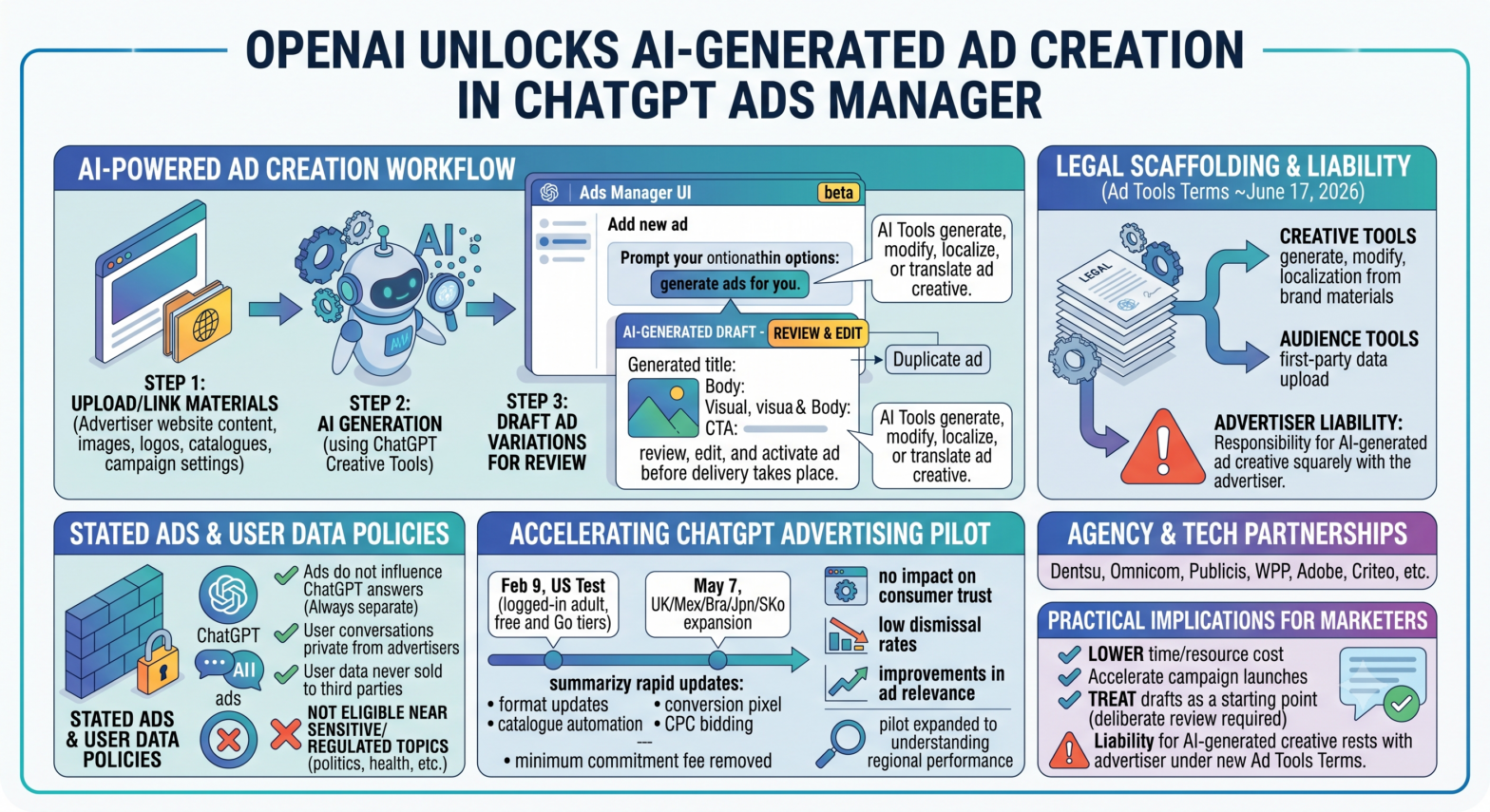
Advertisers using OpenAI's ChatGPT Ads Manager now have the option to let the platform generate ad creative on their behalf, bypassing the manual creation process entirely. The feature, surfaced publicly this week when digital marketing practitioner Anthony Higman posted screenshots of the interface on X, is accessible under the "Add new ad" option and is described on-screen as the ability to "generate ads for you."
Once triggered, the platform drafts an ad for the advertiser to review, edit, and approve before it goes live on the ChatGPT ad network. The interface prompt reads: "We generated an ad variation based on your website and campaign settings. Review, edit as needed, and activate when you're ready." Higman's screenshots also revealed a separate duplicate ad option that allows advertisers to quickly copy and replicate existing ads within their campaigns.
OpenAI has not issued a standalone press release for this specific feature, and no formal announcement has been published to its blog as of the date of this article. The capability appears to be consistent with the AI-generated creative tools OpenAI began defining in policy terms earlier this year. On or around June 17, 2026, OpenAI published new Ad Tools Terms that defined Creative Tools as AI-powered features that generate, modify, localize, or translate ad creative from a brand's own materials, such as catalogues, website content, images, and logos. The appearance of a live generation feature in Ads Manager suggests those tools are now moving from policy documentation into the platform itself.
The ChatGPT Ads Platform: How It Got Here
On January 16, 2026, OpenAI officially confirmed that ChatGPT would enter the paid advertising space. Testing began in the U.S. for logged-in adult users on the Free and Go subscription tiers, with Plus, Pro, Business, Enterprise, and Education tiers excluded from ads.
The U.S. test formally began on February 9, 2026. Since then, the platform has expanded steadily. Advertisers can now create ChatGPT ads through agency and technology partners or through a beta self-serve Ads Manager, with cost-per-click bidding and expanded measurement tools also added to give businesses more flexible campaign management options.
OpenAI confirmed partnerships with leading agency holding companies including Dentsu, Omnicom, Publicis, and WPP, and added technology partners such as Adobe, Criteo, Kargo, Pacvue, and StackAdapt.
In a May 7, 2026 update, OpenAI announced plans to expand the ads pilot to the United Kingdom, Mexico, Brazil, Japan, and South Korea.
How the Ad System Works
Ads run on separate systems from the chat model, and advertisers have no ability to shape, rank, or alter ChatGPT's responses. When users see an ad, it is always clearly labelled as sponsored and visually separated from the organic answer.
Advertisers do not have access to users' chats, chat history, memories, or personal details. They receive only aggregate information about how their ads perform, such as the number of views or clicks.
Ads are not eligible to appear near sensitive or regulated topics, including personal health, mental health, or politics. During the test, OpenAI will not show ads in accounts where the user indicates, or the platform predicts that the user is under 18.
Scale and Commercial Ambition
OpenAI expects to generate $2.5 billion in ad revenue in 2026. Criteo, an early ad-tech partner, reported that over 2,000 brands are now advertising on ChatGPT through its platform.
OpenAI's VP and Head of Global Ads Solutions, Dave Dugan, stated at Cannes Lions 2026 that roughly 20% of queries on ChatGPT have a direct commercial intent, with even more carrying upper-funnel commercial possibility. Benji Shomair, OpenAI's VP of Monetization, said during a press roundtable that "creative variation has been a real key to success" on the platform, a statement that directly contextualizes why automated ad generation has emerged as a platform priority.
What This Means for Advertisers in Practice
AI-generated ad creative tools of this type typically draft copy and format assets by crawling the advertiser's website and reading campaign parameters set in the Ads Manager. The output reduces the time-to-launch for new campaigns, particularly for smaller businesses without dedicated creative resources. However, automatically generated ads carry inherent risk: the system has no knowledge of a brand's internal positioning guidelines, current promotional restrictions, pricing accuracy, or legal compliance requirements. Advertisers who activate AI-generated copy without thorough review run the risk of publishing claims that are off-brand, inaccurate, or non-compliant, consequences that the platform does not absorb. As noted in OpenAI's own Ad Tools Terms, AI-creative liability sits squarely with the advertiser. Review by a qualified marketing professional before activation is not optional; it is where brand protection actually happens.
OpenAI's creative specialist Chad Nelson has stated that AI is not positioned to take creative marketing jobs but rather to enhance them, a framing that supports treating auto-generated assets as a first draft, not a final deliverable.