Ad creative workflows across Meta's platforms are about to change. Meta confirmed in its April 8, 2026 announcement on about.fb.com that Muse Spark, the first model produced by its Meta Superintelligence Labs division, is now live in the Meta AI app and on meta.ai, with a staged rollout to Facebook, Instagram, WhatsApp, Messenger, and Ray-Ban Meta AI glasses planned for the coming weeks.
A New Model Architecture Built for Meta's Ecosystem
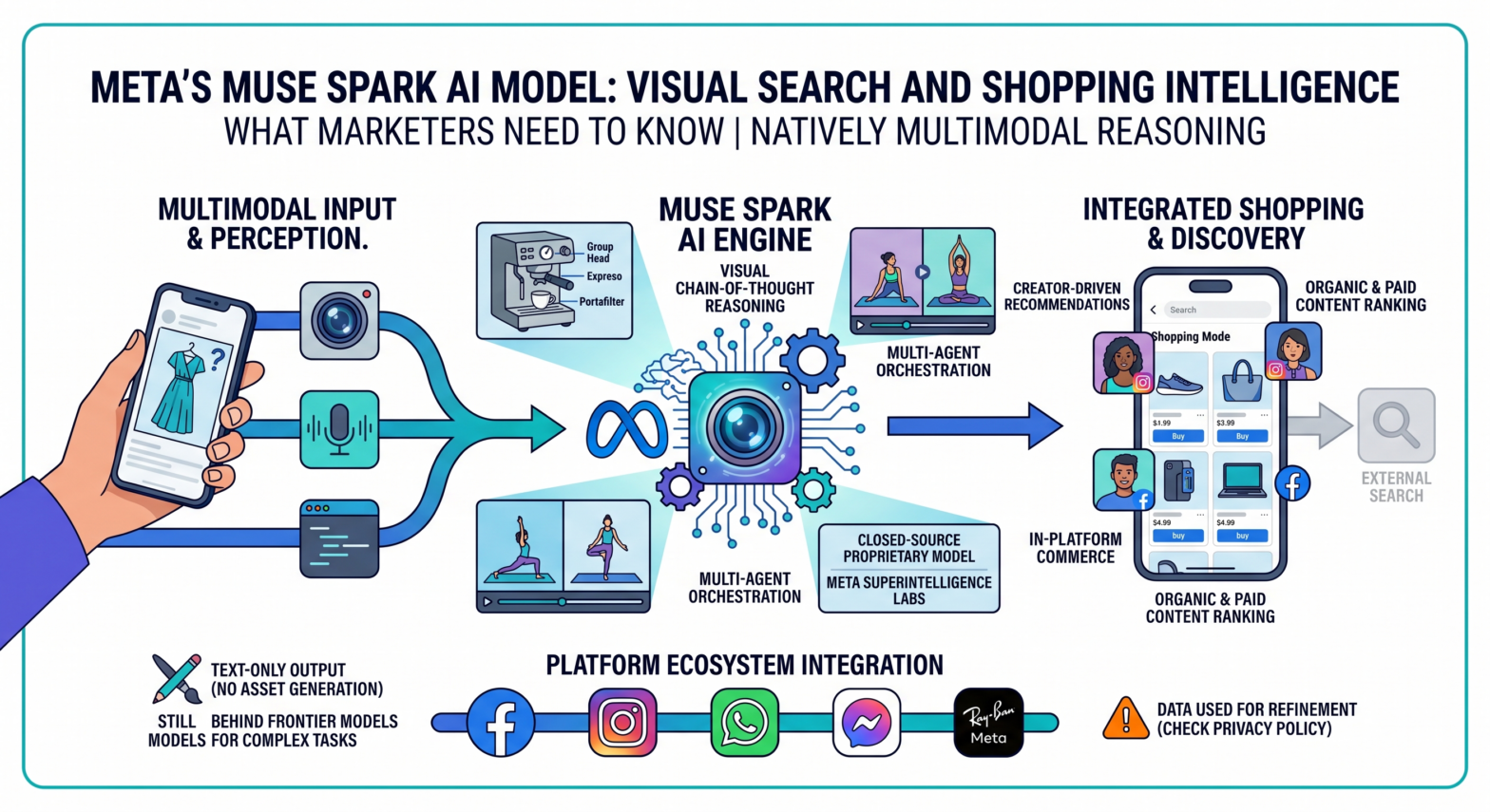
Unveiled on April 8, 2026, Muse Spark is the inaugural model from Meta's new Muse family, developed by Meta Superintelligence Labs and engineered as a natively multimodal reasoning model with tool-use, visual chain-of-thought reasoning, and multi-agent orchestration. The model does not replace Llama. Llama models are open-source and designed for general use and developer access, while Muse Spark is proprietary, built from a ground-up architecture rebuild and specifically designed to power Meta's consumer AI products with advanced reasoning and multimodal capabilities.
Over the last nine months, Meta Superintelligence Labs rebuilt its AI stack from the ground up, moving faster than any prior development cycle. Muse Spark is the first model in the new Muse series, a deliberate, scientific approach to model scaling where each generation validates and builds on the last before going bigger. The initial model is small and fast by design, yet capable enough to reason through complex questions in science, math, and health. Meta's own technical blog states the company can reach the same capabilities with over an order of magnitude less compute than its previous model, Llama 4 Maverick.
A Shopping Mode Powered by Creator Content
The feature with the most direct consequence for performance marketers is a dedicated shopping mode. Muse Spark is introducing a shopping mode that pulls from content across Instagram, Facebook, and Threads to recommend products, styles, and brands, and rather than directing users to external search engines or marketplaces, Meta is keeping that journey inside its ecosystem, with recommendations shaped by creators, posts, and community activity.
A dedicated shopping mode represents the clearest expression of Meta's differentiation argument, drawing on content from creators within Meta's ecosystem alongside signals about individual user interests and behaviour, enabling recommendations that a general-purpose model trained without that context cannot easily replicate. For advertisers, this means organic creator content and paid brand creative will increasingly compete for the same AI-driven recommendation surfaces. Discovery is moving inside platforms, where recommendations are shaped by content, creators, and community activity rather than traditional search, and commerce is being pulled directly into conversational interfaces, shortening the path from inspiration to purchase.
Multimodal Perception Changes How Ads Are Evaluated
Unlike previous model iterations that stitched vision and text together, Muse Spark was rebuilt from the ground up to integrate visual information across its internal logic, an architectural shift that enables "visual chain of thought," allowing the model to annotate dynamic environments, such as identifying the components of a complex espresso machine or correcting a user's yoga form via side-by-side video analysis.
Based on technical benchmarks, Meta released comparing Muse Spark to rivals. The new model excels in areas related to image and video processing, characteristics that are important for advertisers seeking to make dynamic campaigns for an audience accustomed to viewing short-form video on Reels or content on Facebook and Instagram. Independent benchmarking by Artificial Analysis confirmed this finding. Muse Spark is the second-most capable vision model Artificial Analysis has benchmarked, scoring 80.5% on MMMU-Pro, behind only Gemini 3.1 Pro Preview at 82.4%.
The model accepts voice, text, and image inputs, but currently produces text-only output. This constraint is relevant to marketers evaluating whether the model can generate ad creative assets directly; it cannot, at this stage.
Multi-Agent Reasoning and What It Signals for Campaign Planning
Users can switch between an Instant mode for quick answers and a Thinking mode for complex reasoning. In Thinking mode, Muse Spark can launch multiple sub-agents in parallel, one drafting an itinerary, another comparing options, and a third finding activities, to deliver faster and more comprehensive answers. Muse Spark is Meta's first reasoning model, meaning it can work through a process in a step-by-step fashion, using different strategies if its initial approach does not work.
For ad teams, the multi-agent architecture matters beyond the consumer-facing interface. Meta is adding shopping and socially informed discovery features tied to content across its platforms, and the model's ability to orchestrate parallel reasoning tasks mirrors the direction Meta's ad tools are heading, toward automated, context-aware creative selection rather than static asset delivery.
Where Muse Spark Falls Short
Meta has been direct about the model's current limitations. Meta stated in its launch materials that "Muse Spark offers competitive performance in multimodal perception, reasoning, health, and agentic tasks," and acknowledged it continues "to invest in areas with current performance gaps, specifically long-horizon agentic systems and coding workflows."
For agentic tasks, GDPval-AA puts Muse Spark at 1,444 ELO, trailing GPT-5.4 by 228 points and Claude Opus 4.6 by 163 points. For multi-step autonomous workflows, GPT-5.4 and Claude remain stronger options. Marketers considering Muse Spark for automated copy generation pipelines or complex agentic ad-build workflows should treat it as a competitive but not leading option against current frontier models.
Access, Rollout, and the Closed-Source Shift
Muse Spark is proprietary, a sharp change from its predecessor family of models called Llama, which consisted of open-source offerings, though the company said it plans to eventually release some open-source versions. Taking a cue from other frontier AI labs, Meta aims to eventually offer third parties paid API access to Muse Spark after an initial private API preview with select parties. No pricing for API access has been announced.
All flavours of the model are currently free to use, though Meta may impose rate limits. Muse Spark users will need to log in with an existing Meta account such as Facebook or Instagram, in order to use it. Consumers should be aware that Meta's privacy policy sets few limits on how the company can use any data shared with its AI system. That data posture is relevant to marketers who direct customers to use Meta AI tools as part of branded interactions.
What This Means for Ad Creative Teams
For marketers running paid social campaigns on Meta's platforms, the Muse Spark rollout has practical workflow implications that are not yet fully resolved. The model's native integration of social content into shopping recommendations means that organic brand presence, creator partnerships, community posts, and product imagery quality will directly influence which brands surface in AI-driven discovery results. An ad creative that is optimized for visual clarity and entity recognition is better positioned to be interpreted and surfaced by the model's multimodal perception layer. Because Muse Spark produces text-only output at launch, creative teams will not yet be replacing asset production workflows with the model directly, but they should expect that the assets they produce will increasingly be evaluated and ranked by AI systems like it.
Meta confirmed in its April 8 announcement that the next-generation model in the Muse series is already in development, and that Meta also plans for Muse Spark to eventually power the company's Vibes AI video feature in the Meta AI app.