
YouTube video creators who use photorealistic AI tools but skip the disclosure requirement will now be labelled by the platform regardless. YouTube announced on May 27, 2026, in its official blog post that while the manual disclosure requirement for realistic AI content remains in place, the platform is rolling out new internal signals to help identify AI-generated content starting this month.
The announcement covers two distinct changes: where disclosure labels appear on-screen, and how labels get applied when creators do not self-report AI use.
New Label Placement Across Long-Form and Shorts
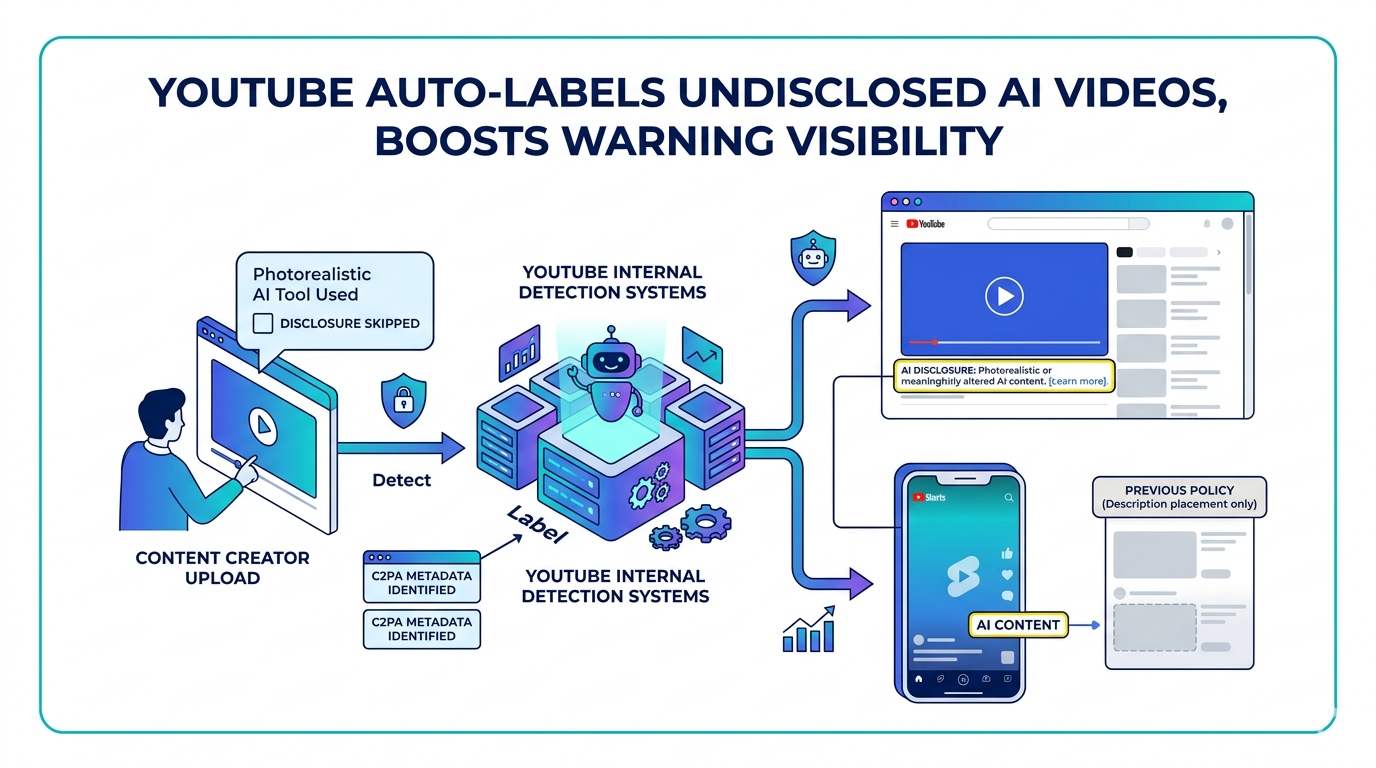
Previously, AI content labels were placed inside the expanded description section, making them invisible unless a viewer actively opened it, with the exception of videos touching on sensitive topics like health or news, which received more prominent treatment.
Under the updated policy, the disclosure label for photorealistic and meaningfully AI-altered or AI-generated content is moving to a more prominent position: for long-form videos, the label will now appear directly below the video player and above the description; for Shorts, the label will appear as an overlay on the video itself.
This consolidated placement is now the single label format for all photorealistic and meaningfully AI-altered or generated content on YouTube. For content that is unrealistic, animated, or only slightly altered, the disclosure continues to appear in the expanded description.
Automatic Detection for Undisclosed AI Content
Beginning in May 2026, YouTube's systems will use new internal signals to identify AI-generated content. If a creator does not specify whether AI was used, but those systems detect significant photorealistic AI use, the platform will automatically apply a label.
The manual disclosure requirement remains active. Creators must still disclose AI use at upload time through YouTube Studio. The automatic detection functions as a supplementary safety net, not a replacement for that responsibility.
YouTube did not publicly specify which technical signals its detection system uses. The official YouTube blog post states only that "we're rolling out new internal signals to help identify AI-generated content," without elaborating on the underlying methodology.
Permanent Labels and the Dispute Process
Creators who believe their content was incorrectly identified as AI-generated can update the disclosure status in YouTube Studio. That dispute option, however, does not apply in all cases.
According to YouTube, AI labels will "remain permanent" for content created using YouTube's own AI tools, such as Veo or Dream Screen, and for content that contains C2PA metadata, based on standards from the Coalition for Content Provenance and Authenticity, indicating the video was fully AI-generated.
Creators who export content from C2PA-compliant tools such as Adobe Firefly or those using Content Credentials should expect their YouTube uploads to be labelled before they finish processing.
No Direct Effect on Monetization or Recommendations
Despite the updated labelling system, some criticism remains regarding implementation, with users arguing the warning notices are still visually too small and can be missed during casual viewing.
YouTube addressed the question of algorithmic and monetization impact directly in its May 27 blog post. The company stated that a disclosure label alone does not change how a video is recommended or whether it is eligible to earn money.
Others continue requesting stronger viewer controls, including the ability to reduce or completely disable AI-generated content recommendations. Currently, YouTube does not offer users an option to filter out AI-generated videos entirely.
Implications for Marketers and Video Content Producers
For brands and agencies producing video content for YouTube, the practical implication is that photorealistic AI-generated content, including AI avatars, synthetic spokesperson videos, and AI-generated product demonstrations, will now carry a visible disclosure label, whether or not the uploader applies one at the time of upload. Channels relying on undisclosed AI production to appear indistinguishable from human-produced content can no longer count on that going undetected by the platform. The label itself carries no algorithmic penalty under YouTube's stated policy, but its placement below the video player on long-form content and as a direct on-screen overlay on Shorts means viewer-facing visibility is substantially higher than it was under the previous description-buried system.
YouTube announced these changes on May 27, 2026. The company stated in its blog post that the changes are "designed to balance transparency with creator control."