
Meta’s personal AI ambitions are moving into everyday commerce. Muse is now available in Singapore with connections to major regional shopping, dining and travel services, although some partner features will arrive after launch.
The October 27 expansion gives Meta a localized test of whether an AI agent can move beyond answering questions and complete multi-step tasks across services people already use.
Singapore Launch Makes Local Connectors the Product
Muse is available in Singapore through iOS, Android and muse.ai, according to Meta’s Singapore launch announcement.
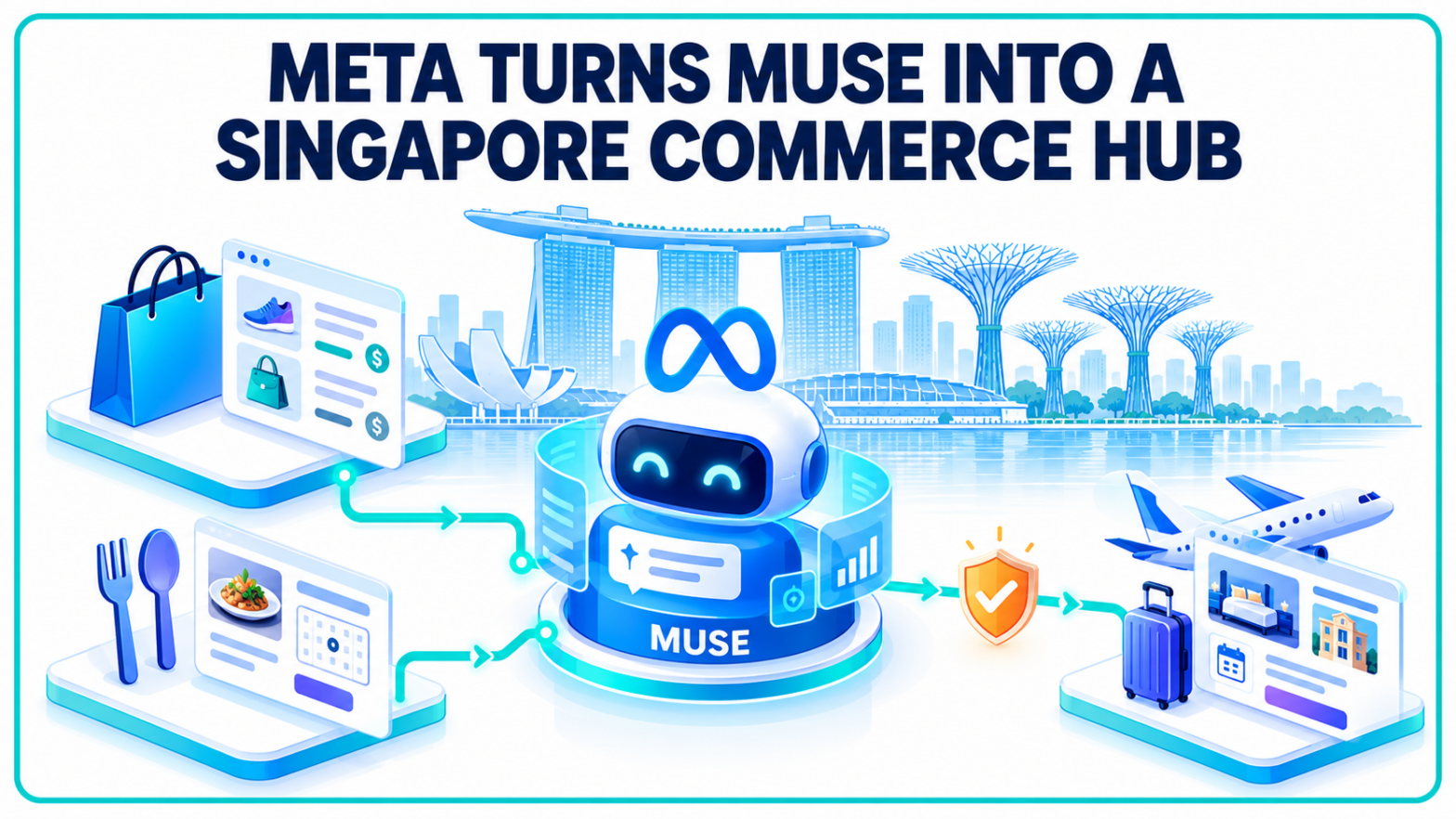
Users can connect Gmail, Google Calendar and Instagram, allowing the agent to work with email, schedules and saved social content. The local partner list includes Shopee, Grab, Singapore Airlines, Agoda, ShopBack, Klook, Trip.com and Lazada.
Those integrations give Muse a practical role in several common consumer journeys. Meta says users can ask it to research products and compare prices on Shopee or Lazada, plan grocery purchases through GrabMart, explore dining offers through Grab Dine Out or check travel and reservation options across participating services.
ShopBack adds another layer by connecting the agent with cashback opportunities and in-store dining deals.
Not every experience is necessarily active on day one. Meta says connector functions will roll out progressively, with some becoming available after the initial Singapore launch. The company did not provide a partner-by-partner schedule or specify which functions are being held for later release.
TechWyse previously reported on how Meta Muse entered Shopify’s AI shopping channels and what that shift could mean for merchant distribution and attribution. The Singapore rollout takes a different route by naming services with strong local and regional recognition rather than presenting Muse solely as a general-purpose global assistant.
Muse Can Research a Purchase, but the User Keeps Approval
Muse is designed to carry out work rather than stop at a recommendation. Meta’s original product announcement describes an agent that can browse websites, fill out forms and continue longer tasks after the user closes the app.
That makes the distinction between assistance and action important.
A conventional chatbot may suggest a hotel or summarize product options. A personal AI agent can potentially continue through several stages of the task, using connected services and returning when it needs a decision.
Meta says Muse requests approval before sensitive actions such as sending an email or making a purchase. Users decide which services to connect and what level of access to grant, including whether the agent can only read email or also send messages.
The Singapore announcement does not say that Muse can independently complete every purchase, reservation or booking available through its named partners. Its wording ranges from researching and comparing products to exploring ticketing and reservation options. The progressive rollout also leaves the precise level of automation dependent on the connector and its current availability.
That qualification matters. Local brand participation confirms that Muse can work across those commercial categories, but it does not make every partner experience identical.
Shopping and Travel Data Move Closer to the Decision
The connector strategy places Muse between a consumer’s request and the services capable of fulfilling it.
Instead of opening several shopping apps, comparing listings manually and then moving to checkout, a user may begin with a broader instruction. The agent can help narrow the options before the person approves the next sensitive step.
Other AI shopping agents have increasingly brought product discovery, comparison and ordering into conversational interfaces. Meta’s Singapore model adds locally familiar services to that pattern, including transport, food delivery, accommodation, flights and cashback.
The commercial questions are not limited to whether an agent can find an item. Product availability, price, merchant information, loyalty benefits and reservation inventory all affect the quality of the response. Meta has not detailed how Muse ranks competing options, how prominently individual partners appear or whether sponsored placement will be part of the Singapore experience.
For marketers and ecommerce teams, the immediate practical implication is that accurate product, offer and availability data may influence discovery before a shopper reaches a conventional search result or storefront. Measurement may also become less straightforward when research begins inside an agent and the final action occurs through a connected service. Meta has not announced dedicated reporting or attribution tools for the Singapore connectors.
Muse Secure VM Separates Credentials From the Agent
Connecting an agent to email, calendars and commercial accounts creates a larger access question than submitting an isolated prompt.
Meta says Muse addresses that risk through Muse Secure VM, a dedicated computer in the cloud where connected-service data and credentials are stored. The company says the agent cannot see users’ passwords or payment methods, even though it can use securely stored credentials to complete authorized work.
A separate system called Sentinel reviews Muse’s outgoing internet activity and can request permission from the user. Meta also says people can review an audit trail, change permissions, disconnect services and ask Muse to forget specific information.
According to Meta, conversations and data stored in the virtual machine are not shared with its advertising systems. Users can also opt out of having their Muse interactions used to train Meta’s AI models.
These are company-stated product controls, not an independent security assessment.
Meta previously said it planned to introduce a Confidential VM layer later in 2026, encrypting the virtual machine with a key held by the user. The Singapore announcement refers to the existing Secure VM architecture but does not confirm that the planned Confidential VM protection is available at launch.
Singapore Adds a Local Route Into Agentic Commerce
Much of agentic commerce has centred on the infrastructure connecting product discovery with carts and checkout. Meta’s Singapore launch emphasizes another requirement: connections to services that reflect how people in a specific market already shop, travel and make reservations.
That approach could reduce the need for consumers to learn a new set of merchant interfaces. It also gives Meta a role in coordinating journeys that may cross several companies, such as comparing a destination, checking flights, reviewing accommodation and finding activities.
The company has not published Singapore-specific subscription prices or explained the limits separating free and paid usage. Meta says Muse is free for most needs, with subscription plans available for people who want to do more.
Muse is currently accessible in Singapore on iOS, Android and the web. Meta says support for AI glasses is coming soon, while some of the announced shopping, dining and travel connector experiences will become available after launch.