

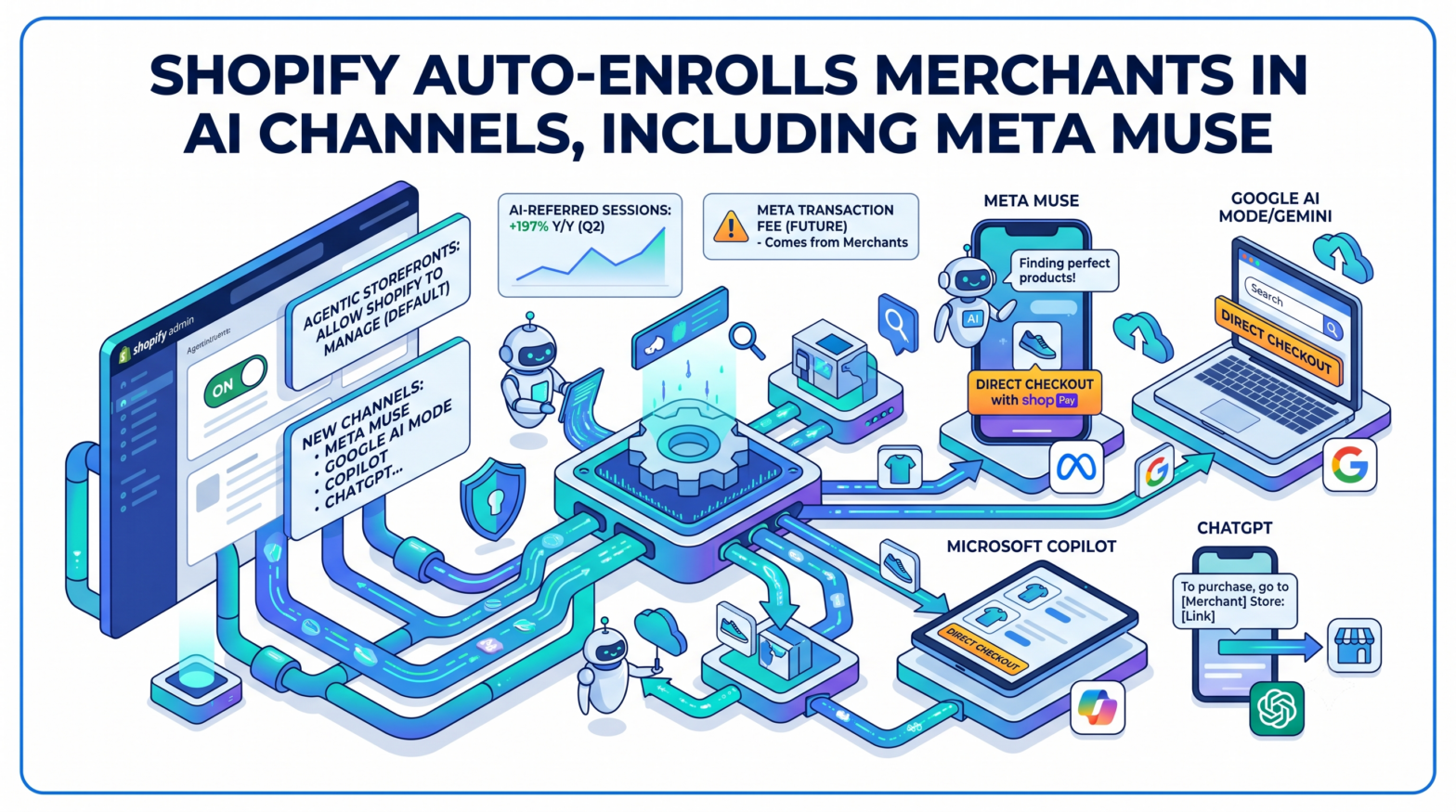
Eligible Shopify merchants now have their products distributed to Meta's AI agent without any action on their part. Shopify's September 8 changelog confirmed that Meta was added as an AI channel in the Agentic Storefronts section of Shopify admin that day, the same day Meta launched Muse, and that products are shared with Meta by default through Shopify Catalog.
How the Default Setting Works
Shopify's Help Center states that the "Allow Shopify to manage for me" setting in Sales channels > Agentic is on by default. With it on, AI shopping channels can read a store's products through Shopify Catalog, direct checkout is switched on for the relevant channels, and the store is enrolled automatically in new agentic storefront channels.
Many Shopify merchants began receiving notice from Shopify on January 12, 2026, informing them they were auto-opted in to agentic shopping experiences with major AI and LLM platforms. Shopify's September 8 changelog states that Meta now appears alongside other AI channels in the Agentic Storefronts section of the Shopify admin, and that products are shared with Meta by default through Shopify Catalog when eligible.
The admin also surfaces a grouped row called "Other channels." Shopify's help page says this group includes "Independent developers and startups that are building niche or experimental shopping agents" and "New third-party partners that have recently gained access to Shopify Catalog for testing." Stores enrolled under the default setting are opted into this group as well.
Google is handled differently from the other platforms. Shopify Catalog is how most of these apps get your product list. Google AI Mode and Gemini read products from Google Merchant Center instead.
Which Stores Qualify for Direct Checkout
Shopify calls the in-chat purchasing capability direct checkout. For eligible stores, customers on Meta surfaces, including Muse where Muse itself is available, can complete a Shopify-powered direct checkout without leaving the Meta experience. Eligibility for direct checkout varies by platform.
According to Shopify's help documentation, Meta direct checkout covers eligible stores selling in the US, Canada, or Mexico, while Google, Copilot, and ChatGPT list US customers.
ChatGPT operates differently from the other three. Rather than completing the transaction inside the chat interface, ChatGPT redirects the customer to the merchant's own online store checkout. Meta, Google, and Copilot each complete the purchase without the customer ever opening the merchant's website.
What Meta's Muse Is
Meta introduced Muse on September 8, 2026, calling it a personal AI agent built to run errands, manage schedules, and carry out multi-step tasks across a user's digital life. Meta's announcement describes Muse as an agent that "can open a browser, fill out forms, and negotiate on their behalf," and states that it asks the user for approval before sensitive actions like making a purchase.
On September 21, 2026, Shopify CEO Tobias Lütke announced that Shopify is "partnering deeply with Muse to enable agentic checkout with Shop Pay on all Shopify stores." Amazon, by contrast, began blocking the Muse AI agent from its platform on Sunday night, September 20, 2026, according to Bloomberg. Amazon stated it was not given notice or a choice about whether its store should be available through Muse.
Tracking and Attribution Gaps
When a customer completes a purchase inside a chat app through direct checkout, the transaction does not pass through the merchant's website. Shopify's documentation for the Google and Copilot channels states that Google Analytics and custom pixels will not fire for direct checkout orders, with only server-side tracking active. Shopify's Meta channel documentation states that third-party analytics pixels do not fire in Meta's checkout. Shopify does record these orders in the admin; Shopify's help documentation states that Meta orders "are displayed in your Shopify admin in the same way as for any other sales channel."
Shopify's Agentic page includes a shopper count at the top. Shopify reported that AI-referred sessions to storefronts grew 197% year-over-year in Q2 2026. That figure captures visits from AI apps, not direct checkout sales, which appear separately in the admin dashboard. The shopper count on the Agentic page tracks visits, but the full revenue picture requires checking both metrics.
In Q2, AI-referred sessions to Shopify storefronts grew 197% year-over-year, and orders also grew 3x. That growth showed up across nearly every product category tracked, indicating more shoppers are using AI to both research and buy.
Current Fee Structure and Meta's Stated Future Model
No platform currently charges fees on these transactions, though Meta CEO Mark Zuckerberg said the company expects to take a small percentage of transactions in the future. Meta will take a small cut of transactions Muse completes on behalf of users, and the fee will come from merchants, not from users themselves. Zuckerberg first disclosed this model on the Sources podcast with Alex Heath, published September 8, 2026. No comparable public statement has been made by Google or Microsoft regarding future transaction fees on their respective channels.
Store owners remain the merchant of record, handling all fulfillment and returns.
How Merchants Can Adjust or Disable Enrollment
Merchants who want control over each individual channel must turn the master "Allow Shopify to manage for me" setting off first. Turning it off reveals separate controls. According to Shopify's help documentation, the merchant can then switch Shopify Catalog access on or off, switch "Auto enroll new storefronts" on or off, and, depending on the channel, switch direct checkout on or off.
Turning off catalogue access may take up to 7 days to fully stop data sharing. Merchants who want to hide a single product from all AI channels, including direct catalogue access, must mark that product as unlisted. Shopify's product documentation notes that unlisted status also removes the product from sitemaps, organic search engine indexing, and online store search.
Practical Implications for Merchants
Merchants using platform-side analytics tools such as Google Analytics or advertising dashboards as their primary sales reporting method may undercount revenue from agentic channels, since direct checkout purchases on Meta, Google AI Mode and Gemini, and Microsoft Copilot do not trigger client-side tracking pixels. Checking orders filtered by sales channel within Shopify admin is currently the most complete view of what each AI channel is generating. Merchants who want granular visibility into which channel is contributing direct checkout revenue, and which would be subject to any future Meta transaction fee, should use the orders list filtered by channel rather than the aggregate Agentic page shopper count, which measures link-referred visits rather than completed agent purchases.
Meta Chief AI Officer Alexandr Wang confirmed the Shopify partnership, saying Meta wants to "give our Musers access to a wide range of stores to find the absolute perfect products."