
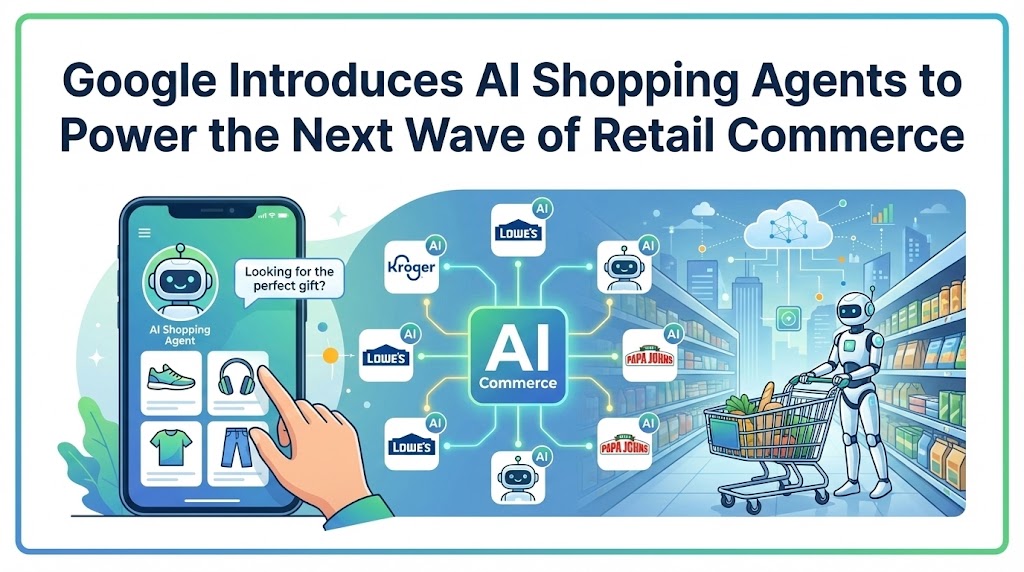
Google is formally entering the AI-powered commerce space with the launch of new AI shopping agents designed specifically for retailers, signaling a major shift in how brands prepare for agent-driven purchasing behavior.
The tools, part of Google’s Gemini Enterprise for Customer Experience, are built to help retailers deploy their own AI agents that assist shoppers with product discovery, personalization, customer support, and ordering—without forcing brands to hand control over to third-party chatbots.
Google Targets Agent-Based Shopping at the Retail Level
Unlike consumer-facing AI assistants, Google’s approach focuses on enabling retailers to build and operate their own agent-driven shopping experiences. These AI agents can guide customers through product selection, answer questions, and complete transactions across digital touchpoints, including mobile apps, websites, and voice interfaces.
Google says the tools are designed to reduce the technical burden of developing AI agents from scratch, allowing retailers to integrate advanced capabilities while maintaining ownership of customer relationships and data.
Major Retailers Are Already Testing the Technology
Large brands are already preparing for a future where AI agents play a meaningful role in shopping journeys.
Grocery chain Kroger is piloting Google’s shopping agent within its mobile app. The AI assistant helps shoppers compare items, personalize recommendations, and complete purchases by factoring in contextual signals such as meal planning, time constraints, pricing sensitivity, and brand preferences.
According to Kroger’s digital leadership, the pace of AI agent adoption is accelerating so quickly that delaying investment could create long-term competitive disadvantages.
Home improvement retailer Lowe’s is using Google’s agent technology as the backend for its virtual assistant, Mylow. The company reports that customers who interact with the AI assistant are converting at more than twice the rate of those who do not.
Papa Johns is also testing Google’s food-ordering agent, which can estimate order quantities, assist with group orders, and function across phone, web, and mobile app experiences. Rather than building its own AI infrastructure, the pizza chain is focusing on applying AI agents to improve ordering convenience.
Why Retailers Want Their Own AI Agents
As AI-powered shopping expands, retailers face a strategic decision: allow products to be purchased directly inside third-party AI chatbots, or develop owned AI experiences.
While platforms like ChatGPT, Copilot, and Gemini are introducing native checkout features, making products directly shoppable inside external AI tools carries risks. Retailers could lose brand visibility, customer loyalty, upsell opportunities, and advertising revenue.
By contrast, retailer-owned AI agents provide greater control over how products are presented, how recommendations are generated, and how customer data is used.
Industry analysts note a growing shift toward internal capability building rather than reliance on external AI marketplaces.
Lowering the Barrier to AI Agent Adoption
Building effective AI agents remains technically complex, particularly as the underlying models and capabilities evolve at a rapid pace.
Google positions its new tools as an abstraction layer that allows retailers to benefit from advanced AI without rebuilding systems every time the technology changes. This is especially important as agent architectures can become outdated in weeks rather than years.
As a result, many retailers—including Lowe’s and Kroger—are adopting multi-vendor strategies, working with several AI providers simultaneously to reduce dependency on a single platform.
Agentic Commerce Is Moving Fast—but Not Replacing Everything
Despite rapid momentum, retailers caution that AI agents will augment—not replace—existing shopping behaviors.
Customers continue to use traditional channels such as phone orders and in-store interactions, even as AI-driven experiences expand. For most brands, AI agents represent an additional layer of convenience rather than a wholesale transformation of commerce overnight.
What This Means for Marketers and Ecommerce Leaders
Google’s move into retailer-focused AI agents highlights a broader shift toward agentic commerce, where AI systems increasingly influence what consumers buy and how they buy it.
For marketing and digital leaders, the implications are significant:
-
AI agents will become a new surface for product discovery and conversion
-
Retailers that control their own agents retain data, branding, and upsell opportunities
-
Search, paid media, and onsite optimization strategies will need to adapt to agent-driven journeys
As AI-based shopping matures, brands that invest early in owned AI experiences may be better positioned to compete in a future where machines increasingly mediate commerce decisions.
Looking Ahead
Google’s retailer-focused AI agents mark a pivotal step in the evolution of AI-assisted shopping. Rather than owning the transaction, Google is positioning itself as the infrastructure provider that helps brands stay competitive in an agent-first world.
For retailers, the message is clear: AI agents are no longer experimental. They are becoming a strategic priority—and the window to prepare is rapidly narrowing.