

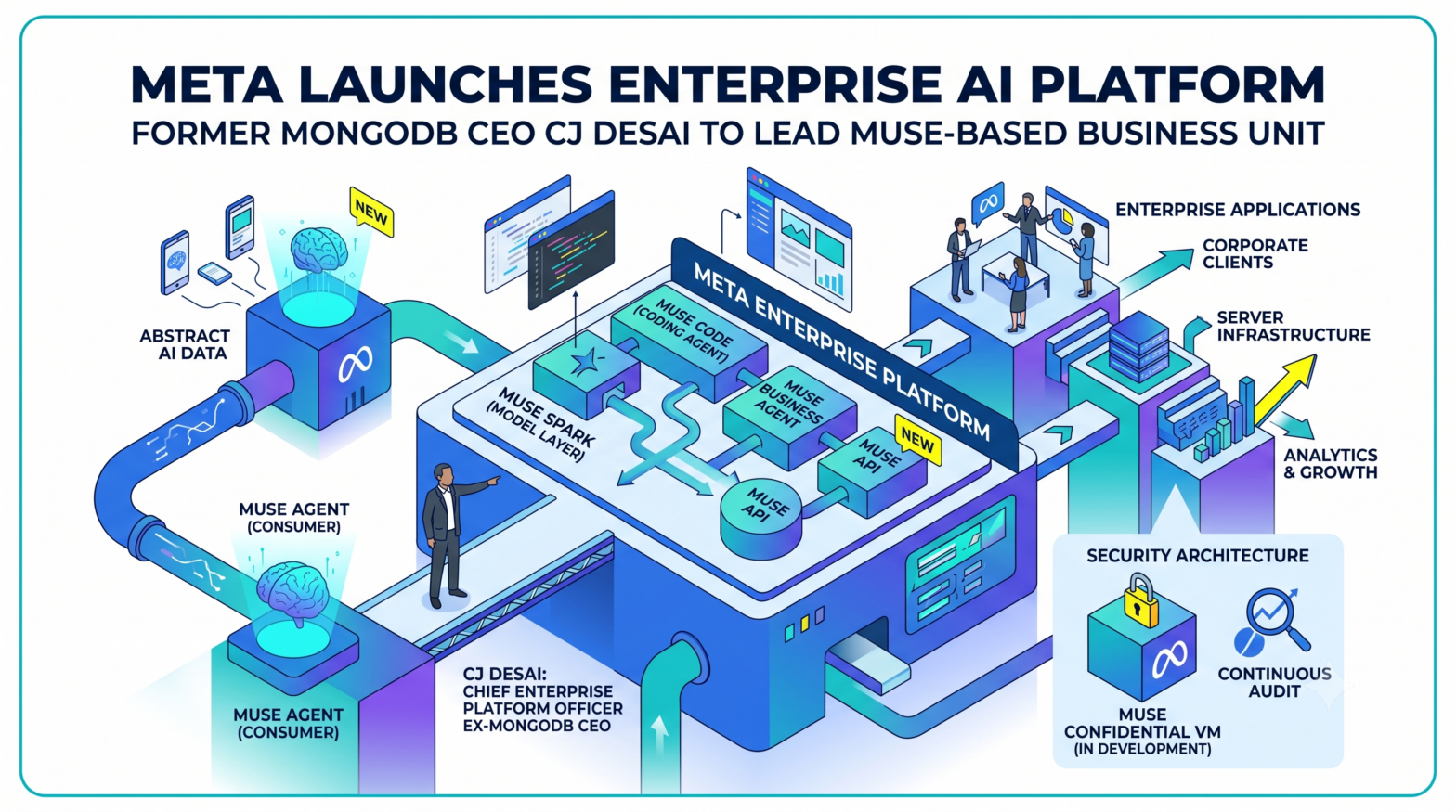
Meta is formally entering the enterprise AI market with a new dedicated business unit. CEO Mark Zuckerberg announced Meta Enterprise Platform on September 28, describing it in an official release as "the next major pillar of our business."
What the Platform Offers at Launch
Meta says the new platform will initially focus on bringing its full technology stack to businesses and developers, including Muse, Meta Business Agent, Muse API, and Muse Code. Muse Spark is the underlying model, Muse Code is the coding agent built on it, and Muse is the personal agent available to consumers. Meta Enterprise Platform is organized as the commercial layer intended to package that growing stack into deployable products for corporate clients.
Muse has been promoted by Meta as an always-on digital assistant capable of performing tasks such as booking restaurant reservations or summarizing email threads, with Meta writing in its September 8 announcement that Muse "can work on a person's behalf across the apps they use daily." The new enterprise division comes just three weeks after Muse was launched as a consumer-facing AI agent.
Zuckerberg said in the September 28 release that Meta's enterprise push will draw on capabilities he characterized as rare in the industry, citing "advanced models, leading agents, large-scale infrastructure, and years of working closely with many businesses."
CJ Desai Appointed Chief Enterprise Platform Officer
Chirantan "CJ" Desai is joining Meta Platforms as its chief enterprise platform officer and will lead the new Meta Enterprise Platform unit, reporting directly to Zuckerberg. Desai, who was in his role at MongoDB for less than a year, will be leading the platform for businesses.
Before MongoDB, Desai led product and engineering at Cloudflare and served as president and chief operating officer at ServiceNow, with earlier roles at EMC, Symantec, and Oracle also listed in his MongoDB leadership biography. The appointment gives Zuckerberg an executive with enterprise operating and go-to-market experience to lead a product set that spans infrastructure, agents, and developer access.
Desai stepped down from MongoDB effective immediately on September 28. MongoDB's board named Dev Ittycheria as interim president and CEO, also effective immediately. Ittycheria had led MongoDB for 11 years, from 2014 to 2025, during which the company grew from roughly $35 million to more than $2.3 billion in annual revenue. The board has retained an executive search firm to identify a permanent successor. MongoDB stock fell 25% on the news.
Security Architecture and Known Limitations
In the September 28 announcement, Desai stated that "security and privacy are built into Meta's enterprise products from the outset." Meta's AI security roadmap includes a feature called Muse Confidential VM, set to roll out later this year, which is designed to isolate Muse instances to the extent that not even Meta can access their contents, with the company also planning to share a continuous audit allowing users to verify the technology works as intended.
Meta's security documentation states that the current architecture does not technically prevent Meta from accessing information in a user's virtual machine when needed to operate or secure the service, and the company has not confirmed that Confidential VM protections are available in today's Muse.
Meta has not announced specific pricing or availability details for the new enterprise platform.
Market Context and Practical Implications
Meta's push into the AI agent market with Muse has seen strong consumer demand, with the app overtaking OpenAI's ChatGPT as the leading free iOS app. The enterprise effort would give Meta another route to sell AI services to companies that already use its platforms, while placing its agents and models in competition with offerings from established cloud, software, and AI vendors.
For digital marketers and enterprise buyers, the platform's stated focus on Meta Business Agent is particularly relevant. Businesses that already advertise or operate through Meta's consumer-facing properties may find early integration points through that product. However, with no pricing, no customer commitments disclosed, and the Confidential VM security layer not yet generally available, organizations evaluating the platform will need to assess deployment readiness against their own security and compliance requirements.
The announcement names no enterprise revenue or customer commitments, leaving adoption to prove whether this becomes a meaningful business beyond Meta's ad engine.