Google is tightening the screws on search spam again.
Less than eight weeks after its June enforcement update, another global spam update is now rolling through Google Search. For publishers and SEO teams, the timing matters almost as much as the update itself. Google has now launched three confirmed spam updates in 2026.
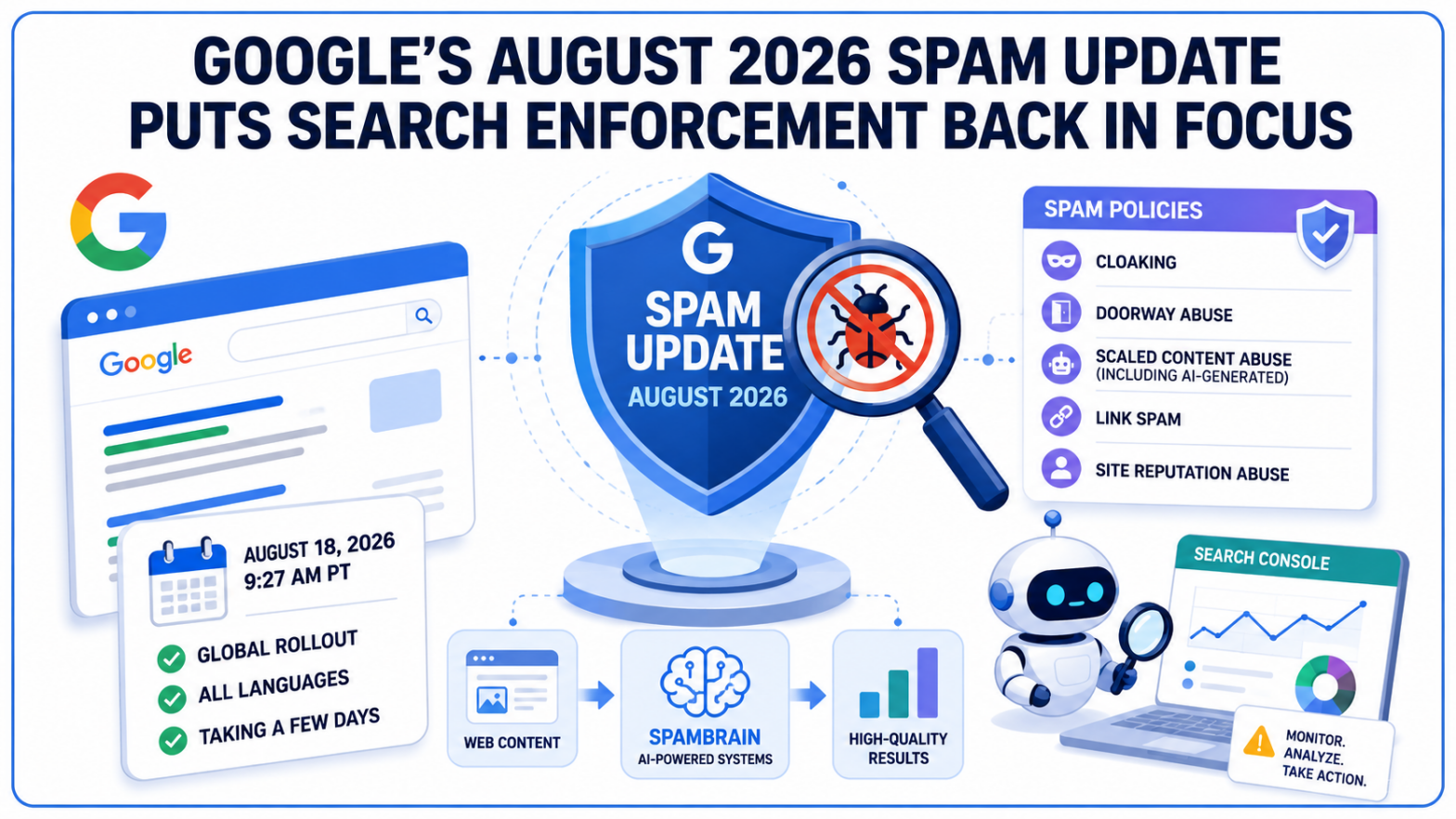
According to Google’s Search Status Dashboard, the August 2026 spam update began on August 18 at 9:27 a.m. Pacific Time. Google says it applies globally, covers all languages, and may take a few days to complete.
Google has not identified a new spam policy or singled out a specific tactic in its rollout notice.
That leaves SEOs with a familiar job: watch the data, resist early conclusions, and separate actual enforcement signals from ordinary ranking movement.
Three Spam Updates in Five Months Changes the Context
The August rollout is not happening in isolation.
Google’s ranking update history shows spam updates on March 24, June 24, and now August 18. The June rollout lasted just over two days, while the March update was completed in less than a day. The current August update remains active, with Google only saying that completion could take several days.
Three spam updates within roughly five months does not prove that Google has increased the severity of enforcement. It does show that its anti-spam systems are being updated frequently enough that publishers cannot treat these rollouts as rare cleanup events.
The broader direction has already been visible.
Google describes spam updates as notable improvements to automated systems that operate continuously. Its documentation specifically names SpamBrain, an AI-based spam-prevention system, as one example of technology Google periodically improves to catch new types of abuse.
That distinction matters. A Google spam update is not a temporary filter switched on for a few days. The rollout represents changes to systems that continue operating after Google marks the update complete.
Google Is Policing More Than Traditional Blue-Link Rankings
The definition of search spam itself has widened.
Google’s current spam policies define spam as techniques designed to deceive users or manipulate Search systems into featuring content prominently. That definition now explicitly includes attempts to manipulate generative AI responses in Google Search.
The policy connects familiar SEO abuse with newer attempts to influence AI-generated answers.
Google lists practices including cloaking, doorway abuse, expired domain abuse, hidden text, keyword stuffing, link spam, scraping, scaled content abuse and site reputation abuse. Scaled content abuse can include using generative AI to create large numbers of pages when those pages provide little or no additional value to users.
The presence of AI in that policy should not be read as a blanket penalty on AI-assisted content. Google’s definition focuses on the purpose and value of the content, not simply which tool produced it.
That is consistent with the direction TechWyse has tracked across AI search: Google continues tying visibility in generative search experiences to its broader search quality and ranking systems rather than offering publishers a separate shortcut for AI results.
Spam enforcement is now part of that same ecosystem.
A Ranking Drop Is Not a Spam Diagnosis
The first few days of any ranking update create a predictable problem: correlation starts looking like causation.
A site loses visibility while an update is rolling out. The update becomes the explanation.
Google’s own documentation is narrower. Sites that experience changes after a spam update are told to review Google’s spam policies and make sure they comply. A policy-violating site can rank lower or disappear from results, but a ranking change during the rollout does not itself prove that a spam system caused the loss.
Organic performance can move for plenty of other reasons, including site changes, indexing problems, seasonality, competitors gaining ground, shifting query demand or unrelated changes to Google’s ranking systems.
There is another reason not to rush.
Google says that when a site makes changes after violating spam policies, improvement may occur only after its automated systems learn over a period of months that the site is complying again. That makes reactive edits during the first hours of a rollout particularly difficult to evaluate.
For SEO teams, the practical approach is to monitor Google Search rankings, impressions, clicks, affected query groups and landing-page patterns while the rollout remains active. If losses persist after completion, compare affected sections against Google’s documented spam policies before making broad changes. The timing of a decline is evidence to investigate, not a diagnosis on its own.
Link Spam Still Comes With a Different Recovery Problem
Google’s documentation also makes an important distinction between general spam updates and updates that specifically target link spam.
When Google neutralizes the effect of spammy links, the ranking benefit those links previously supplied is lost. Removing or cleaning up the links does not restore the artificial ranking value they once provided.
Google has not labelled the August 2026 rollout a link spam update.
Still, its broader spam policies continue to prohibit links created primarily to manipulate rankings. Examples include paid links that pass ranking credit, excessive link exchanges, automated link creation, low-quality directory links, optimized links distributed through widgets and low-value content built mainly to manipulate linking signals.
That creates a useful boundary for interpreting the current rollout. Google has confirmed a general spam update, not a campaign against one disclosed tactic.
SEOs should be careful not to invent a target before Google names one.
Recovery Could Take Longer Than the Rollout
Google expects the August update itself to take only a few days.
Recovery is another matter.
The company says sites affected by its automated spam systems may need months of sustained compliance before those systems recognize the change. There is no reconsideration request for an ordinary algorithmic spam demotion comparable to the process available after some manual actions.
That puts more weight on trend analysis after the rollout closes.
Search Console data can help identify where visibility changed, but the useful questions sit below the sitewide totals. Did impressions fall across the entire domain or within one directory? Did branded queries hold while commercial pages dropped? Did losses cluster around mass-produced templates, syndicated material or pages with unusual backlink profiles?
Those patterns provide more information than a single visibility score.
As of August 19, Google still lists the August 2026 spam update as active on the Search Status Dashboard. No completion notice or additional details about specific systems targeted by the rollout have been published.
For now, that is the boundary of what Google has confirmed.