Google is not giving publishers a new AI loophole.
The message from Search is getting sharper: if a page exists mainly to satisfy a system, not a reader, AI Search is unlikely to make that weakness easier to hide.
Google Search chief Liz Reid has tied visibility in AI-driven search experiences to two familiar requirements: make content accessible to Google, and make it worth reading once people find it. That framing comes as publishers, SEOs, and brand content teams continue questioning how AI Overviews, AI Mode, and other generative search features will change discovery.
The answer is less exotic than many expected.
Google’s own guidance for generative AI features in Search says the same best practices that support Google Search visibility still apply to AI features. The company says generative AI search is rooted in its core ranking and quality systems, not a separate optimization layer.
That puts the pressure back on the content itself.
AI Search Still Starts With Crawlable Pages
The first condition is technical.
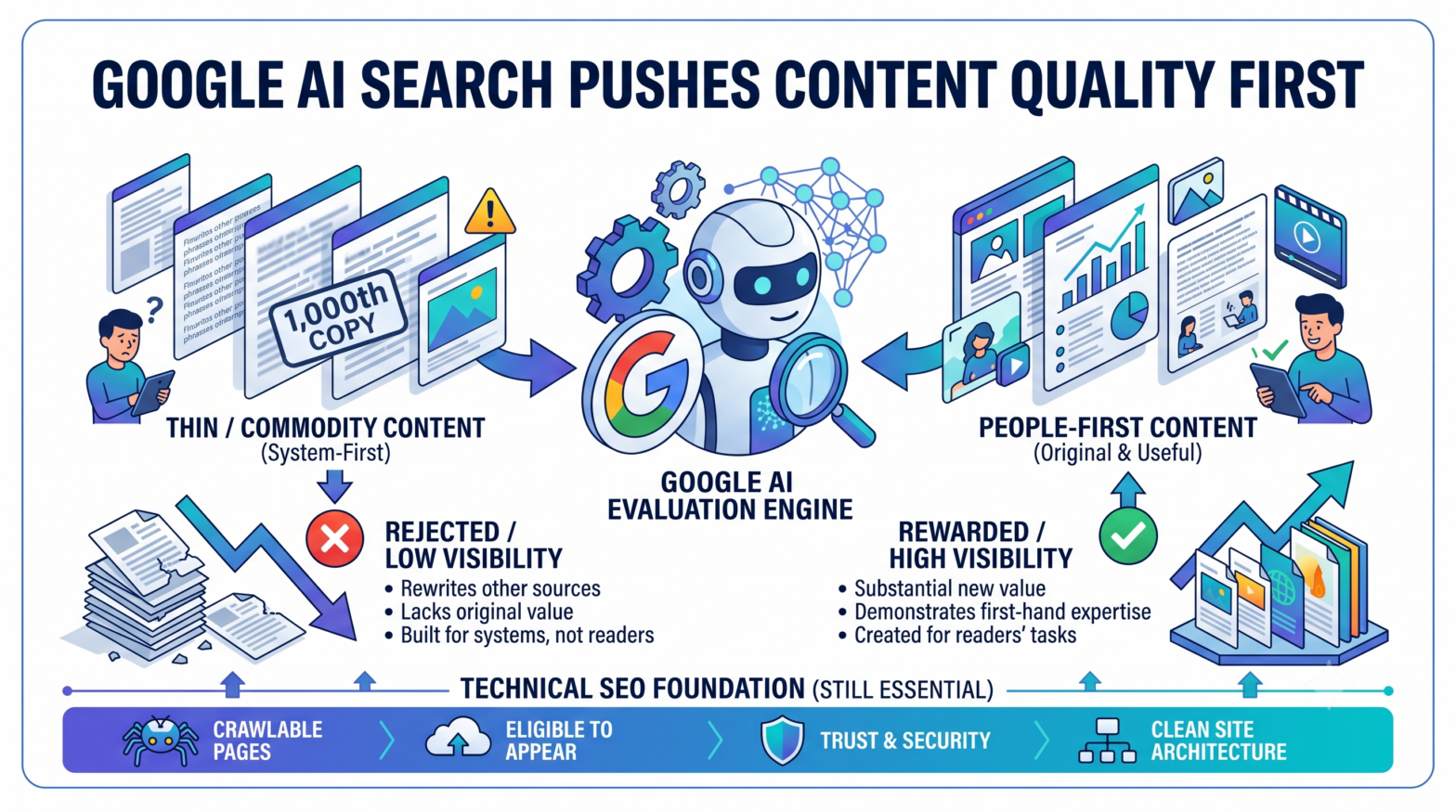
Google cannot use content it cannot access, understand, index, or show with a snippet. Its AI optimization guidance states that pages must meet Search technical requirements and be eligible to appear in Google Search with a snippet before they can appear in generative AI features.
That matters because some publishers have been weighing more restrictive crawling decisions as AI-generated answers become more common. Blocking access may reduce exposure to AI systems, but it can also limit eligibility for the very search surfaces where visibility is shifting.
For SEO teams, that keeps the old fundamentals in play: clean crawl paths, indexable pages, accurate canonical signals, useful internal linking, accessible media, and page structures that help Google understand what a page is actually about.
Technical SEO is not being replaced by AI optimization.
It is being dragged into a more visible role because Google’s AI features still need a reliable source layer underneath the generated answer. Pages that are buried behind poor architecture, blocked resources, confusing rendering, or inconsistent metadata are at a disadvantage before content quality is even judged.
That aligns with TechWyse’s earlier coverage of how Google says AI Search still runs on SEO, where the company’s position was clear: generative AI visibility is not detached from search quality systems.
The new pressure point is not whether SEO still matters. It is whether the content being optimized deserves the visibility teams are chasing.
The “1,000th Copy” Problem Is Getting Harder To Defend
Google’s people-first content guidance has long pushed creators to ask whether a page offers original information, reporting, research, analysis, or value beyond what already appears in search results.
That test now carries more weight.
In its helpful content documentation, Google asks site owners to evaluate whether their content provides substantial value compared with other pages in search results, avoids simply rewriting other sources, and demonstrates first-hand expertise or depth of knowledge.
For publishers, that is a direct challenge to commodity content.
A page that summarizes the same announcement, uses the same examples, and adds no evidence from the author’s own experience is easier to produce. It is also easier for users to skip. In an AI Search environment, it may become easier for Google to satisfy the query without sending traffic to yet another interchangeable page.
The phrase “people-first content” can sound soft. The operational standard is not soft at all.
It asks whether the page has a reason to exist beyond capturing a query. It asks whether the creator has done the work. It asks whether a reader would trust the source, bookmark it, share it, or feel they learned enough to complete the task they came to solve.
That is a high bar for large-scale content programs built around search volume first and editorial usefulness second.
For brands, the practical question is no longer “Can we publish a page for this keyword?” It is “What do we know, prove, show, explain, or document better than the pages already ranking?”
Generative AI Search Rewards Useful Specificity
Google’s AI guidance points website owners toward “valuable, non-commodity content” created for a real audience.
That phrase matters.
Non-commodity content is not just longer content. It is not a generic post with a few expert quotes added near the bottom. It is content with clear ownership: original examples, practical detail, product experience, field knowledge, data, testing, commentary from people who understand the subject, and enough context for the reader to make a decision.
For marketers, that changes how content briefs should be written.
A brief built around keyword variations, competitor headings, and word count targets may still produce something indexable. It may not produce something distinctive enough to matter in AI Search.
Google’s guidance also encourages relevant images and videos when they support the page. That is not decoration. In generative search experiences, content can surface beyond standard web links, giving publishers more opportunities to appear through visual and video assets when those assets help answer the query.
The same logic applies to ecommerce and local business content.
A product page with manufacturer copy and thin specifications is commodity content. A page with real product comparisons, availability details, use cases, original photos, return policy clarity, and customer decision support is more useful. A local service page that lists cities and repeats the same service copy is commodity content. A page that explains real process, regional considerations, pricing factors, credentials, and customer outcomes is more useful.
AI did not create that difference.
It made the difference harder to ignore.
SEO Advice Is Being Pulled Back To Basics
The rise of AEO, GEO, LLM optimization, and AI visibility tools has created a crowded market of new terminology.
Google’s response has been conservative. Its generative AI guidance says that optimizing for generative AI search is still SEO because the features are connected to Google Search ranking and quality systems.
That does not mean search behaviour is unchanged. Users are asking longer, more complex questions. AI Overviews and AI Mode can synthesize answers before a user clicks. Search Console reporting is also being adjusted as Google rolls out more AI-specific visibility data, a shift TechWyse covered in its reporting on Search Console AI reports.
The strategy layer, however, is not being replaced by a trick.
Google has also pushed back on narrow AI search shortcuts. TechWyse recently covered Google’s position that llms.txt will not help rankings, reinforcing the distinction between optional AI interoperability files and actual Google Search visibility.
That distinction is useful for teams deciding where to spend time.
Crawlability matters. Page experience matters. Clear structure matters. Content depth matters. Trust matters. Authorship and sourcing matter where readers expect them. So does a site’s ability to show that it has a focused purpose and real expertise behind the information it publishes.
A custom markdown file or AI-facing label cannot compensate for weak pages.
What Marketers And SEOs Should Change In Practice
For marketers and SEOs, the practical shift is in content governance.
Content planning should put evidence before keywords. Briefs need to identify what original value the page will add, who is qualified to provide it, what supporting media or data should be included, and what user decision the content is meant to support. Existing pages should be audited for duplication, thin rewrites, unclear authorship, outdated claims, and sections written mainly to satisfy search engines rather than readers.
This is especially important for businesses publishing at scale.
A program that produces hundreds of similar pages may still be crawlable. It may still target valid queries. But if those pages do not offer meaningful differentiation, they become more exposed as Google’s Search and AI systems continue prioritizing helpful, reliable, people-first content.
The measurement layer also needs adjustment. Rankings and clicks still matter, but they are no longer the full visibility picture. AI Search reporting, branded demand, assisted discovery, engagement quality, and conversions from smaller but more intentional audiences will become harder to separate from search performance.
Google’s position leaves publishers with less room to treat AI visibility as a new technical add-on.
The stronger reading is simpler: content that people would choose to read without a ranking incentive is becoming the safer long-term asset.