
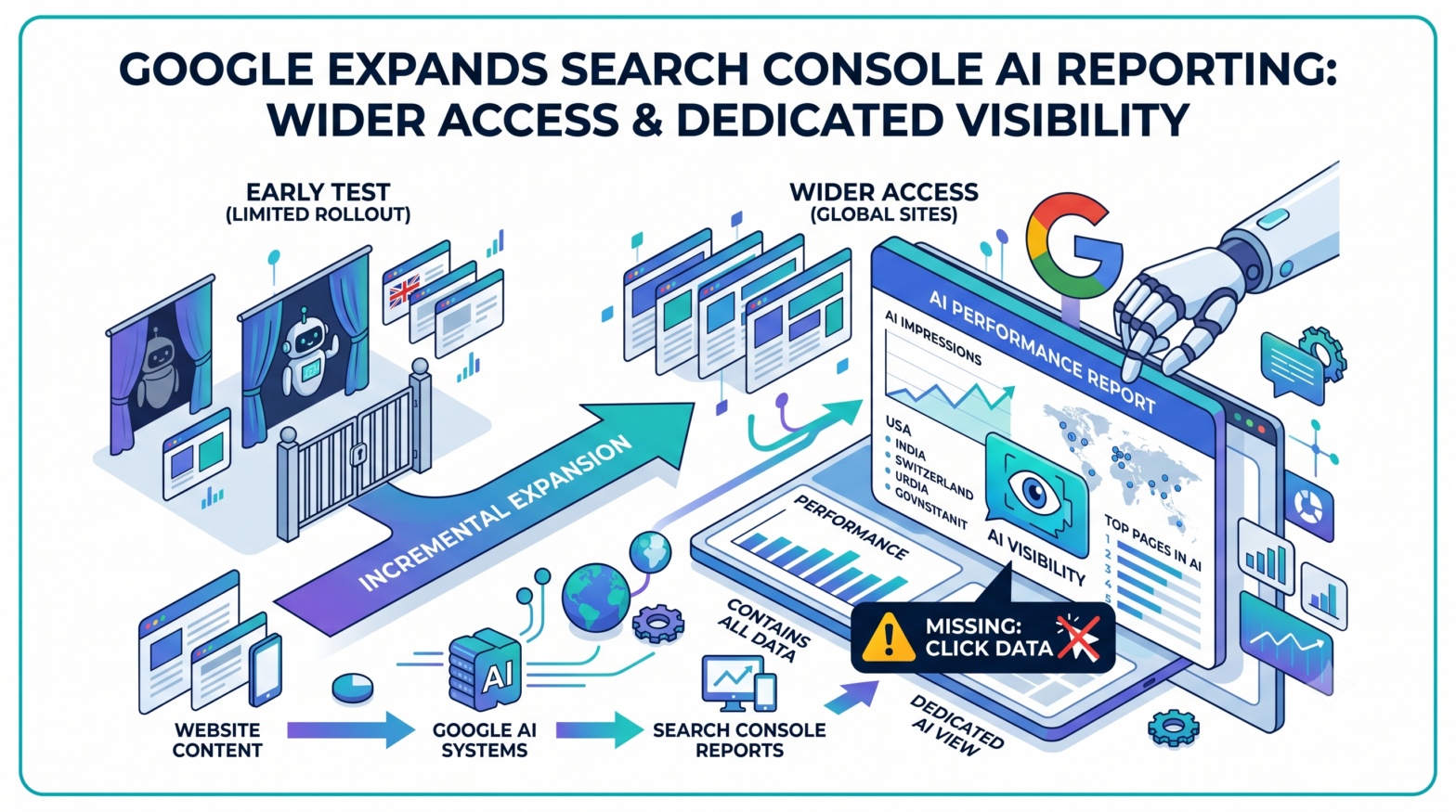
Google’s AI search data is no longer locked inside a narrow early test.
More site owners are now seeing dedicated generative AI performance reports in Google Search Console, extending access beyond the first limited rollout and giving publishers a clearer view of when their pages appear in AI Overviews, AI Mode, and other AI-powered search surfaces.
The AI Search Report Is Moving Past Its First Gate
Google first announced the new generative AI performance reports on June 3, positioning them as a separate Search Console view for visibility inside AI-generated search features. The initial launch was limited to a subset of websites while Google tested the reporting experience and collected feedback.
That early phase appears to be widening.
Google Search Advocate John Mueller said on Bluesky that the reports are being released gradually:
"We’re just rolling these out incrementally to sites, and reviewing the feedback along the way. I know everyone wants the new shiny thing immediately… but first, patience."
The expansion matters because the first rollout was treated by many SEOs as a controlled test, not a broadly available reporting layer. Early sightings were closely watched because Google had not provided a firm timeline for when more Search Console properties would gain access.
Now, reports are appearing for sites outside the initial UK-heavy test group, including properties associated with the United States, India, Switzerland, and other markets.
Not everyone will see them yet.
Google’s language still points to an incremental release, not a full global launch. For teams checking Search Console daily, that creates a familiar split: some accounts will have a new AI reporting view, while others will still see only the standard Performance reports.
Google Search Console Finally Separates AI Visibility From the Main Web Report
The new report does not create a completely new universe of data. It separates a slice that was already being counted elsewhere.
Google said in its Search Central announcement that generative AI feature data remains included in the overall Performance report. The difference is that site owners now get a dedicated view for visibility inside AI-powered features.
That distinction is easy to miss.
Before this update, impressions from AI Overviews and AI Mode were folded into broader Search Console reporting. Site owners could see total search performance, but they could not isolate AI search visibility in a clean interface. The new report breaks out impressions tied to generative AI features, giving SEOs a better way to monitor whether their pages are surfacing inside these experiences.
The report includes impressions, pages, countries, devices, and dates. Device data is available for Search results, while the date view can be analyzed across hourly, daily, weekly, and monthly levels.
Click data is still absent.
That is the gap publishers will notice first. Search Console can show that a URL appeared in Google’s generative AI search features, but it does not show how many users clicked from those AI responses to the site. For publishers already tracking lower click-through rates from AI-heavy results pages, that missing layer keeps the report useful but incomplete.
TechWyse previously covered Google’s original launch of dedicated generative AI performance reports in Search Console, including the limited early rollout and the lack of click metrics. The latest expansion does not change the report’s basic structure. It changes who can begin using it.
AI Overviews and AI Mode Are Becoming Measurable Search Surfaces
For years, SEO reporting revolved around rankings, impressions, clicks, and average position. AI search is breaking that neat model.
A URL can now be visible without behaving like a traditional blue-link result. It may appear as a cited source in an AI Overview, help ground an AI Mode response, or show up in a generative AI feature attached to Discover. The user may see the brand, read the answer, and never click.
That does not make the impression worthless.
It does make it harder to interpret.
The new Search Console report gives marketers a first-party signal for AI visibility, but it does not answer the larger performance question on its own. A rise in AI impressions may indicate stronger topical authority, better retrieval, or wider exposure in conversational search experiences. It may also coincide with fewer organic clicks if the AI response satisfies the query directly.
Both can be true.
That is why the report is likely to become part of SEO diagnostics rather than a replacement for existing Search Console analysis. Teams will still need to compare standard Web performance, page-level clicks, query-level behaviour, ranking movement, and conversion data before drawing conclusions about the business impact of generative AI visibility.
Google’s broader position remains that AI search eligibility is tied to familiar SEO fundamentals. In TechWyse’s coverage of Google’s AI Search guidance rejecting GEO shortcuts, the company framed generative AI visibility as rooted in its existing Search index, ranking systems, and quality signals.
That context matters here. The report may be new, but Google has not introduced a separate optimization system for AI Overviews or AI Mode.
The Missing Click Metric Keeps the Report From Settling Publisher Questions
The biggest reporting blind spot is still traffic attribution.
Impressions tell site owners when URLs appear. Pages show which URLs surfaced. Countries and devices help locate where exposure is happening. Dates make trend monitoring possible.
But clicks are the number publishers want most.
Without click data, marketers cannot directly calculate AI search click-through rate inside Search Console. They also cannot compare AI Overview impressions against organic Web impressions in the same way they would compare rankings, snippets, or rich result formats.
That makes the report better suited for visibility analysis than revenue analysis.
For publishers, ecommerce brands, SaaS companies, and local businesses, the practical question is not only “Did Google use our page?” It is “Did that visibility send qualified traffic, influence branded demand, or replace a click that used to happen?”
Search Console cannot answer all of that yet.
Google has said it is still working with site owners to understand which insights would be most useful, including the possibility of adding more metrics over time. That leaves the door open for future reporting changes, but there is no confirmed timeline for click-level AI search data.
There is also no clear indication that Search Console’s AI reporting is available through the Search Analytics API at the same level as standard performance data. For larger SEO teams using dashboards, data warehouses, and automated reporting pipelines, UI-only visibility would limit how easily the data can be integrated into regular reporting workflows.
The Rollout Lands As AI Search Controls Become a Larger Publisher Issue
The reporting expansion is happening alongside a broader debate over publisher control in AI search.
Google’s June 3 announcement focused on performance reporting, but the company has also been testing controls that would let site owners opt out of appearing in certain generative AI search features without removing themselves from regular Google Search. That distinction is central for publishers that want traditional search visibility but do not want their content used to ground AI-generated answers.
The control is not the same as robots.txt, and it is not the same as blocking AI crawlers across the web.
Google has said the opt-out applies to generative AI features in Search, including AI Overviews and AI Mode, while regular Search and Discover visibility remain separate. That structure gives site owners a more specific lever than removing pages from Google altogether.
It also creates a strategic dilemma.
Appearing in AI search may produce brand exposure and source visibility. Opting out may protect content from use in AI responses but could also remove a site from a growing part of the search interface. The new Search Console reports give site owners more evidence to weigh that decision, even if the absence of click data keeps the picture partial.
For marketers, the practical implication is straightforward: treat AI search reporting as a visibility layer, not a standalone performance scorecard. Check whether key commercial, informational, and brand pages appear in the report; compare those trends against Web clicks and conversions; and avoid making content or crawlability decisions based only on AI impressions. Existing SEO basics still apply, including indexability, useful content, internal linking, and technical accessibility. Tools such as llms.txt are not ranking levers for Google’s AI surfaces, so the report should be used to observe visibility, not chase speculative files or shortcuts.
Search Reporting Is Catching Up to the Interface
Google Search has already changed faster than most reporting systems built around it.
AI Overviews shifted answers higher on the results page. AI Mode turned search into a conversational interface. Google has also been testing new link treatments, source previews, and citation formats designed to keep web links visible inside AI-generated responses.
Search Console is now starting to reflect that interface change more directly.
TechWyse’s earlier analysis of Google’s AI Mode described the move from static result lists toward direct, conversational answers. The new reporting layer brings that shift into measurement, even if the metrics remain early and limited.
For now, site owners gaining access should document the first date the report appears, export available trend data where possible, and compare AI visibility against existing organic performance. Sites without access will need to wait for the incremental rollout to reach their properties.
Google has not announced a universal availability date.
The reports are expanding, but the rollout is still being paced by feedback, testing, and account-level availability inside Search Console.