Google Search Console can make a technical SEO issue look bigger than it is.
That was the risk over the past few weeks, as the Page Indexing report lagged behind fresh data and left site owners reading stale indexing signals during one of the most sensitive parts of any SEO workflow: figuring out whether Google can actually find and index their pages.
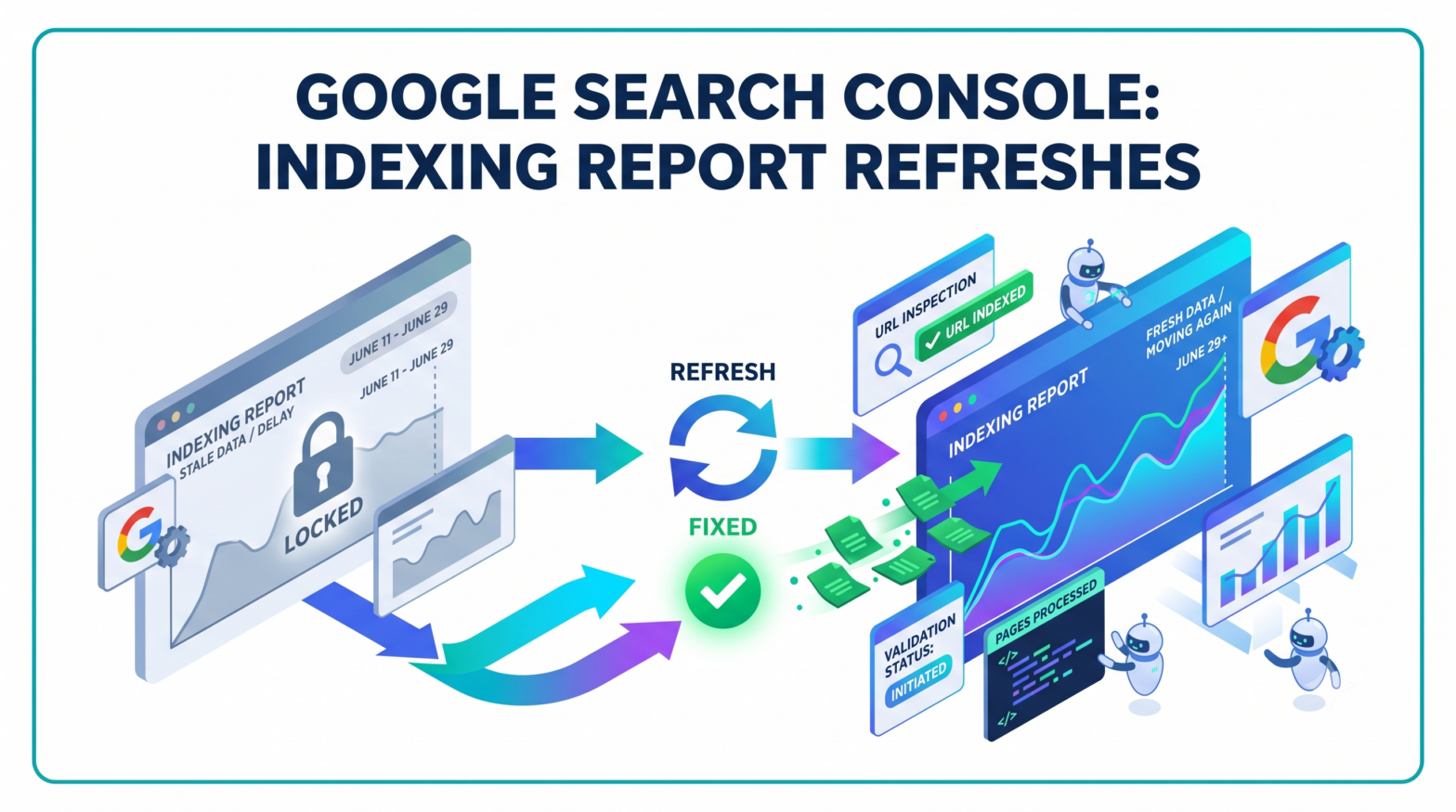
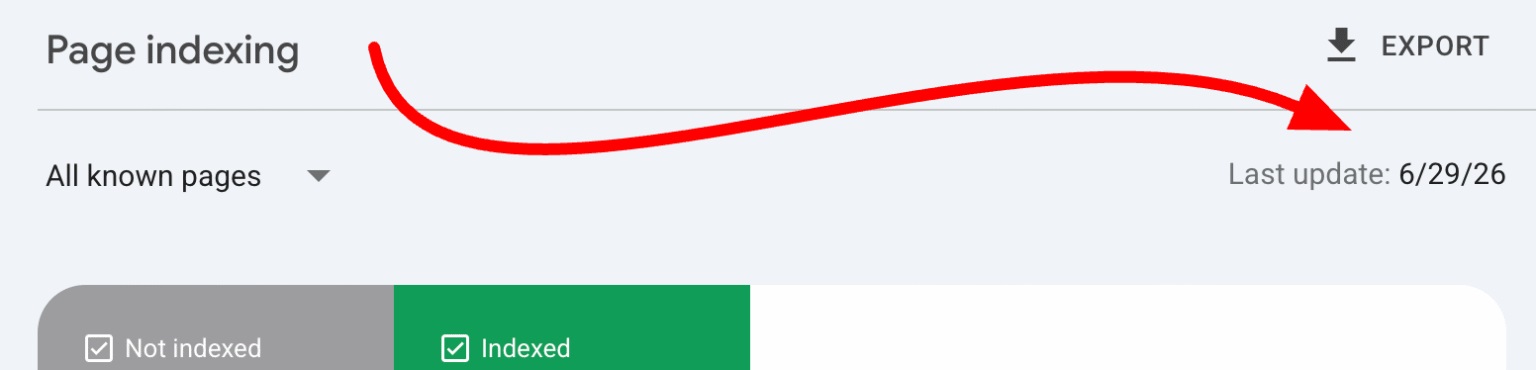
The report is now showing fresher data again, with monitoring across the SEO industry pointing to an update through June 29, 2026, after the report had been stuck around June 11.
For marketers, publishers, agencies, and developers, the fix is not a ranking update. It is a reporting update. But when teams are debugging traffic drops, migrations, new templates, canonical changes, or crawling problems, stale reporting can still distort decisions.
A Reporting Delay Can Look Like An Indexing Problem
The Page Indexing report in Google Search Console is designed to show which pages Google has indexed and which pages were not indexed, along with reasons Google discovered during crawling or processing. Google’s own documentation describes the report as a way to understand index status across a site, review why pages are excluded, and inspect affected example URLs.
That makes the report one of the first places SEOs check when a site launch, redesign, content migration, or large publishing push does not perform as expected.
A delay changes the readout.
If a site owner published 200 new landing pages after June 11, the Page Indexing report would not immediately show whether those URLs had moved into the index. If a developer fixed a canonical error, the report might still show the old issue. If an ecommerce site changed faceted navigation controls, the report could lag behind Google’s latest crawl behaviour.
That gap is where bad decisions happen.
Teams may start undoing fixes, resubmitting URLs, rewriting robots.txt rules, or changing internal links before the data catches up. In technical SEO, a stale chart can create the appearance of a new problem even when Google’s actual indexing systems are moving separately from the visible report.
Search Console is still essential. It is not real-time instrumentation.
The Page Indexing Report Is A Diagnostic Tool, Not A Live Crawl Feed
Google’s documentation makes a clear distinction between report data, validation, and live inspection workflows. The Page Indexing report groups index status across known URLs, gives example URLs for specific issues, and allows users to inspect individual URLs from the details view.
That setup is useful for spotting patterns.
It is less useful for minute-by-minute confirmation.
The report can tell an SEO team that pages are blocked by robots.txt, marked with a noindex directive, duplicated under another canonical, discovered but not indexed, or crawled but not indexed. It can also show whether those issues are growing or shrinking over time.
But Google also notes that validation takes time. When a user clicks Validate Fix, Search Console begins checking affected URLs, and that process can take several days or longer. Google says validation typically takes up to about two weeks, with some cases taking longer.
That detail matters right now.
A refreshed Page Indexing report does not mean every fix made during the delay has already been fully processed. It means teams can start comparing fresher aggregate data against live URL Inspection results, server logs, sitemap submissions, and actual search performance again.
Those checks should not all be collapsed into one chart.
Search Console’s Own Anomaly Page Shows The Limits Of Reporting Confidence

Google maintains a Search Console data anomalies page for known events that may affect report data. The page explains that changes in aggregation methods, logging errors, or other events can create dips or bumps in charts, and it records known issues from recent months.
As of the latest public anomaly page reviewed for this article, Google lists no recent issues under the Page indexing Report section.
That does not erase the practical disruption caused by the reporting delay observed by SEOs. It does clarify something important: Search Console reporting and Google’s underlying crawling, indexing, and ranking systems should not be treated as the same thing.
A reporting lag is not automatically a deindexing event.
That distinction becomes more important as SEO reporting gets more fragmented. Marketers are already trying to reconcile classic organic traffic data with AI search surfaces, changing click behaviour, and evolving Search Console reporting. TechWyse recently covered how Google is expanding Search Console measurement around AI experiences in Google Adds AI Search Reports & Opt-Out to Search Console, a shift that puts more pressure on teams to understand what each report can and cannot prove.
The indexing report delay sits inside that larger problem.
Search visibility is no longer judged by one metric, one chart, or one dashboard. The more important Search Console becomes, the more dangerous it is to read every line movement as a confirmed site issue.
The Risk Is Highest For Sites Already In Motion
Not every site felt the delay equally.
A static brochure site with no recent publishing activity may have had little reason to watch the Page Indexing report daily. A news publisher, ecommerce site, job board, marketplace, SaaS content hub, or franchise website would feel the gap more sharply.
Fresh pages matter more when publishing velocity is high.
For publishers, the delay could complicate checks around whether Google is discovering new articles quickly enough. For ecommerce teams, it could slow investigation into product or category pages that were excluded after template changes. For agencies, it could create reporting friction with clients expecting confirmation that fixes were processed.
Technical SEO work often happens under time pressure. A migration has dates. A product launch has dates. A seasonal campaign has dates.
When the index status report is stale, teams need to lean harder on secondary checks. Google’s URL Inspection tool can test individual URLs. XML sitemaps can show submitted URL sets. Crawl logs can confirm whether Googlebot is reaching key templates. Performance data can show whether indexed pages are earning impressions, although that does not prove indexation for every URL.
For indexing issues tied to individual pages, nuance matters. TechWyse previously reported on Google’s explanation of the “Page indexed without content” status in Google Explains ‘Page Indexed Without Content’ Error, where server-side and CDN-level access problems can create misleading assumptions about rendering. That kind of issue cannot be solved by staring at an aggregate chart alone.
The same principle applies here.
A fresh report is useful. A fresh report is not a substitute for diagnosis.
Marketers Should Reset Baselines Before Reporting July Performance
The practical implication is straightforward: SEOs and marketers should avoid using the stale June window as a clean baseline for July indexing performance.
Any dashboards, client reports, or internal SEO health checks that relied on Page Indexing data from the delayed period should be reviewed against the refreshed report date. Teams should separate actual URL-level issues from reporting lag, especially before escalating concerns about traffic loss, crawl budget, canonical handling, or widespread deindexing.
This is especially important for sites that made major technical changes during the delay.
If an SEO team changed templates, robots directives, canonical tags, redirects, sitemap logic, pagination rules, or internal linking between June 11 and June 29, the refreshed data should be reviewed carefully before calling the outcome good or bad. The first clean comparison should be built from current Search Console data, URL Inspection checks, log analysis where available, and actual Search performance patterns.
That is basic measurement discipline. Not panic.
The same thinking applies to site moves. Google has already tightened how Search Console should be used during domain migrations, including Change of Address handling across domain variants, as TechWyse covered in Google Updates Domain Migration SEO Rules. Indexing reports are part of that workflow, but they are only one part.
The Page Indexing report is updating again. SEOs can go back to reading the chart, reviewing exclusion reasons, exporting affected URL samples, and validating fixes through the normal Search Console workflow.
The report is useful again because the data is moving. The next mistake would be pretending it moves in real time.