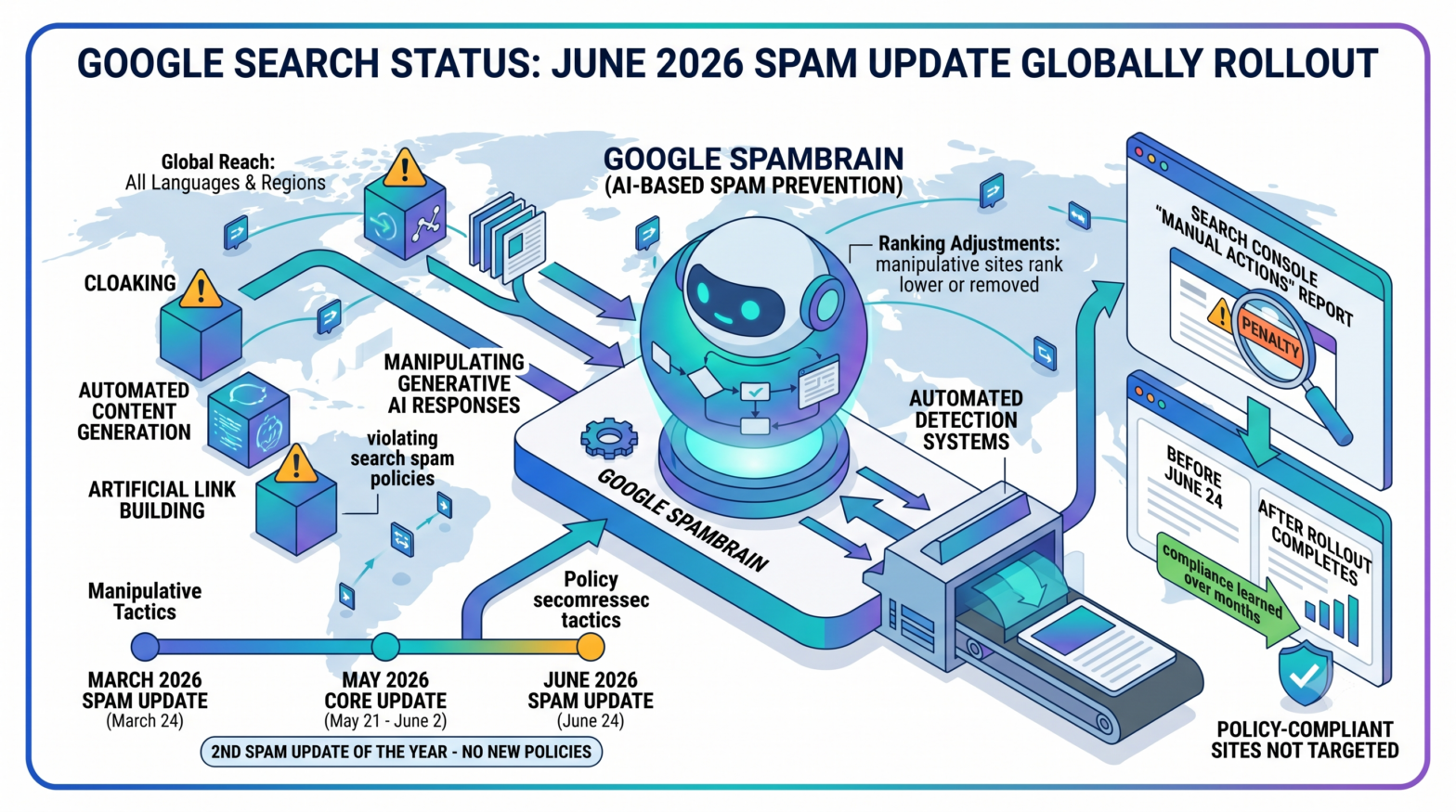
Google search rankings are changing for websites that rely on manipulative tactics, effective immediately. The Google Search Status Dashboard confirmed on June 24, 2026, at 9:03 a.m. PDT that the June 2026 spam update began rolling out globally, applying to all languages and regions, with the rollout expected to take a few days to complete.
What the Update Covers
This is the second spam update of 2026, and Google announced no new spam policies alongside it. Google described the update as "a normal spam update", the same language it used when releasing the March 2026 spam update. The update targets sites violating Google's search spam policies, but does not target link spam, site reputation abuse, or certain other specific policies.
Spam updates differ from core updates. Google's spam updates documentation describes them as improvements to the automated systems that detect spam, including SpamBrain, its AI-based spam-prevention system. Core updates, by contrast, are broad changes to Google's ranking systems.
Update Timeline in Context
The June 2026 spam update is the second confirmed spam enforcement action of 2026, arriving approximately three months after the March 2026 spam update, which launched on March 24 at 12:18 PDT and completed in approximately 19.5 hours, the fastest spam update on record. Prior to that, the August 2025 spam update ran for nearly four weeks.
The May 2026 core update ran from May 21 through June 2, 2026, preceded by the March 2026 core update, which ran from March 27 through April 8, 2026. The June spam update arrives less than four weeks after that core update was completed, continuing what has been a compressed update cycle in 2026.
On May 15, 2026, Google updated its spam policies page to state explicitly that spam includes attempting to manipulate generative AI responses in Google Search, the first time AI manipulation was named directly in the policy. No companion blog post accompanied the June update announcement, and the Google Search Status Dashboard entry remains the only official confirmation as of publication.
How Google's Spam Systems Work
Google's spam policies documentation states that while its automated detection systems operate continuously, the company periodically makes notable improvements to how those systems function and designates those improvements as named spam updates. SpamBrain is Google's AI-based spam-prevention system, which is periodically improved to better detect both existing and new types of spam.
Sites that see a change after a spam update should review Google's spam policies to confirm compliance. Sites that violate those policies may rank lower in results or not appear in results at all. If changes are made, improvement may follow only after Google's automated systems learn over a period of months that the site complies.
In the case of a link spam update, one that specifically targets link spam, making changes may not generate an improvement. When Google's systems remove the effects spammy links may have had, any ranking benefit those links previously generated is lost. Google has not confirmed whether the June 2026 update specifically deals with link spam.
Diagnostic Considerations for Site Owners
The May 2026 core update, which completed on June 2, was notably turbulent. Sites that were already experiencing volatility from that core update cycle may find it difficult to isolate the June spam update's effect.
Website owners are advised to monitor performance and avoid making major changes until the update has fully rolled out. For sites that do observe ranking movement, the relevant comparison is ranking data from before June 24 against data collected at least several days after the rollout completes and the dashboard entry updates to reflect completion.
For digital marketers managing client sites, the practical implication is straightforward: sites built on policy-compliant content and legitimate SEO practices are not the intended target of spam updates. Sites that have used tactics such as cloaking, automated content generation, or artificial link building should audit against Google's current spam policies before any ranking losses are attributed to other causes. Google's Search Console Manual Actions report is the appropriate first diagnostic step to determine whether the update triggered an automated penalty.
Google will update its Search Status Dashboard when the rollout is entirely finished.