Google has been giving its AI permission to rewrite product titles. Advertisers can finally see what it has been saying.
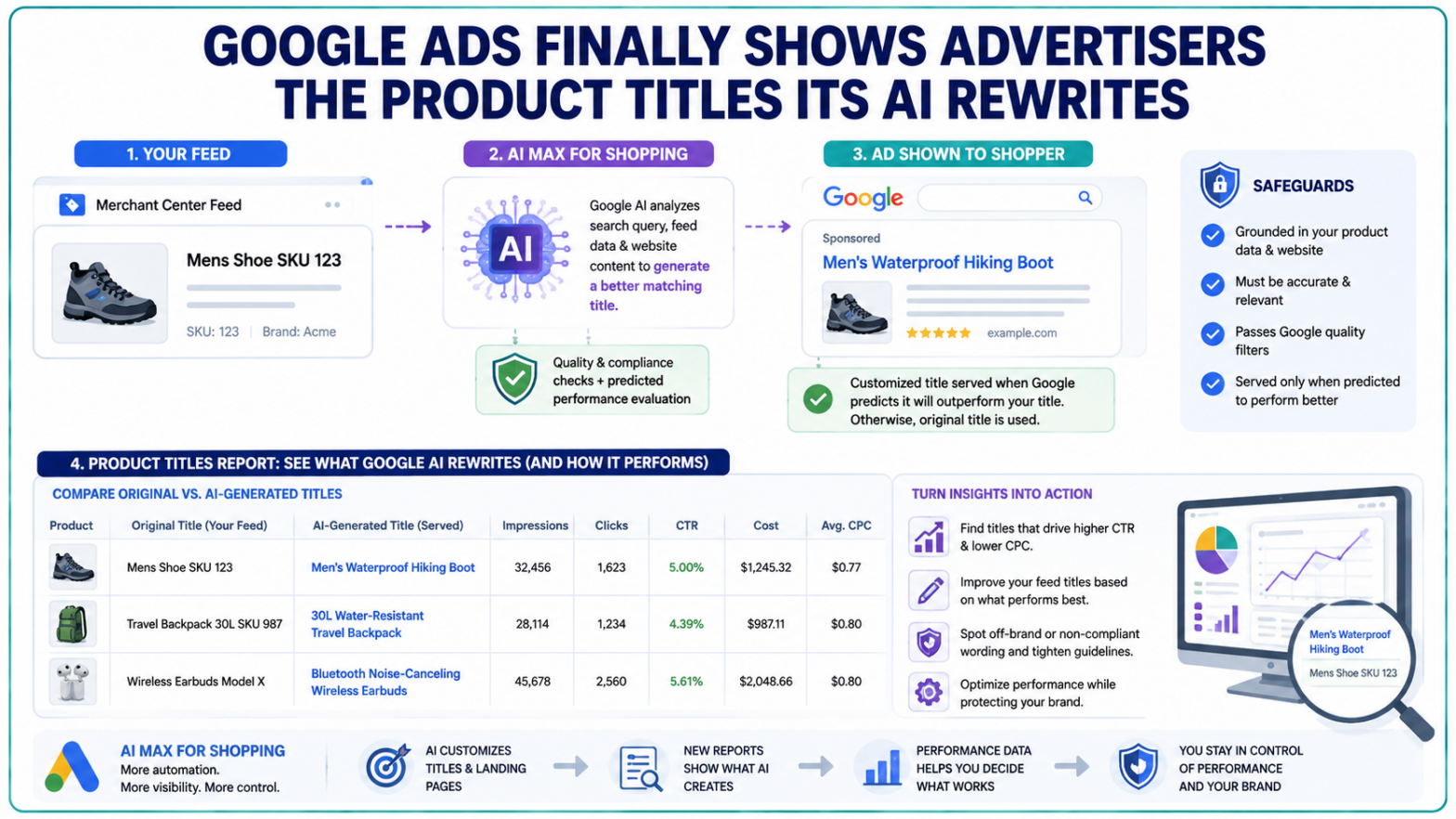
A new Product titles report is appearing in Google Ads for AI Max for Shopping campaigns, exposing the customized titles Google's systems generate alongside the original product copy supplied by the merchant. More importantly, the report attaches performance data to those variations, giving retailers a way to judge whether Google's version actually earned the creative control it was given.
That closes a significant visibility gap inside Google's increasingly automated Shopping stack.
Google's own documentation now lists the Product titles report as part of the reporting available for AI Max for Shopping, alongside asset, landing page, and search term reporting.
Google Can Change the Product Title Before the Shopper Sees It
The title sitting in a Merchant Center feed is no longer guaranteed to be the title served in an ad.
With text customization enabled in AI Max for Shopping, Google AI can dynamically generate another product title based on the shopper's query and intent. Google says the system uses information from the Merchant Center feed and website content, combining extraction techniques with generative AI.
Google provides a deliberately simple example. A feed title such as "Mens Shoe SKU 123" could become "Men's Waterproof Hiking Boot" when the system determines that description better matches what someone is searching for.
The original version remains available. Google's documentation says a customized title only serves when its systems predict that it will outperform the advertiser-provided title. If Google does not expect an improvement, the original title can be used instead.
That makes AI-generated titles less like a permanent feed rewrite and more like dynamic ad creative.
For retailers, though, the distinction only goes so far. The shopper sees the title Google chooses, not necessarily the language the brand approved in its product catalogue.
The Missing Piece Was Knowing Which Version Actually Ran
Giving an algorithm creative latitude becomes much harder to govern when the advertiser cannot easily inspect the resulting creative.
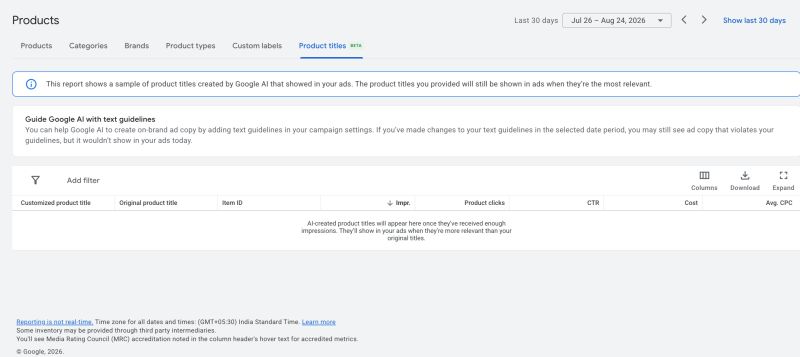
The new Product titles report addresses that problem.
Advertisers can see the customized product title generated by Google next to the original title submitted through their feed. The surfaced report also includes impressions, product clicks, click-through rate, cost, and average CPC, allowing teams to compare how Google's generated wording performs when it is served.
That turns title customization into something advertisers can actually audit.
A retailer might find, for example, that Google repeatedly emphasizes a material, use case, or product characteristic that the original feed title buries. If that generated version produces stronger engagement, the data may expose weaknesses in the retailer's own product title optimization.
The opposite scenario matters just as much.
A generated title can perform well numerically while still introducing wording a brand would rather not use. Retailers with strict naming conventions, franchise requirements, legal review processes, regulated claims, manufacturer rules, or carefully managed brand language have considerations that sit outside CTR and CPC.
Performance reporting can identify what worked. It cannot decide whether the wording should have been used in the first place.
Brand Compliance Is Now a Reporting Problem Too
Google says generated titles pass quality safeguards before serving.
According to its AI Max documentation, generated wording is checked against the advertiser's product data, must remain grounded in the actual product offering, and passes quality filters intended to produce natural and professional copy. Google's system also evaluates predicted performance before replacing the original title.
Those controls reduce obvious errors, but they do not replace an advertiser's own governance.
"Accurate" and "brand-approved" are not interchangeable.
A title can correctly describe a product and still use terminology that conflicts with merchandising standards. It could place the wrong emphasis on a product feature, drop language a manufacturer expects to appear, or phrase an attribute differently from the wording used elsewhere on the site.
That tension is becoming more relevant as Google Shopping moves further away from static feed presentation.
AI Max for Shopping can already customize product titles and expand landing-page selection. Google says text customization is designed partly for newer search environments such as AI Overviews and AI Mode, where shoppers may enter longer, conversational queries rather than concise product searches.
A static title built around a SKU and product category may not answer those queries well. Google's solution is to rewrite the message dynamically.
The Product titles report gives advertisers a clearer view of the trade-off they are making.
Google Is Pairing More Automation With More Inspection
The reporting update fits a broader pattern in Google Ads.
Google is automating more decisions that advertisers once handled directly, while gradually adding reports and controls that reveal what those systems did after the fact.
AI Max for Shopping already includes reporting for landing pages, search terms, assets, and product titles. For automatically selected landing pages, Google labels the URL as "Automatically selected." Its asset reporting can also surface combinations created through text customization and Final URL expansion.
The Product titles report extends that philosophy directly into product copy.
It also arrives as Google Ads automation is shifting beyond bidding and targeting into creative decisions. Text guidelines, automatically created assets, AI Max, and feed-driven customization all give Google more freedom to decide what the customer sees.
Reporting becomes the counterweight.
Google itself advises advertisers to allow at least two weeks after enabling AI Max for Shopping before making changes such as adding text guidelines, giving the campaign time to learn and optimize.
That guidance makes the new title-level metrics particularly useful because advertisers can inspect actual generated copy after the system has accumulated meaningful delivery rather than reacting to isolated variations.
Retail Teams Now Have Something Concrete to Audit
For ecommerce marketers, the practical change is straightforward: title reviews no longer stop at the Merchant Center feed.
Teams using AI Max text customization can periodically compare advertiser-provided titles with Google's served variations, then evaluate both performance and compliance. Strong CTR or low CPC can inform future feed work, while repeated off-brand or undesirable wording can signal a need for tighter text guidelines or a reassessment of how much customization the campaign should receive.
The report does not restore full manual control over each impression.
It does something Google Ads automation has often lacked instead: it shows advertisers the words the machine chose, and attaches enough performance data to make those choices measurable.
Google continues to describe AI Max for Shopping as a beta feature. Its documentation now formally includes product-title reporting in the available reporting suite, placing generated product copy alongside search terms, assets, and landing pages as another automated campaign decision advertisers can inspect after delivery.