
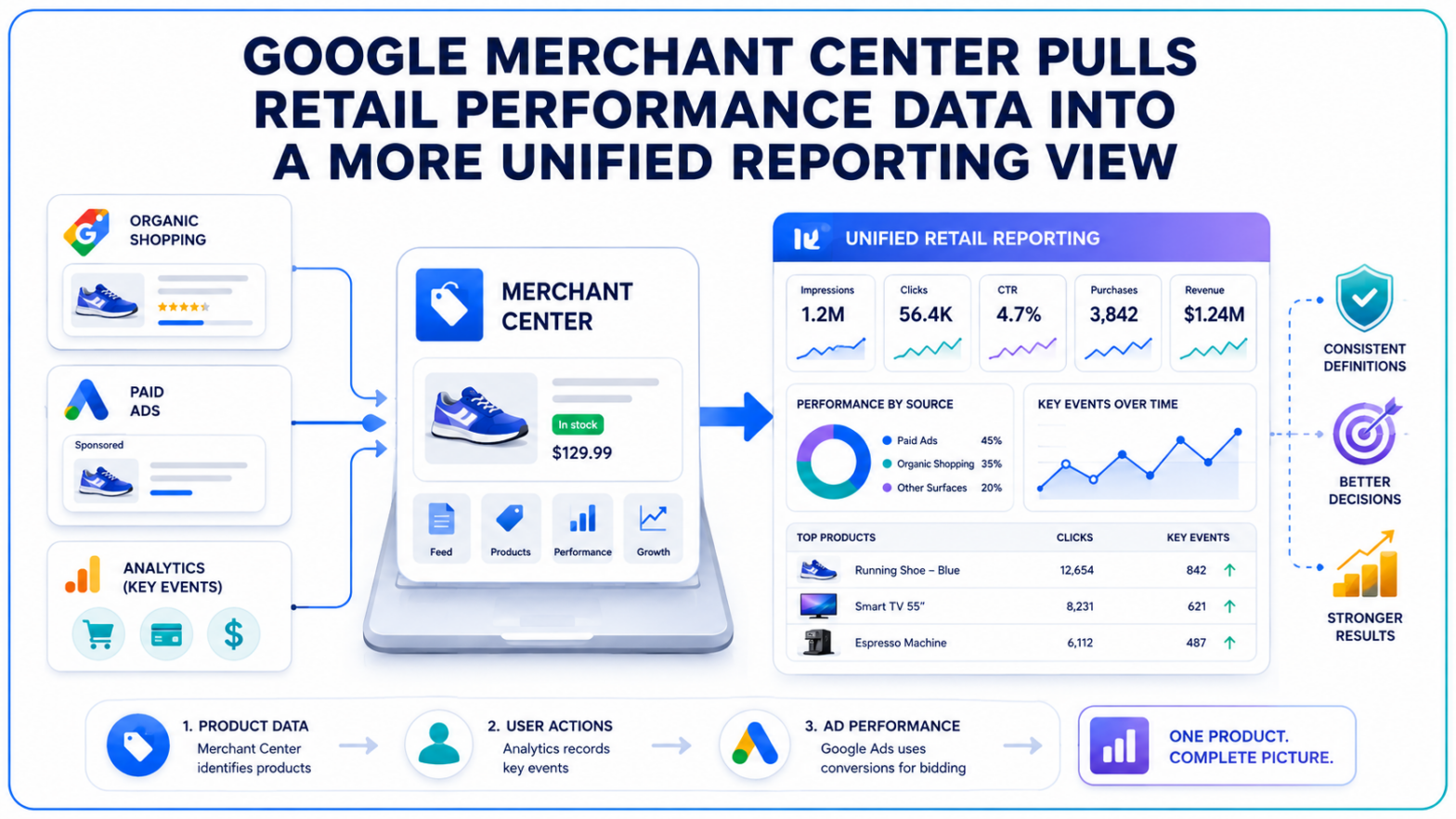
Retail measurement has had a basic problem for years: the product is the same, but the reporting changes depending on where Google shows it.
Merchant Center is starting to close that gap. Google is expanding its reporting model around key events, giving retailers a more consistent way to evaluate important customer actions tied to their products without treating paid ads, organic product listings, Analytics and Merchant Center as entirely separate measurement systems.
The shift does not turn Merchant Center into a replacement for Google Ads or Google Analytics. It does make the product feed increasingly important as a common measurement layer across Google's commerce ecosystem.
Merchant Center Is Becoming More Than a Feed Dashboard
Merchant Center was once largely operational.
Upload the feed. Fix disapprovals. Check pricing. Make sure Google could understand what was in stock.
That job has expanded considerably.
Google's Merchant Center documentation now describes key events as an umbrella measurement concept covering actions important to a retailer's business. Those can include conversions associated with advertising as well as purchases coming from free product listings.
Google made the terminology change after acknowledging that conversions had previously been measured differently between Google Analytics and Google Ads, creating discrepancies for advertisers comparing performance between systems. Merchant Center's former "conversion tracking" terminology has consequently shifted toward "key event" reporting.
For retailers, that distinction matters more than the naming suggests.
A product can now appear through an increasingly complicated mix of free Shopping results, paid placements, AI-powered discovery and campaigns that distribute inventory across several Google surfaces. Reporting each interaction under completely separate measurement definitions makes product-level analysis harder.
The broader direction of Google Merchant Center is toward bringing more of that commerce context into one environment.
The Product Is Becoming the Common Reporting Layer
Google campaigns no longer behave neatly by channel.
Performance Max can distribute ads across Search, YouTube, Display, Discover, Gmail, Maps and Shopping inventory. Google itself positions the campaign type as a way to access its advertising inventory through one campaign rather than managing each surface independently.
The reporting problem follows naturally.
A retailer may care about the performance of a running shoe, television or coffee machine as a single commercial item. Google, however, may expose that product to shoppers through several different experiences before a purchase occurs.
Looking at only the Shopping tab tells part of the story. Looking only at a Search campaign does the same.
Google's move toward shared key-event definitions gives Merchant Center a stronger role in connecting those product interactions to business outcomes. Google says key events recorded in Analytics can be used to create Google Ads conversions, with conversion information shared between Ads and Analytics so marketers can work from consistent data across the two platforms.
That does not eliminate attribution questions. It does reduce one particularly frustrating problem: two Google products disagreeing over what the underlying conversion metric represents.
The change also fits Google's recent push for more Performance Max reporting. Google has spent much of the past year exposing more channel-level information from automated campaigns that were once difficult to dissect.
Merchant Center is approaching the same transparency problem from the product side.
Organic Shopping and Paid Advertising Still Need Separate Reads
Unified reporting can easily be mistaken for interchangeable reporting.
It is not.
Merchant Center explicitly distinguishes key events from conversions. A key event is a broader Analytics concept describing an important user action. A conversion refers specifically to an action being used to measure advertising performance and optimize bidding in Google Ads.
Purchases from organic product results are treated differently again.
Google defines a Merchant Center purchase as a completed transaction after a customer clicks an organic Google result leading to a retailer's product or store experience. Merchant Center's product reporting can currently show metrics including impressions, clicks, click-through rate and purchases.
Retail teams therefore still need to understand where a metric originated before comparing performance.
An increase in purchases attributed to organic product listings is not evidence that paid Shopping efficiency improved. Likewise, stronger conversion value inside Google Ads cannot automatically be interpreted as stronger free-listing performance.
The dashboard may become more consolidated. The traffic sources remain different.
That distinction becomes particularly important as Google adds more automation to Shopping campaigns, where product feeds are increasingly being used for targeting, creative generation and landing-page selection.
Google Is Quietly Standardizing Commerce Measurement
There is a larger measurement strategy behind the Merchant Center changes.
Google Analytics renamed important behavioural conversions as "key events" partly to separate general business actions from Google Ads conversions. Google said the change was intended to create a more consistent definition of conversions between Analytics and Ads.
Merchant Center is adopting that same framework.
Google Analytics can also export purchase and in-app purchase key events resulting from organic-search clicks into Merchant Center. Those events then become available in Merchant Center reporting, using the attribution model configured in the linked Analytics property.
That creates a more connected measurement chain:
Merchant Center identifies the product. Analytics records the user behaviour. Google Ads can use qualifying conversions for campaign reporting and bidding.
The individual systems still have separate jobs, but the definitions moving between them are becoming less fragmented.
For agencies and in-house retail teams, that matters because Google's own reporting environments are also becoming less useful as permanent standalone archives. Recent changes to Google Ads reporting have already made long-term data governance a more important consideration for advertisers maintaining detailed historical performance records.
A unified Google interface is useful. It should not become the retailer's only source of historical truth.
A Cleaner Dashboard Will Not Fix Bad Measurement
For marketers managing ecommerce accounts, the practical change is straightforward: Merchant Center can increasingly serve as a product-level checkpoint between feed visibility, organic performance and important customer actions, while Google Ads remains the place to evaluate paid campaign efficiency and bidding.
Retail teams should make sure Merchant Center, Google Analytics and Google Ads are correctly linked, then check that purchase events, attribution settings and product identifiers remain consistent between systems. A consolidated view is only useful when the events feeding it represent the same customer actions.
Google already allows merchants to create custom reports and dashboards directly inside Merchant Center using metrics such as impressions, clicks and CTR. Those reports can be saved, combined into dashboards and downloaded for deeper analysis.
Now the measurement underneath those reports is becoming more closely aligned with Google's broader advertising and Analytics infrastructure.
That is the bigger change.
Retailers are not getting one metric that explains every channel. They are getting a more consistent framework for following the same products and business outcomes as shoppers encounter them across Google's increasingly connected commerce ecosystem.