
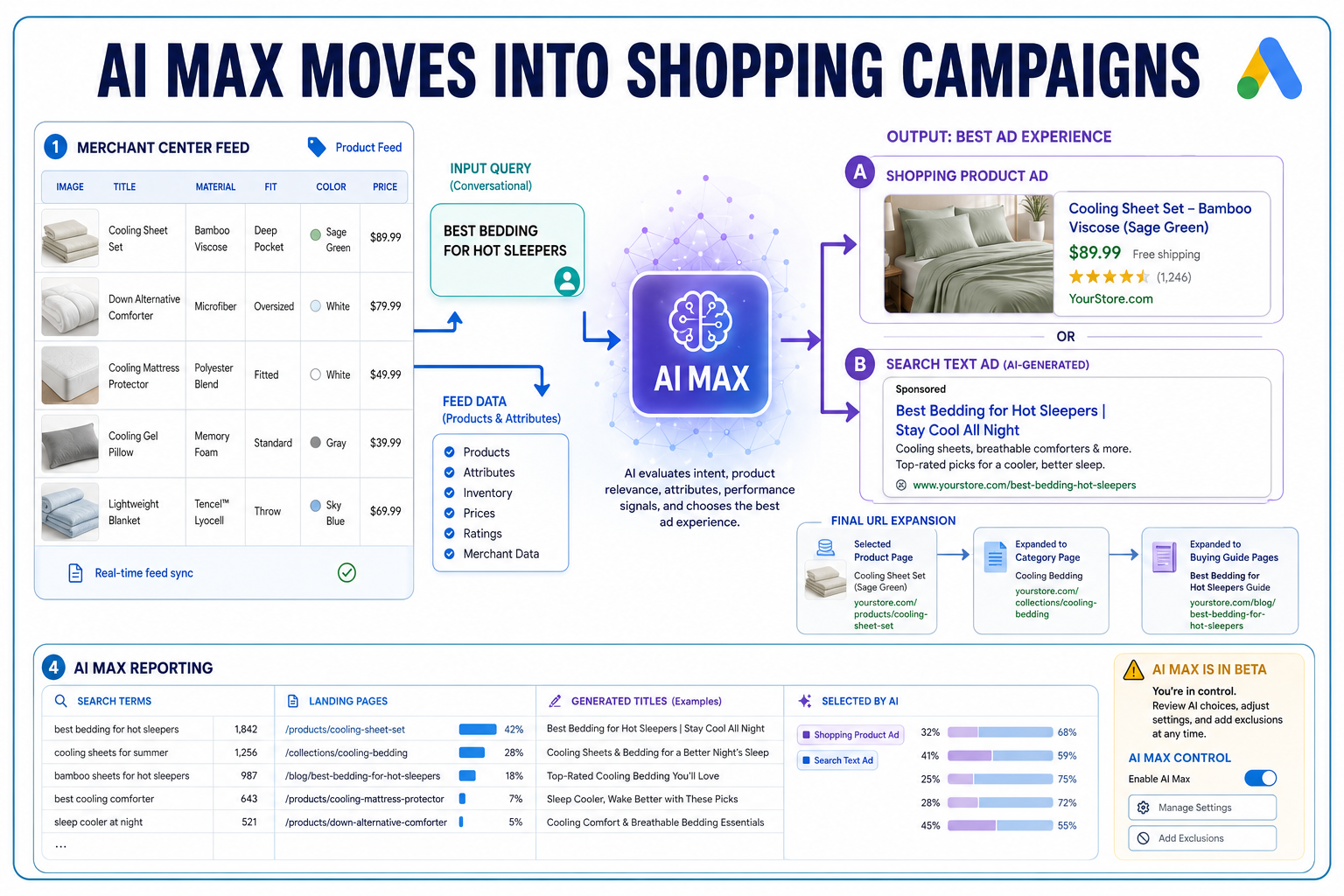
Standard Shopping campaigns are starting to look less standard.
A surfaced Google Ads interface shows AI Max controls appearing inside Shopping campaign settings, and Google’s own Help Center now documents AI Max for Shopping campaigns as a beta suite built for conversational product searches, feed-powered creative changes and expanded landing-page selection.
Shopping Ads Are Being Pulled Into Conversational Search
Google’s AI Max push is no longer confined to Search campaigns.
In its official Help Center documentation, Google describes AI Max for Shopping campaigns as a beta that uses Google AI to connect Shopping ads with people making “complex, conversational searches.” The feature is designed to move Shopping campaigns beyond static product ads that respond mainly to direct product queries.
That shift matters because product discovery is no longer always clean or SKU-specific. A shopper may search for “best breathable bedding for hot sleepers” instead of a brand, product name or exact material. Traditional Shopping campaign matching can struggle when the query describes a need rather than a product.
AI Max for Shopping is meant to close that gap using Merchant Center feed data, website context and Google’s ad automation.
Google separately announced AI Max for Shopping on April 30, saying the feature uses feed details such as fabric softness, material durability and fit to understand product context. The company said retailers already using Shopping campaigns can upgrade in one click while keeping existing product targeting controls and bidding flexibility.
The Beta Adds Text Customization And Final URL Expansion
The core AI Max for Shopping features are text customization and Final URL expansion.
Text customization lets Google AI dynamically adjust product titles or ad copy so the message better matches shopper intent. Google says the system can use Merchant Center feed attributes and website content, then generate titles that are grounded in the advertiser’s actual product data.
That is the delicate part.
For retailers, product titles have long been a feed optimization discipline. They are structured, controlled and often tuned around category, brand, size, material, colour and high-intent product language. AI Max introduces a more fluid version of that logic, where Google can adapt product messaging to the query when it predicts better performance.
Final URL expansion goes further. Instead of sending users only to the product URLs listed in a Merchant Center feed, Google can direct traffic to other relevant commercial pages on the advertiser’s site, such as category pages, new-arrivals pages or editorial buying guides.
Google’s Help Center says Final URL expansion requires text customization to be turned on so ad copy matches the selected landing page. It also says the feature can unlock text ads powered by a Merchant Center feed and dynamic landing pages, allowing Shopping campaigns to show for more research-based searches.
That changes the campaign’s role. A Shopping campaign can start acting partly like a product discovery engine and partly like a Search campaign.
Google Can Choose Between Shopping And Text Formats
The most consequential change may be format selection.
Google’s April announcement says AI Max for Shopping includes Optimal Format Selection, which automatically chooses whether to show a text ad or a Shopping ad based on what is most relevant to the shopper’s needs. The recently shared screenshots describe the same broad capability: Google may decide whether the query is better served by a product ad or text ad.
For advertisers used to the clearer boundaries of Standard Shopping, that is a meaningful expansion.
Shopping ads traditionally leaned on product feed attributes, images, prices and Merchant Center eligibility. Text ads lived in Search campaign structures, with different creative controls and query logic. AI Max for Shopping begins to mix those behaviours inside the Shopping campaign environment.
Google is positioning the feature as an upgrade rather than a forced migration. Its documentation says advertisers can use both text customization and Final URL expansion, or choose text customization only. The April product announcement also says advertisers can turn off Final URL expansion at any time to restrict delivery to Shopping ads.
That control will matter for retailers with strict landing-page rules, regulated product categories, complex promotions or carefully segmented campaign structures.
Feed Quality Becomes A Larger Creative Input
Merchant Center data is becoming more than campaign fuel. It is becoming creative source material.
Google’s Help Center says AI Max for Shopping treats a feed as a deeper product database, extracting attributes such as waterproofing, stability or store-pickup availability to match complex queries. Google also says generated titles are checked against the advertiser’s product offerings and will only serve when predicted to perform better than the uploaded title.
For ecommerce teams, the practical implications are clear: weak feed data now limits more than Shopping eligibility. Sparse titles, missing attributes, thin descriptions and inconsistent product taxonomy can affect how well Google’s AI understands the product and how safely it can customize ads. Feed optimization becomes tied to query matching, creative relevance and landing-page selection at the same time.
That connects with Google’s broader AI commerce direction. TechWyse recently covered how Merchant Center is gaining AI shopping insights, giving retailers more visibility into product discovery across AI Mode, AI Overviews and Gemini. AI Max for Shopping is the paid-media side of the same movement: product data is being used to answer broader shopping intent, not just populate a product box.
Reporting Will Need A Different Read
Google has published separate reporting documentation for AI Max for Shopping campaigns.
The available reports include product titles, assets, landing pages and search terms. Google says the landing pages report will show advertiser-provided URLs and Final URL expansion URLs, with a “Selected by” column identifying pages automatically selected by Google AI.
The asset report can show combinations of assets and expanded final URLs, including advertiser-uploaded assets and assets created through text customization. Advertisers can remove assets that do not align with their business or that do not meet requirements.
Google also advises waiting at least two weeks after enabling AI Max for Shopping before making changes such as adding text guidelines, so the campaign has time to learn and optimize.
That reporting layer will be important because AI Max changes what advertisers need to audit. It is no longer enough to review product-level performance alone. Teams will need to check which search terms are being captured, which landing pages Google selects, which generated titles appear, and whether text formats are sending shoppers into the right part of the site.
TechWyse has already reported on Google’s broader changes to Performance Max product reporting, where expanded measurement created new interpretation challenges for advertisers. AI Max for Shopping brings a similar theme into Standard Shopping: more reach and automation, paired with more need for disciplined reporting.
Standard Shopping Control Is Not Disappearing Yet
The appearance of AI Max inside Shopping campaign settings does not mean Standard Shopping campaigns are being retired.
Google’s documentation still frames AI Max for Shopping as a beta feature and an optional optimization layer for Shopping campaigns. Performance Max remains Google’s cross-channel campaign type for retailers, while AI Max for Shopping is focused on modern Search behaviour, feed-based text ads and Shopping campaign enhancement.
That distinction is important. Google is not asking every retailer to abandon Shopping campaign structures for Performance Max. It is giving Shopping campaigns more of the automation that once sat mainly inside Performance Max and AI Max for Search.
The pattern is consistent with Google’s recent Ads roadmap. Dynamic Search Ads are being absorbed into AI Max for Search, a move TechWyse covered in its reporting on Google’s DSA migration to AI Max. Shopping now appears to be following the same product philosophy: keep the familiar campaign shell, then add AI-powered matching, creative and landing-page decisions inside it.
For retailers, the beta turns Standard Shopping into a more flexible but less predictable campaign environment. Google has documented the feature, the controls and the reporting. The operational work now sits with advertisers: checking feed quality, URL coverage, generated assets and the gap between incremental reach and campaign intent.