

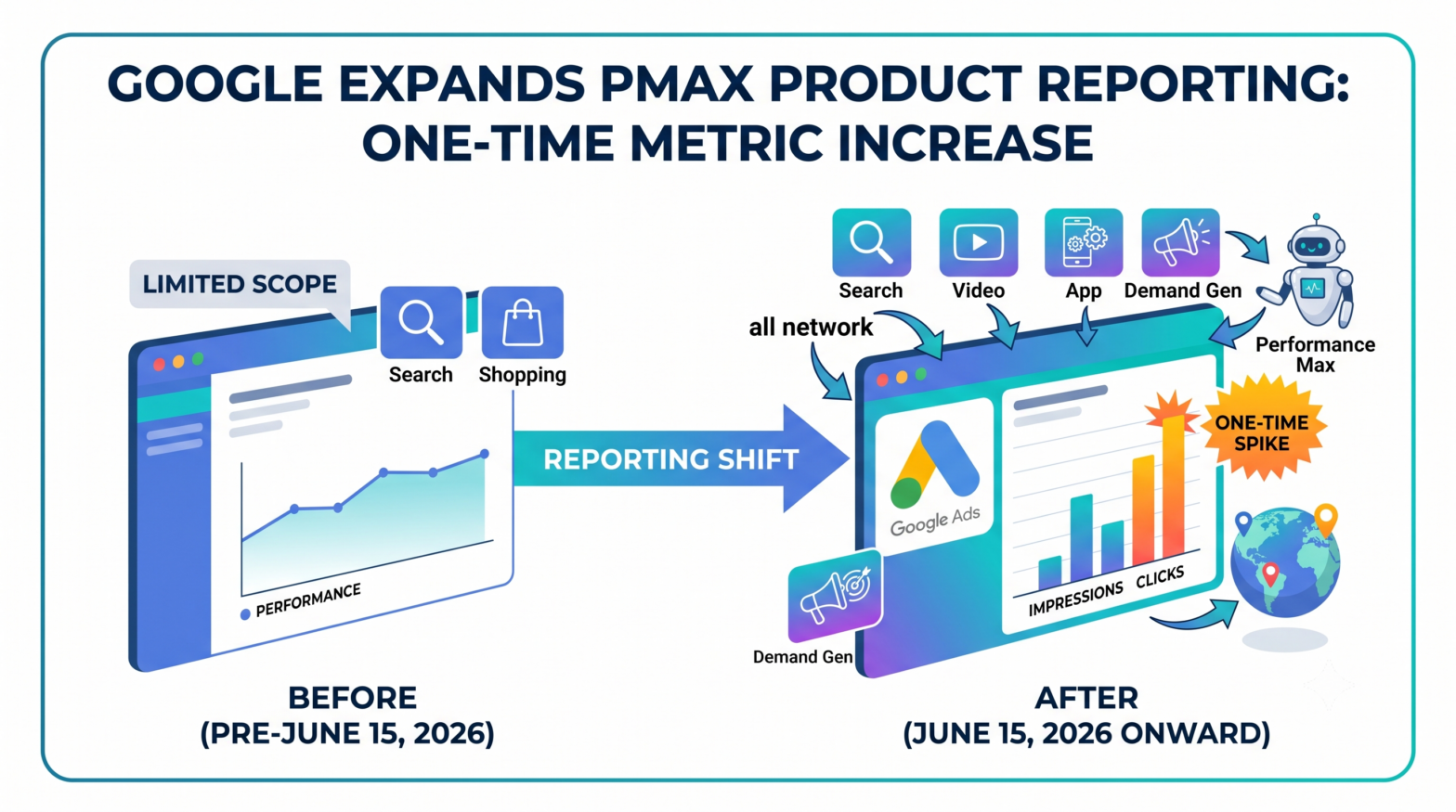
Google has changed what advertisers see when they pull product-level reports for Performance Max campaigns. As of June 15, 2026, Google expanded product reporting to cover all eligible networks, a change the company disclosed in its Google Ads Help Center under "About Product Reporting" and confirmed via the Google Ads Developer Blog in an April 2026 post titled Product reporting changes for Google Ads starting June 15, 2026.
What Changed in Product Reporting
Previously, product performance metrics such as cost and conversions were only available for products included in Performance Max ads serving on Search networks and Standard Shopping campaigns. That scope has now broadened significantly.
Advertisers will now find a comprehensive set of metrics for their products across campaigns that use Google Merchant Center. This includes data for all networks in Performance Max campaigns, as well as metrics for Video, App, and Demand Gen campaigns.
Starting June 15, 2026, the Google Ads API began transitioning product reporting to include data from all Performance Max networks. The change applies to the Products tab in Google Ads and affects how performance data is aggregated across an advertiser's account.
Why Reported Metrics Appear to Have Spiked
Advertisers reviewing recent account data may notice sudden increases in impressions, clicks, and other top-line metrics. Google's Help Center documentation is explicit about the cause: this may cause a one-time increase in metrics such as impressions, clicks, and more for Performance Max campaigns only.
This change can lead to a noticeable, one-time spike in key metrics such as impressions and clicks, not because the account's performance has suddenly improved, but because the reporting metrics now capture a wider range of data. The underlying campaign activity has not changed; the measurement perimeter has.
This distinction is consequential for accounts being reported against historical baselines. Data recorded before June 15 reflects only Search network and Standard Shopping activity, while data from June 15 onward reflects the full network scope. The two datasets are not directly comparable without segmentation.
Scope of the Update: Which Campaigns Are Affected
The update covers multiple campaign types connected to Google Merchant Center. The update offers comprehensive performance metrics across all campaign types and channels, including Shopping, Video, App, and Demand Gen.
The update introduces expanded metrics for the `shoppingproduct` resource and consistent reporting through `shoppingperformance_view`, ensuring all Google Merchant Center campaigns are covered. For advertisers using the Google Ads API to pull product reports programmatically, schema-level changes accompany the UI update.
How Advertisers Can Isolate the Data
Google's Help Center documentation recommends a specific filter for separating network-level activity within expanded reports. Advertisers can use the Network (with search partners) filter to view conversions and cost at the channel level for specific products.
Network-level analysis allows advertisers to segment performance by network to see which channels, for example, YouTube versus Search, drive the most engagement or conversions for specific products. This segmentation is the primary tool for distinguishing pre-existing Search performance from activity newly surfaced by the expanded reporting scope.
Practical Implications for Campaign Reporting
For agencies and in-house teams managing month-over-month Performance Max reporting, the June 15 change introduces a hard break in historical continuity for product-level metrics. Any report comparing impressions, clicks, or cost at the product level across a date range that spans June 15 will reflect two different measurement methodologies. Annotating this date in dashboards and appending a footnote to client-facing reports is standard practice when a platform changes its attribution or reporting scope mid-period. Analysts should also verify whether automated alerts tied to metric thresholds have been triggered by the reporting expansion rather than by actual changes in campaign delivery.
Google confirmed in its Help Center documentation that the one-time metric increase applies to Performance Max campaigns only and is a direct consequence of the expanded data scope, not of any change to how the underlying campaigns serve ads.