
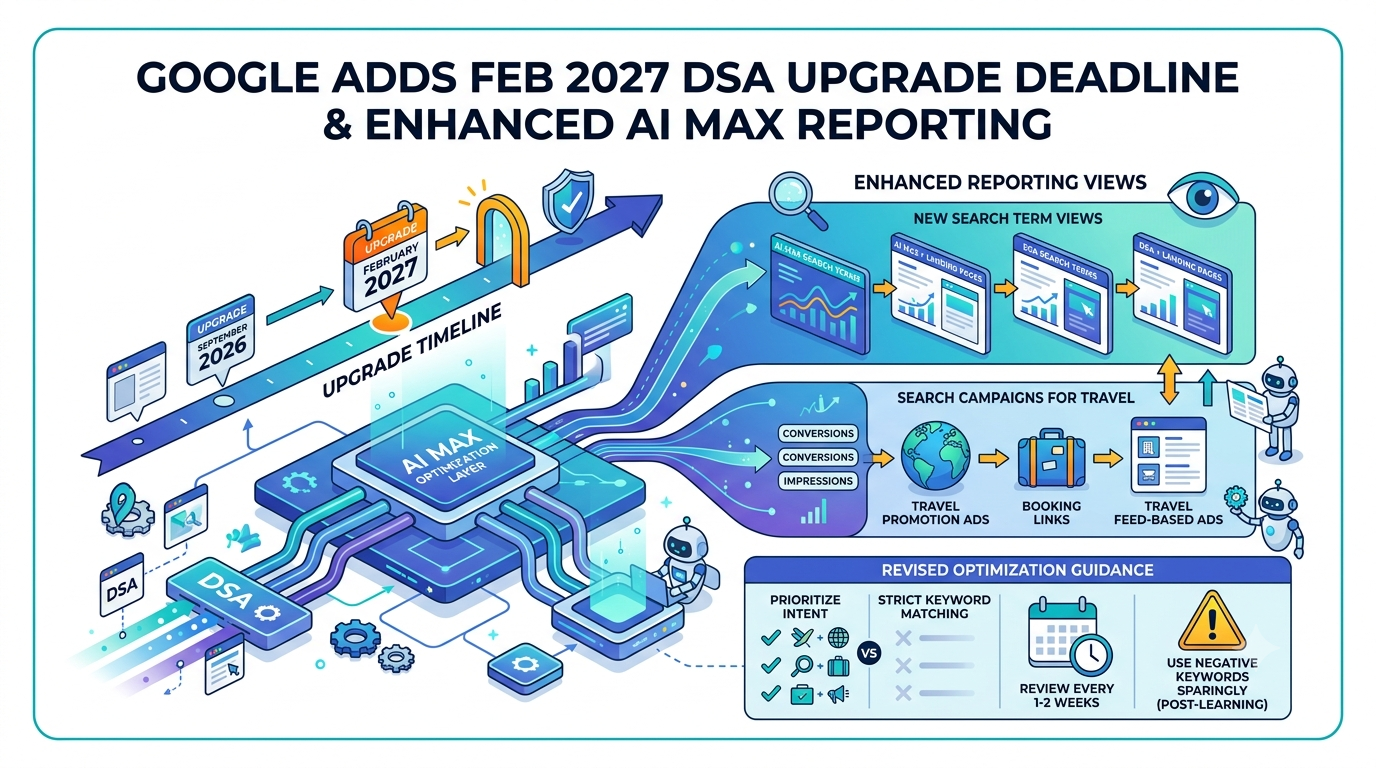
Paid search advertisers running Dynamic Search Ads now have a hard-coded retirement date embedded directly in Google's official reporting documentation. Google's updated help page for AI Max for Search campaigns, "About reporting in AI Max for Search campaigns," states that starting in February 2027, campaigns using Dynamic Search Ads will automatically be upgraded to AI Max. The changes to the help document include documentation of the DSA-to-AI Max deadline, more information on understanding reports, a new section on navigating and interpreting Search Campaigns for Travel performance reports, and updates to optimization guidance focused on intent and regular review cadence.
The documentation update introduces no new product features. Its significance is procedural: the February 2027 deadline, previously communicated through blog posts and liaison announcements, is now formalized in the primary help resource advertisers use to manage AI Max campaigns.
The February 2027 DSA Deadline in Context
The DSA automigration is now set for February 2027, while Automatically Created Assets and campaign-level broad match campaigns remain on the original September 2026 migration timeline.
Google extended the deadline for automatically upgrading DSA campaigns to AI Max from September 2026 to February 2027, a five-month delay driven by advertiser feedback, while simultaneously restoring the ability to create new DSA campaigns as of June 15, 2026. The announcement was published on June 11, 2026, on the Google Ads Developer Blog by Bob Hancock of the Google Ads API Team. Google Ads Liaison Ginny Marvin confirmed the extension on X on June 12, 2026.
Google said the ability to create new DSA campaigns will be removed again in January 2027, immediately before the February 2027 automigration begins. When DSA campaigns are automatically migrated in February 2027, Google states legacy settings will be preserved as closely as possible, existing URL controls will carry over, and all three AI Max features will be enabled by default.
New Reporting Views in the Search Terms Report
The updated documentation introduces four distinct views within the search terms report. Advertisers can now analyze performance across search terms, search terms and landing pages from AI Max, search terms from Dynamic Search Ads, and search terms and landing pages from Dynamic Search Ads.
Google also clarified that search term reports show where users are directed after clicking an ad and highlighted new options for excluding underperforming search terms or landing pages through negative keywords and negative URLs.
AI Max includes improved reporting to give advertisers more transparency into how the AI is performing. The `ai_max_search_term_ad_combination_view` report provides data on performance for combinations of search terms, headlines, and landing pages, showing which search queries triggered ads and how those specific combinations performed.
At the bottom of the keywords report, two aggregate rows provide AI Max-specific performance totals. The first captures total traffic from broad match keywords created by AI Max. The second captures total traffic from search queries matched through landing pages or assets, outside of keyword targeting.
Travel Campaign Reporting Gets a Dedicated Section
Google introduced a new section dedicated to Search Campaigns for Travel. The documentation explains how reporting consolidates performance data across multiple campaign components into a unified view, helping advertisers evaluate search terms, inventory performance, and conversion outcomes. Travel advertisers can also segment reports by ad format to compare performance across Travel Promotion Ads, Booking Links, and Travel Feed-based ads.
Search Campaigns for Travel brings travel ad formats and campaign management features into Search, unifying how campaigns are managed and helping to boost performance and reach. Advertisers can use the format with Travel Promotion Ads or Booking Links to streamline workflows or leverage existing features and provide enhanced control.
Revised Optimization Guidance
The updated best practices place greater emphasis on intent-based targeting rather than strict keyword matching. Google's documentation now advises advertisers to prioritize conversion goals over keyword relevance, to review search term and item group performance every one to two weeks, and to use negative keywords sparingly to avoid limiting the benefits of AI-driven intent matching.
Google's documentation also specifies that advertisers should wait at least two weeks after enabling AI Max on a new or existing campaign before making changes such as adding negative keywords, to allow the system sufficient time to learn and optimize.
What This Means for Paid Media Teams
The addition of the February 2027 auto-upgrade deadline to official reporting documentation signals that Google considers the transition timeline settled. Paid media teams reporting on Search campaign performance to clients should account for the fact that DSA and AI Max search term data now appear in separate views within the same report interface, a structure change that affects how attribution is read and communicated. Campaigns using Automatically Created Assets and the campaign-level broad match setting will continue to be auto-upgraded starting in September 2026, meaning some accounts will see AI Max changes before the February 2027 DSA deadline. Teams managing mixed-format accounts should audit which campaign components fall under each timeline before the September cutoff.
With hundreds of thousands of global advertisers already scaling their Search campaigns with AI Max, Google confirmed that AI Max is moving out of beta, with improved performance quality across targeting and creative capabilities, along with more enhanced controls.