

Dynamic Search Ads are not disappearing as quickly as advertisers were told.
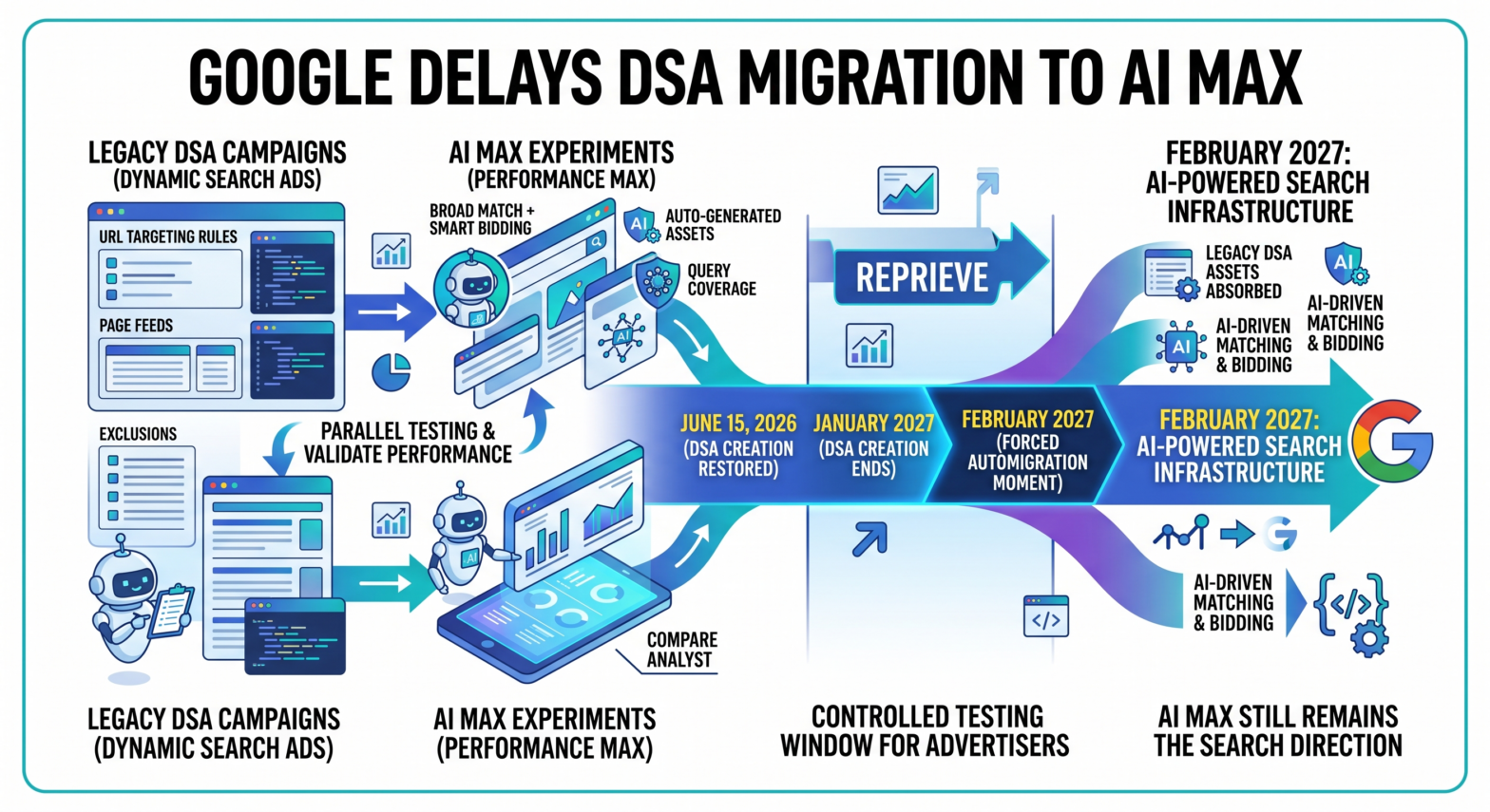
Google has pushed the automatic migration of DSA campaigns to February 2027 and restored the ability to create new DSA campaigns starting June 15, 2026. The delay gives paid search teams more time to test AI Max, preserve working campaign structures, and avoid being pushed into a rushed transition during the original September timeline.
Google confirmed the change in a June 11 post on the Google Ads Developer Blog, stating that DSA automigration is moving from September 2026 to February 2027. The company also said DSA campaign creation is being restored after advertisers had been preparing for a faster shutdown of the legacy format: https://ads-developers.googleblog.com/2026/06/dynamic-search-ads-dsa-automigration.html
The September Deadline Is No Longer The Deadline
The most important change is the timeline.
Google had previously planned to automatically upgrade remaining Dynamic Search Ads into AI Max for Search campaigns, or Search campaigns using broad match and Smart Bidding, beginning in September 2026. That forced migration has now been delayed by roughly five months.
The new timeline gives advertisers from June 2026 through January 2027 to test, restructure, and voluntarily migrate their DSA campaigns. In January 2027, Google says the ability to create DSAs will be removed again. In February 2027, any remaining active DSA campaigns will begin moving automatically into Performance Max or AI-powered Search campaigns.
That creates a much wider transition window.
For teams running large DSA portfolios, the extra time matters. Dynamic Search Ads have often been used by advertisers with large websites, deep inventories, location pages, service pages, or frequently changing content. They allow Google to use site content to match ads to relevant queries without requiring advertisers to build every keyword path manually.
AI Max is meant to absorb that function into a broader automation layer. But it is not a one-for-one replacement in how advertisers structure targeting, control URLs, write creative, or measure query coverage.
That is why the delay is not just a calendar adjustment. It is a campaign governance reset.
DSA Creation Is Back, But Only Temporarily
Google is also restoring the ability to create new DSA campaigns on June 15, 2026.
That reversal gives advertisers a tactical option they did not expect to have for much longer: maintaining existing DSA baselines while testing AI Max alternatives side by side. Google specifically recommends using Campaign Experiments to compare AI Max for Search campaigns, broad match, and Smart Bidding against current DSA performance before migrating.
That is the practical value of the restored creation window.
Advertisers can rebuild broken DSA structures, launch fresh DSA tests, preserve baseline activity, or maintain campaign coverage while preparing AI Max experiments. Agencies and in-house teams can also avoid migrating every account at once simply because the product deadline is approaching.
Still, the restoration should not be read as a full retreat.
Google’s direction remains clear. Dynamic Search Ads are still being transitioned into AI-powered campaign infrastructure. The restored creation period is a buffer, not a cancellation.
TechWyse previously covered the original retirement plan in Google Ends Dynamic Search Ads, Forces Migration to AI Max Starting September 2026, where the first migration timeline gave advertisers a much shorter runway. This update changes that operational picture, especially for accounts that had already begun compressing migration work into the summer.
Now the pressure moves from emergency migration to controlled testing.
The Real Issue Is Control, Not Nostalgia
Dynamic Search Ads have always occupied an unusual place in paid search.
They are automated, but not fully opaque. Advertisers can still use page feeds, URL rules, exclusions, ad group segmentation, and negative keywords to shape where the system goes. For large accounts, that structure has made DSA useful for mining long-tail demand while keeping some connection to site architecture.
AI Max changes the control model.
Google positions AI Max as a more advanced system that uses advertiser inputs, website content, existing ads, broad matching, Smart Bidding, and asset-based signals to find additional relevant searches. That may improve coverage. It can also make the migration more complicated for advertisers who built DSA around specific URL logic.
TechWyse examined that concern in Google Confirms AI Max URL Control Gaps as DSA Migration Deadline Approaches, where URL-based targeting and exclusion differences were central to advertiser anxiety. The new delay does not erase those gaps. It gives teams more time to map them.
That mapping work is not optional.
If a DSA campaign currently targets only a specific directory, product category, city page set, service type, or inventory segment, the AI Max equivalent needs to be tested against that same business logic. The campaign may still perform. It may also expand into queries or landing pages that require tighter exclusions, brand controls, text guidelines, or structural separation.
The extra five months are only useful if advertisers use them to inspect those differences before Google moves the campaigns for them.
API Users Have A Cleaner Audit Path
The announcement is aimed partly at developers and tool builders because the Google Ads API plays a central role in identifying affected campaigns.
Google included a query advertisers can use to find enabled Search campaigns with Dynamic Search Ads settings. The query checks the campaign resource for Search campaigns where campaign.dynamic_search_ads_setting.domain_name is not null.
That is a useful starting point for agencies, platforms, and large advertisers managing DSA across many accounts.
Manual account checks can miss legacy structures, paused-but-important builds, or campaigns in shared naming systems that no longer describe what they actually do. API-level audits make it easier to inventory active DSAs, flag migration risk, group accounts by complexity, and decide which campaigns should be tested first.
The order matters.
Not every DSA campaign deserves the same migration path. A low-spend catch-all campaign can move differently than a high-volume DSA structure tied to ecommerce inventory, marketplace content, or thousands of service-location pages. Some accounts may use DSA mainly for query discovery. Others may use it as a core acquisition engine.
Those are different migration problems.
Google’s restored DSA creation window gives technical teams time to build account-level reports, automate checks, and document the campaigns that need human review before February 2027.
AI Max Still Remains Google’s Search Direction
The delay should not distract from the larger shift.
Google is moving Search advertising toward AI Max, broad match, Smart Bidding, automatically generated assets, and more flexible query coverage. Dynamic Search Ads are being absorbed into that operating model because Google wants fewer legacy campaign mechanics running beside its newer AI systems.
That direction has been visible across several recent Google Ads updates.
At Google Marketing Live 2026, Google expanded its AI advertising stack through Ask Advisor, AI Mode ad formats, and commerce tools, which TechWyse covered in Google Marketing Live 2026: AI Ads, Ask Advisor & UCP. Google has also continued clarifying where AI Max fits into AI Overviews, AI Mode, broad match eligibility, and keywordless targeting, as covered in Ginny Marvin Clarifies AI Max and AI Search After GML 2026.
The DSA delay fits that pattern in a specific way.
Google is not slowing its AI search advertising transition. It is slowing one part of the forced migration so advertisers can bring more structure into the move.
That may help Google as much as advertisers. A rushed migration could create performance volatility, reporting confusion, and resistance from teams that rely heavily on DSA. A longer testing period gives Google’s AI Max adoption story a better chance of landing with fewer account-level shocks.
What Advertisers Should Do During The Extension
For marketers, the practical impact is straightforward: the DSA migration window has reopened, but the endpoint has not disappeared. Paid search teams should inventory all active DSA campaigns, document the URL rules and exclusions that currently shape them, and run side-by-side tests against AI Max or broad match with Smart Bidding before January 2027. Accounts with strong DSA performance should preserve a baseline while testing migration paths, rather than replacing working structures without comparison data.
The biggest mistake would be treating the delay as permission to wait.
February 2027 is now the forced migration moment. January 2027 is when new DSA creation is scheduled to go away. Between now and then, advertisers can still control the pace, the test design, and the campaign structure.
After that, Google controls more of the handoff.
The restored DSA window gives advertisers room to be deliberate. It does not change where Google is taking Search campaigns.
Dynamic Search Ads have bought themselves time.
AI Max is still waiting at the end of it.