
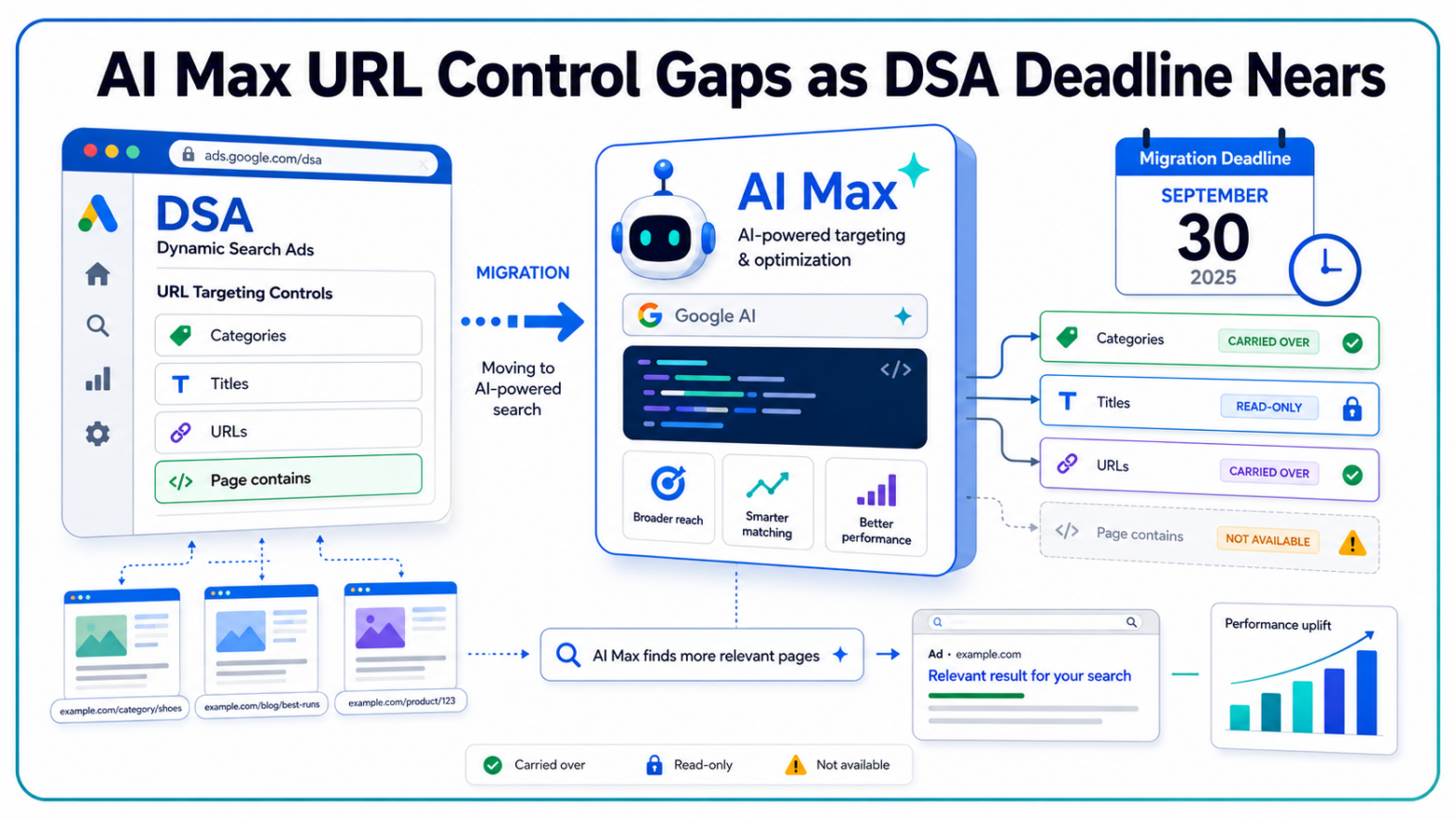
Advertisers migrating from Dynamic Search Ads to Google's AI Max platform will find that some URL-based targeting rules from their existing campaigns are not fully replicable in the new format. Google Ads Liaison Ginny Marvin confirmed in a May 2026 LinkedIn exchange that while AI Max supports several forms of URL control, certain DSA targeting conditions, including "page contains" rules, are not currently supported.
What Google Confirmed About AI Max URL Controls
AI Max supports a combination of URL rule types, including URLs, custom labels in page feeds, and URL combination rules, similar to DSA. URL exclusions are managed at the campaign level, while URL inclusions are managed at the ad group level. AI Max also supports page feeds.
However, Marvin's response made clear that parity with DSA is not complete. The exchange was prompted by digital marketer Gabriele Benedetti, who raised the issue publicly. Benedetti asked whether AI Max would replicate DSA's ability to target campaigns by categories, content, titles, and URLs, controls that DSA users had relied on to align campaign structure with site architecture.
Marvin confirmed that not all DSA targeting rules carry over. Conditions such as "page contains", which allowed advertisers to route traffic based on specific text appearing within a URL path, are among the rules not currently supported in AI Max.
What Happens to Unsupported Rules During Migration
For advertisers moving from DSA to AI Max, existing URL rules will carry over, but with limitations. Unsupported rules will remain active as read-only, meaning they will continue to function but cannot be edited.
To ensure performance stability, AI Max will be enabled with settings configured to mirror an advertiser's legacy setup once auto-upgrades are complete. For DSA users, all three AI Max features, search term matching, text customization, and final URL expansion, will be enabled with legacy URL controls preserved.
The read-only status of unsupported rules means advertisers will have no ability to adjust those conditions after migration. Campaigns relying heavily on "page contains" or similar rule types to manage landing page destinations may see that flexibility effectively frozen rather than eliminated outright.
The Broader Migration Timeline
Google announced on April 15, 2026, that it will stop allowing new Dynamic Search Ads campaigns in September and will automatically migrate DSA, automatically created assets (ACA), and campaign-level broad match settings into AI Max.
Google is rolling out upgrade tools to help advertisers port their historical settings and data into new standard ad groups to ensure an easier transition. Starting in September, eligible campaigns using DSA, ACA, or campaign-level broad match will be automatically migrated to AI Max. Google will stop allowing advertisers to create new DSA campaigns through Google Ads, Ads Editor, and the Ads API once automatic upgrades begin, with all eligible migrations expected to complete by the end of September.
Brandon Ervin, director of product management at Google Ads, stated the driver behind the shift: "When we talk about the new era of search, we're really talking about how people's search habits have become much more complex and difficult to predict."
Controls Google Plans to Add
Google has stated it will bring content and title-related exclusions to the account level in AI Max later this year, giving advertisers the ability to permanently exclude content they do not want used in their ads at the account level.
The planned account-level exclusions would complement AI Max's existing inventory-aware features, which already exclude out-of-stock items automatically.
No specific date has been confirmed for when content and title-based account-level exclusions will become available.
Practical Implications for Advertisers
For advertisers managing large or structured websites whose DSA campaigns were built around granular URL path rules, the migration to AI Max requires a reassessment of how landing page control is configured. The supported controls, page feeds with custom labels, URL inclusions at the ad group level, and campaign-level URL exclusions, represent a different operational model than DSA's rule-based targeting architecture. Advertisers who depended on "page contains" conditions or similar logic to segment traffic by site section will need to evaluate whether page feeds and URL combo rules can replicate the same intent before the September automatic upgrade deadline.
Marvin noted in the LinkedIn exchange that advertiser feedback had been passed to the Google Ads product team.