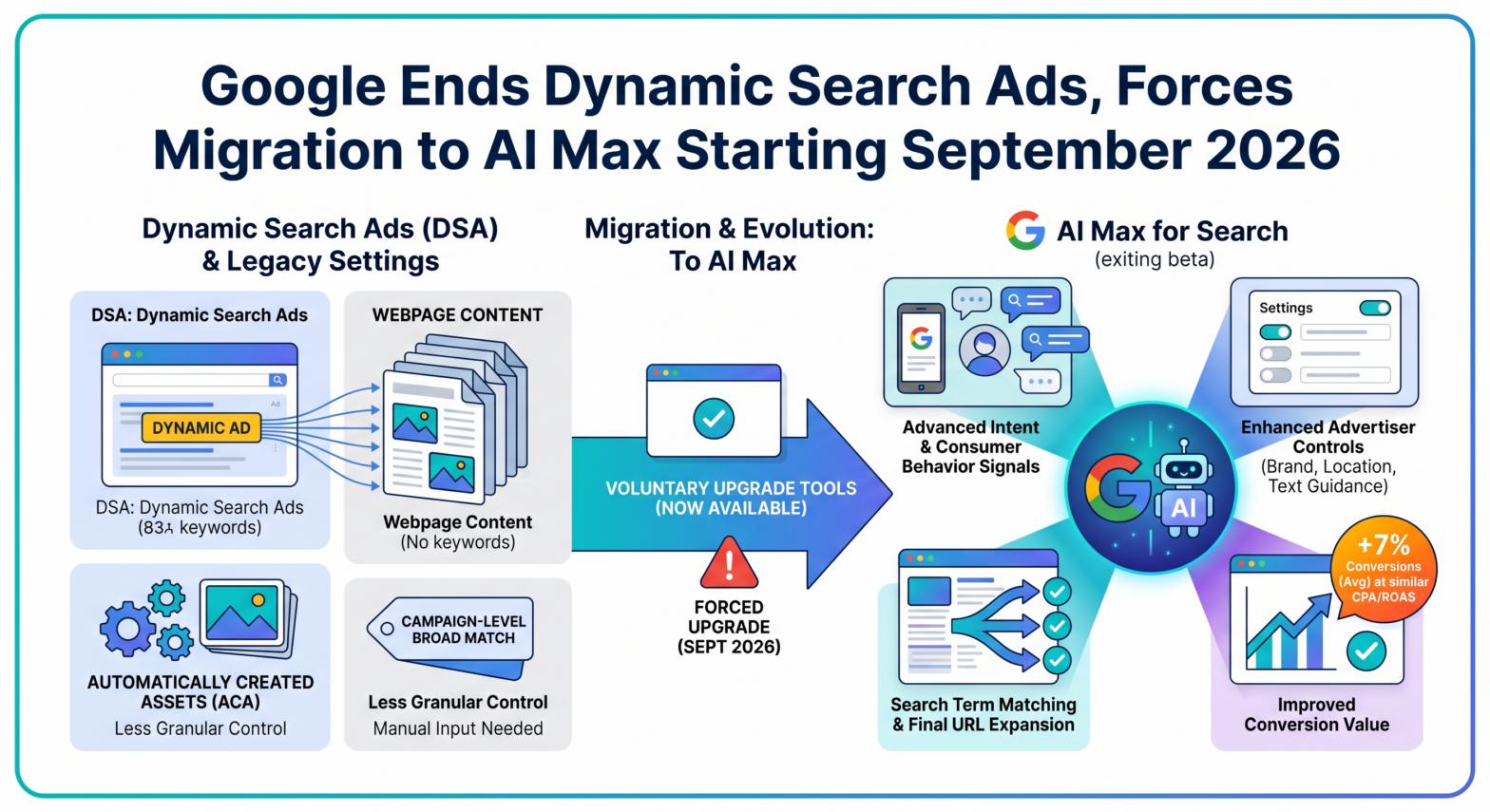
Google is retiring Dynamic Search Ads as a standalone campaign format. The company confirmed in its April 15 Google Ads product blog post that all eligible campaigns running Dynamic Search Ads (DSA), automatically created assets (ACA), and campaign-level broad match settings will be automatically migrated to AI Max for Search campaigns beginning in September 2026.
The announcement also marks a product milestone: AI Max is exiting beta after adoption by hundreds of thousands of global advertisers. Voluntary upgrade tools for existing DSA users are rolling out this week, ahead of the forced transition in the fall.
What Is Being Discontinued and When
Starting in September, remaining eligible Search campaigns with legacy settings will automatically upgrade to AI Max, and advertisers will no longer be able to create new campaigns with DSA via Google Ads, Google Ads Editor, or the Google Ads API. Google expects all eligible migrations to be completed by the end of September.
The retirement covers three legacy configurations. Campaigns using Dynamic Search Ads, automatically created assets, and campaign-level broad match settings will all automatically be upgraded to AI Max.
Dynamic Search Ads automatically generated Search ads based on the content of an advertiser's webpage rather than preset keywords. The format has been especially useful for advertisers with large inventories or frequently changing content.
How AI Max Differs From Dynamic Search Ads
Google positions AI Max as the successor to DSA, not a replacement in kind. AI Max carries the same core benefits as DSA while combining advertiser input, such as ads and website content, with richer signals to help find additional untapped queries and keep ads relevant.
The distinction Google draws is in the scope of signals used. Google says consumer search behaviour is becoming more complex and less predictable, and AI Max is designed to go beyond website landing page signals by using broader real-time intent data.
AI Max also adds more controls for advertisers, including brand, location, and text guidance settings, capabilities that were not available in the legacy DSA format.
Brandon Ervin, director of product management at Google Ads, told MediaPost: "When we talk about the new era of search, we're really talking about how people's search habits have become much more complex and difficult to predict."
Google's Reported Performance Data
According to Google, AI Max for Search campaigns sees an average of 7% more conversions or conversion value at a similar CPA/ROAS when using the full feature suite, search term matching, text customization, and final URL expansion, compared to using search term matching alone.
That figure reflects the performance of the complete feature set. It is also a more conservative benchmark than what Google cited at launch. The current 7% figure is more cautious than the 14% uplift Google cited when AI Max first launched in May 2025, a number that attracted scrutiny given how it conflicted with early independent testing data. Independent testing published in November 2025 found that AI Max delivered conversions at approximately 35% lower return on ad spend than traditional match types across more than 250 retail campaigns.
The Two-Phase Migration Schedule
Google has structured the transition into two phases.
In Phase 1, currently underway, Google is rolling out upgrade tools to help DSA users port over their historical settings and data into new standard ad groups. ACA and campaign-level broad match setting users will see a pop-up banner in their Google Ads UI to upgrade to AI Max.
In Phase 2, beginning in September, automatic upgrades take effect. The migration settings differ by campaign type. DSA users will have all three AI Max features enabled by default: search term matching, text customization, and final URL expansion. ACA users will have search term matching and text customization enabled by default. Campaign-level broad match users will have search term matching enabled by default.
AI Max will be enabled with settings configured to mirror an advertiser's legacy systems once the automatic upgrades are complete.
API and Tooling Impact
The deprecation of DSA creation via the Google Ads API carries meaningful operational consequences for large accounts and automated management platforms. Advertisers or agencies that programmatically create DSA campaigns through API calls will need to update their workflows before September.
Google Ads API version 21, released on August 6, 2025, introduced the `ai_max_setting.enable_ai_max` field to enable AI Max programmatically, but at that point, the feature was still in beta and required explicit enablement. The upcoming automatic upgrades change that default; campaigns will be migrated unless advertisers opt into the voluntary phase beforehand.
Broader Context
The decision to move AI Max out of beta is informed, at least in part, by the shift happening in online search generally. Users are increasingly opting for AI search engines like Anthropic's Claude, Google's Gemini, and OpenAI's ChatGPT rather than traditional search engines. As queries grow longer, more nuanced, and more conversational, the challenges of nailing keyword variations and mastering user intent have deepened.
The sunset of DSA as a standalone format continues a pattern Google has pursued consistently: retiring legacy campaign formats that require more manual input in favour of systems that hand more decisions to automated models.
Notably, some advertisers have already reduced their reliance on DSA ahead of this announcement. Marketers have sunset DSAs largely on their own, with some agency representatives reporting that client ad spend on DSAs is nearly nonexistent.
What Advertisers Should Do Before September
For advertisers still running DSA campaigns, the voluntary migration window now open offers more control than waiting for automatic upgrades. Migrating early allows advertisers to review which settings carry over, audit negative keyword lists, which carry particular importance since AI Max matches based on site content rather than advertiser-defined keywords, and test performance differences before the forced transition begins.
Google recommends using one-click experiments, which give advertisers a cleaner way to compare performance before making a full rollout decision. After migration, monitoring matched search terms, landing page selections under final URL expansion, and conversion path quality will be important for detecting performance shifts.
Google spokesperson's comments reported by Search Engine Land confirmed that keywords are not being eliminated from the equation: "Keywords remain an essential component of a successful campaign strategy, providing the 'fuel' for our AI and for the intent signals necessary to drive performance."
The full feature mapping and eligibility details for the automatic upgrades are available in the Google Ads Help Center.