Google Ads campaigns running broad match keywords remain eligible to appear in AI Overviews and AI Mode without enabling AI Max, a distinction that Google Ads Liaison Ginny Marvin confirmed during a post-Google Marketing Live 2026 Q&A with the PPC Chat community, hosted by Julie Bacchini on May 26, 2026.
The session addressed a series of unresolved questions left over from the GML keynote, covering AI Max's relationship to AI Search inventory, the current state of placement-level reporting, the upcoming AI Brief feature, and Google's escalating emphasis on first-party data quality under the banner of "Data Strength."
Broad Match Remains a Direct Route Into AI Search
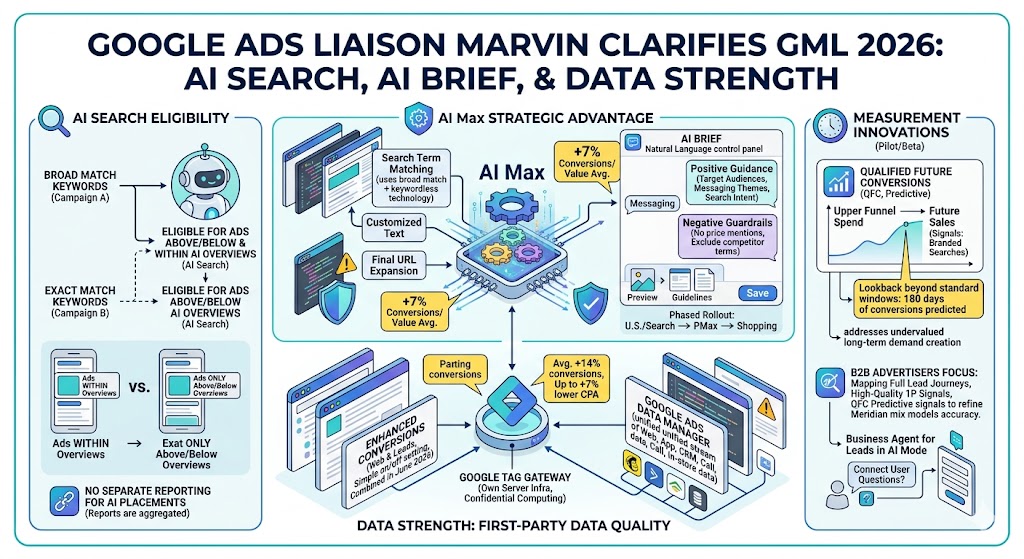
Marvin confirmed that an ad can serve either above or below an AI Overview or within the AI Overview, but not both in the same auction. While both exact and broad match keywords can be eligible to trigger ads above or below AI Overviews, only broad match keywords or keywordless targeting are eligible to trigger ads within AI Overviews.
Marvin also clarified that the presence of the same keyword in an exact match will not prevent a broad match keyword from triggering an ad in an AI Overview, since exact match is not eligible to show ads in AI Overviews and is not competing with the broad match keyword in that auction.
AI Max, Marvin explained, expands on this eligibility. AI Max is not a technical requirement to appear in AI Search, but it functions as a strategic advantage for covering the new semantic demand that AI Overviews generate. Google's Search Term Matching in AI Max uses broad match and keywordless technology together, effectively applying broad match behaviour to phrase and exact match keywords while also enabling keywordless matching for campaigns that do not rely on specific keywords at all.
AI Max has now moved out of beta, with hundreds of thousands of global advertisers using it to scale Search campaigns. Google's own data shows AI Max for Search campaigns sees an average of 7% more conversions or conversion value at a similar CPA or ROAS when using the full feature suite, search term matching, text customization, and final URL expansion, compared to using search term matching alone.
No Segmented Reporting for AI Search Placements
Marvin told the PPC Chat community that advertisers should not expect granular placement data from AI-powered search surfaces in the near term. Ads appearing in AI Overviews and AI Mode are currently reported alongside other top-of-page ads, with no separate performance breakdown available. Google is still evaluating what reporting should look like as these experiences evolve, meaning advertisers will continue to face limited visibility into how much traffic and performance is being driven specifically by AI-powered search experiences.
Segmented reporting for AI Search placements is not yet available, and Google is still learning and actively thinking about what the future of reporting looks like for this experience.
AI Brief: Controls for Automated Campaigns, With a Phased Rollout
Google introduced AI Brief, a new natural language interface powered by Gemini that allows advertisers to use their own words to guide AI Max. Marvin outlined the scope of the feature during the Q&A: advertisers can set both positive guidance, specifying target audiences, messaging themes, and search intent, and negative guardrails, such as instructions to never mention prices or exclude specific competitor terms.
AI Brief functions as a control layer that advertisers can use to describe their brand, audiences, and guardrails in conversational language, with the system interpreting that input to generate ad guidelines with previews. Marvin added that AI Brief will show sample assets and queries before deployment, giving advertisers a chance to refine their inputs before saving.
Instead of relying entirely on traditional settings, advertisers can describe their business context, dictate what their messaging should focus on, identify what to avoid, and define specific searches they want to align with. The feature is rolling out globally in English for Search campaigns first, with Performance Max integration coming later. AI Max for Shopping will follow after that.
Marvin noted that AI Brief inputs are used exclusively within an advertiser's own campaigns and that the feature's capabilities are strictly tied to user permissions; it can only access or modify data for accounts the user already has permission to use.
Data Strength Emerges as Google's Persistent Priority
Throughout the Q&A, Marvin returned repeatedly to the concept of Data Strength, Google's term for the quality and completeness of first-party data flowing into advertising accounts. She named several specific tools advertisers should prioritize.
Google Tag Gateway routes website tagging through an advertiser's own server infrastructure rather than Google's. Advertisers who adopted Google Tag Gateway observed, on average, a 14% uplift in conversions, and those who built their data strength with the gateway see up to 7% lower cost per acquisition. Tags set up with Google Tag Gateway receive confidential computing by default, giving advertisers added security and transparency on how data is collected and processed.
On Enhanced Conversions, Google confirmed that Enhanced Conversions for web and leads will soon be combined into a single on/off setting, and advertisers will no longer need to choose a single implementation method, such as the Google Tag, Google Tag Manager, or the Google Ads API. Starting in June 2026, Enhanced Conversions for web and leads will be combined into a single feature with a simple on/off switch, and the different method selections will no longer appear in the Google Ads account interface.
Marvin also highlighted Google Ads Data Manager, which connects fragmented online and offline data sources, website, app, CRM, call, and in-store data into a unified stream. The Data Manager API serves as Google's centralized hub for connecting first-party data sources, including CRM lists, offline conversions, and website events, to Google Ads, Google Analytics, and Google Marketing Platform. A 2026 update added direct connectors to platforms including Mailchimp, ActiveCampaign, and Klaviyo.
Qualified Future Conversion Targets Long Sales Cycles
Marvin elaborated on Qualified Future Conversions (QFC), one of the measurement features announced at GML 2026. Powered by Gemini, QFC links upper-funnel spend to future sales via signals like branded searches, helping advertisers uncover missed revenue.
QFC is a new predictive measurement metric designed to give advertisers a longer-term and more complete, full-funnel view of the impact of their media spend by looking beyond standard conversion lookback windows. It is specifically aimed at addressing the gap where long-term demand creation is often undervalued because an ad interaction does not result in an immediate conversion or sale, for example, a sale made in 31 days rather than within the 30-day conversion window. In short, QFC represents the total number of conversions that have occurred or are predicted to occur within 180 days of an ad interaction.
Google announced at GML 2026 that QFC is currently in restricted pilot globally, with a beta planned for later in 2026. These predictive signals will eventually integrate with Meridian to further refine marketing mix model accuracy. Marvin identified the metric as particularly relevant for B2B and lead generation advertisers with lengthy consideration cycles.
B2B Advertisers and the Broader Prioritization Framework
Asked specifically about what B2B advertisers should focus on in the months ahead, Marvin pointed to several recent launches beyond the main GML stage. She highlighted Business Agent for Leads, which enables people to ask questions and receive answers drawn from an advertiser's website content directly from the ad. Business Agent for Leads is a new ad type in AI Mode that invites people to ask questions about the company or the ad, connected to a lead form. It is rolling out initially to advertisers in the automotive, education, and real estate verticals, and requires advertisers to be using AI Max or Performance Max for eligibility.
For prioritization overall, Marvin consistently directed advertisers toward building robust measurement frameworks, mapping full lead journeys for bidding, ensuring conversion types are correctly configured, and feeding high-quality first-party signals across Google's data infrastructure, before evaluating which specific campaign type to enable next.
When asked which GML announcements she was most personally excited about, Marvin named new ad formats for AI Search, measurement innovations including QFC, and YouTube Creator Partnerships, reflecting Google's positioning that AI-powered campaigns like AI Max are the best way to ensure businesses are part of the conversation as ads are reinvented for AI Search to feel like helpful additions to a user's conversation.