Google's AI Max advertising platform now covers Shopping campaigns, travel-specific ad formats, and a new Gemini-powered guidance tool called AI Brief. Google confirmed the changes in an April 30, 2026, post to the Google Ads and Commerce Blog, authored by Brandon Ervin, Director of Product Management at Google Ads, marking the product's one-year anniversary.
AI Max Reaches Shopping Campaigns
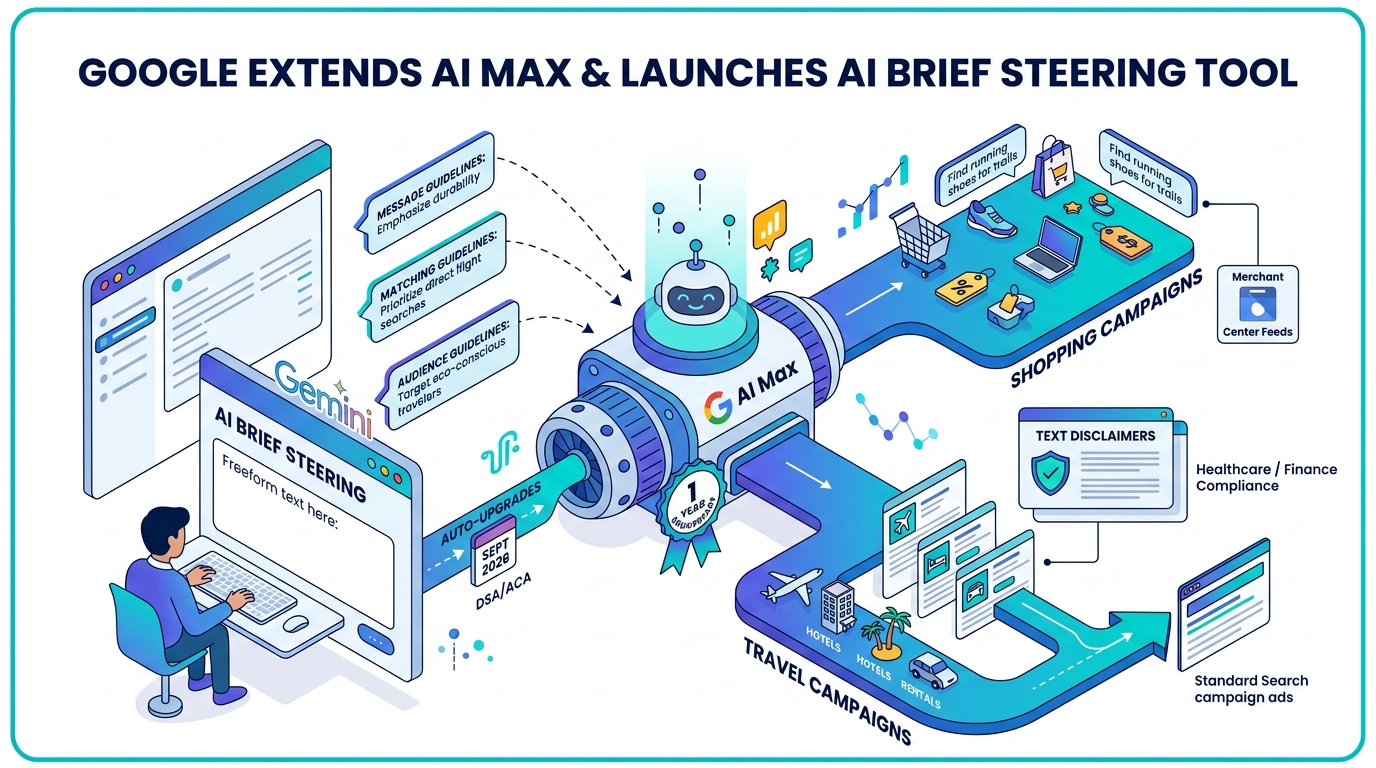
Google, on April 30, 2026, extended its AI Max framework to standard Shopping campaigns, introducing automated features designed to match product ads against conversational search queries rather than only exact product lookups. AI Max for Shopping campaigns enables retailers to connect content with a shopper's intent before they search for specific product details, using the shopper's Merchant Center feeds to transform product data into dynamic Shopping ads that answer conversational queries.
For retailers, AI Max for Shopping campaigns uses Merchant Centre product feeds to generate Shopping ads that can respond to more conversational search queries. It is designed to capture long-tail searches that standard Shopping campaigns may miss. Google said the same approach will also be added to Performance Max. Both AI Max for Shopping and Travel campaigns are rolling out as closed betas globally in all languages.
Travel Ad Management Consolidated into Search Campaigns
Google on April 30, 2026 announced Search Campaigns for Travel, a new campaign structure that brings travel feeds and formats directly into standard Search campaigns. The move ends the need for travel advertisers to manage separate, purpose-built campaign types and consolidates everything, bidding, reporting, creative, and feed management, into a single place.
For years, running hotel, flight, or car rental ads on Google required operating distinct campaign types, each with its own reporting interface, bidding logic, and feed integration. That separation produced fragmented data views, made cross-format budget allocation harder, and limited which AI-powered tools could be applied. Bringing travel formats inside standard Search campaigns means travel advertisers will now be able to activate AI Max with the same controls available to retail, finance, or any other vertical.
AI Brief Gives Advertisers Natural-Language Control Over AI Max
Google, on April 30, 2026, announced AI Brief, a new feature inside AI Max for Search campaigns that allows advertisers to provide natural-language instructions to guide how the AI generates ads and targets searches. The announcement was released alongside the first-anniversary milestones for AI Max and positions AI Brief as a fundamental shift in how advertisers interact with automated campaign systems, moving from structured settings and dropdown controls toward freeform text input powered by Gemini.
AI Brief is a Gemini-powered interface inside AI Max that accepts natural-language instructions across three input types: messaging guidelines, matching guidelines, and audience guidelines. Messaging guidelines allow advertisers to specify what ads should and should not say. Matching guidelines set parameters for which searches the system should prioritize or avoid. Audience guidelines let advertisers define who should receive particular messages and how copy should be tailored to them.
The feature includes a preview step showing sample assets and searches before campaign activation. Existing text guidelines migrate automatically into AI Brief's messaging guidelines section.
According to the announcement, AI Brief will roll out in English for AI Max for Search campaigns over the coming months. Following that initial phase, it will expand to Performance Max and AI Max for Shopping campaigns.
Text Disclaimers Resolve Compliance Gap for Regulated Advertisers
Previously, final URL expansion could create tension between AI-selected landing pages and the need to guarantee required disclosure language in ads. With text disclaimers, Google says required text can appear consistently in responsive search ads even when AI Max features are active.
Text Disclaimers for heavily regulated industries, including healthcare and finance, aim to improve compliance, ensuring that required legal text always appears in ads. It will roll out in the coming weeks globally in all languages.
Context: AI Max's Growth Since Launch
In the year since the April 30, 2025 announcement, AI Max has gained "hundreds of thousands" of advertisers, according to a press briefing hosted by Google. That makes AI Max the "fastest-growing AI search product" in Google's portfolio.
The April 30 announcements follow Google's declaration on April 15, 2026, that AI Max for Search had exited beta. On April 15, 2026, Brandon Ervin announced that AI Max for Search has reached general availability after 11 months of open beta. Simultaneously, Google announced that Dynamic Search Ads, Automatically Created Assets, and the campaign-level broad match setting will auto-upgrade to AI Max in September 2026.
What These Changes Mean for Advertisers in Practice
For Search advertisers already running AI Max, the arrival of AI Brief introduces a structured way to enforce brand messaging standards without relying solely on keyword exclusion lists or negative keyword management. For Shopping advertisers, opting into the closed beta means accepting AI-generated ad copy and automated landing page selection alongside existing feed-based targeting, controls that can each be individually toggled. Regulated-industry advertisers in healthcare and finance who previously had to choose between final URL expansion and mandatory disclosure text can now apply both simultaneously once text disclaimers roll out globally in the coming weeks.
The April 30 announcement was brief, a product teaser rather than a full technical launch document. The blog post explicitly directed readers to secure a seat at Google Marketing Live, signalling that fuller implementation details, timelines, and potentially case study data will be presented there. Google Marketing Live is scheduled for May 20, 2026.