

For regulated advertisers, ChatGPT just became harder to ignore.
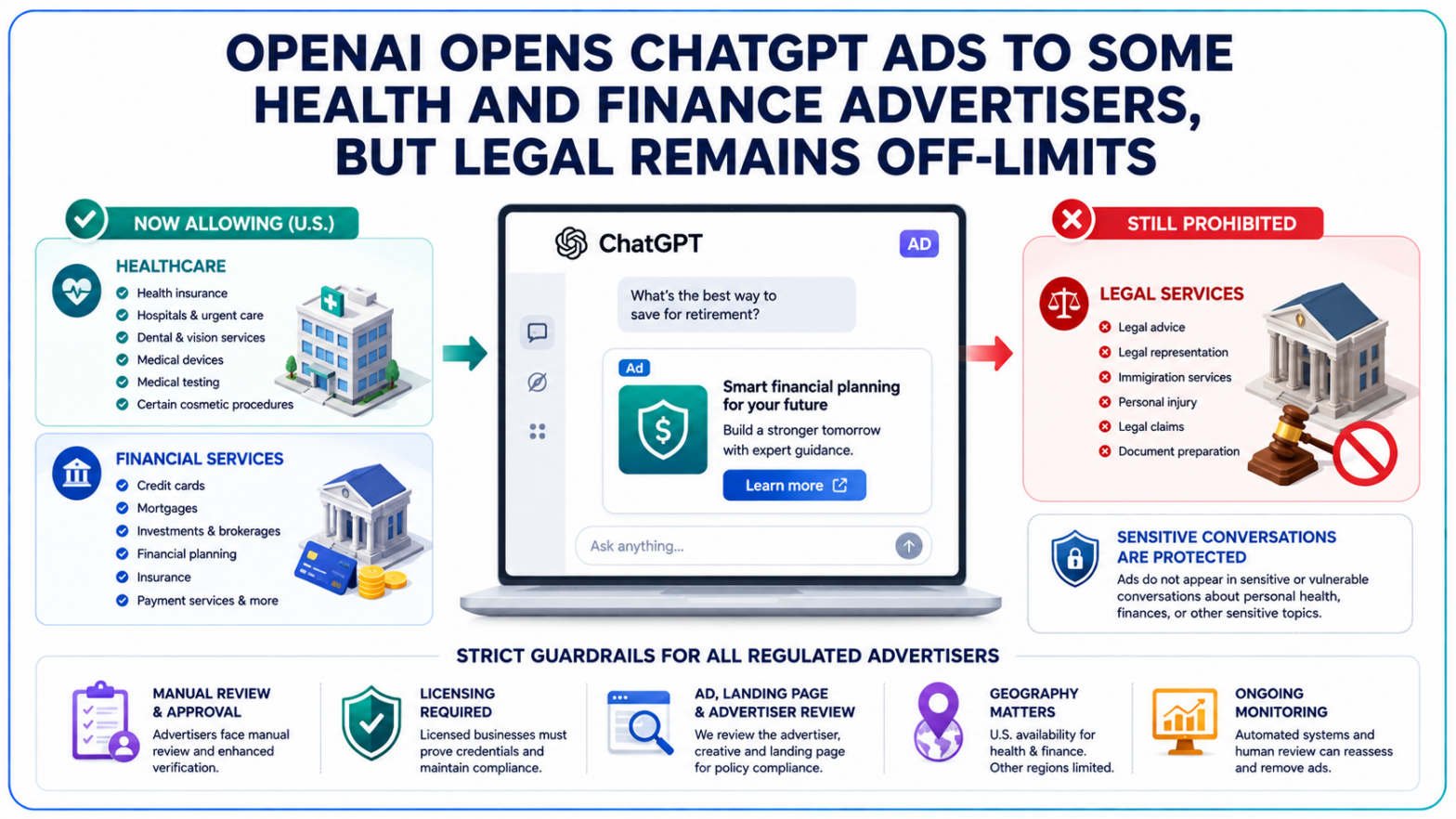
OpenAI has loosened its advertising rules to allow selected health and financial services companies into ChatGPT Ads in the United States, creating a new paid-media opportunity for industries that were largely kept outside the platform's earliest advertising rollout.
But the door is not open equally.
Healthcare and finance advertisers face manual approval, licensing requirements and strict category limits. Legal services remain prohibited entirely. And even approved health or finance ads cannot simply appear beside sensitive conversations about a user's medical condition, personal finances or other vulnerable situations.
That makes this less of a broad deregulation of ChatGPT advertising and more of a controlled test of whether OpenAI can monetize high-value commercial intent without putting ads into the conversations where users are most vulnerable.
OpenAI Is Letting Regulated Advertisers In One Category at a Time
OpenAI's current Ads Policies say the company may approve advertisers in financial services, healthcare and medicine on a case-by-case basis as those categories are gradually introduced.
The July 15, 2026 policy update specifically clarified which health and financial services may qualify and where they can advertise. OpenAI says advertisers in restricted categories may face enhanced verification or manual review, and businesses offering licensed services may be required to prove that they hold the necessary credentials.
Finance has the wider opening.
In the United States, OpenAI may permit ads for auto loans and leasing, credit cards, credit monitoring, deposit accounts, financial planning, insurance, investment services and brokerages, mortgages, personal loans and payment services.
Some categories remain excluded. Credit repair, debt settlement, debt assistance and alternative investments such as bullion are prohibited, while financial services advertising outside the U.S. is generally not allowed.
Healthcare follows a similar model.
Approved U.S. advertisers may be eligible to promote consumer medical devices, dental services, hospitals and urgent care, health insurance, medical testing, vision services, certain cosmetic procedures and other specified offerings. Unsafe or unapproved treatments, unsupported medical claims, experimental therapies and high-risk medical procedures remain prohibited.
That is a significant expansion from the consumer-focused categories that defined ChatGPT's early ad programme.
It also arrives as ChatGPT Ads become more operationally familiar to performance marketers, with self-serve campaign management, CPC bidding and conversion measurement already part of the platform.
Legal Advertisers Are Still on the Other Side of the Wall
The legal category is the important exception.
OpenAI's policy explicitly prohibits ads for legal advice, legal representation and legal services offered to consumers or businesses. The policy names immigration, personal injury, legal claims and document preparation among the prohibited examples.
General legal education can qualify where no legal service is being offered. A law-focused podcast or LSAT preparation course, for example, may be permitted.
A personal injury firm cannot.
That distinction matters because OpenAI's broader ad-content language says approved advertisers within financial services, healthcare and medicine, and legal services "may" be considered as restricted categories roll out. The detailed legal-services section is considerably more restrictive and makes clear that actual legal representation remains off-limits.
Advertisers should therefore read the category-specific rules rather than assuming the high-level regulated-advertiser language signals general eligibility.
For agencies handling healthcare, finance and legal accounts together, ChatGPT cannot yet be treated as a single new acquisition channel across all three verticals.
Healthcare and finance have a route in.
Law firms do not.
ChatGPT Ads Cannot Follow Users Into Sensitive Conversations
The more unusual restriction is not what advertisers can promote. It is where their ads can appear.
ChatGPT advertising does not work like paid search, where commercial intent around a sensitive subject can itself create an ad opportunity.
OpenAI says ads are blocked from sensitive user contexts, including mental and personal health conversations and other vulnerable user journeys. Its Help Center separately says ads are not eligible to appear near sensitive or regulated topics such as personal health, even where an advertiser from that industry has been approved.
That creates an unusual separation between advertiser category and conversational context.
A health insurer may be approved to advertise on ChatGPT. That does not mean its ad can appear while someone is describing symptoms or asking ChatGPT about a personal diagnosis.
A financial advertiser may qualify for the platform. That does not give it unrestricted access to a user discussing a financially vulnerable situation.
OpenAI updated its placement policy in April 2026 to stop categorically excluding every medical, legal and financial advice context from advertising. Sensitive conversations and prohibited contexts still remain ineligible.
For advertisers accustomed to paid search advertising, that changes the targeting logic.
The most commercially obvious conversation may also be the conversation where an ad cannot run.
Conversational Intent Creates a Different Type of Acquisition Channel
ChatGPT's advertising model is being built around more than keywords.
OpenAI's advertiser guidance says ad relevance can consider conversational intent and, where ad personalization is enabled, selected signals from a user's broader ChatGPT experience. The company recommends creating multiple distinct ads around different user needs rather than relying on one generic message.
That matters particularly in health and finance.
Someone researching mortgage options may spend several turns asking about down payments, fixed versus variable rates, closing costs and affordability before displaying obvious commercial intent.
A traditional search campaign sees individual queries.
A conversational advertising system can potentially understand more of the task surrounding them.
OpenAI is also adding more of the infrastructure needed to turn that intent into measurable advertising. Its ChatGPT Ads custom audiences feature allows advertisers to use first-party customer or prospect lists, while measurement integrations and conversion tools are pushing the platform further toward performance advertising.
The combination is more important than any single ad format.
OpenAI is building targeting, audience, bidding and measurement layers around conversations where users are often researching before they have decided exactly what to buy or which provider to choose.
For highly competitive financial and healthcare categories, that could create inventory earlier in the consideration process than conventional bottom-of-funnel search advertising.
Compliance Will Extend Past the Ad Creative
Getting approved is only the first filter.
OpenAI says its ad review covers the advertiser, creative and landing page, not just the text displayed in ChatGPT. An approved ad cannot direct users to a destination that introduces prohibited products, claims or services.
Advertiser identity also matters.
Businesses must accurately represent ownership and affiliations, maintain required professional licences and comply with geographic restrictions. OpenAI says restricted categories such as financial services may receive additional safeguards, including enhanced advertiser verification and manual review.
The company uses automated systems, including machine-learning models and classifiers, to review ads, landing pages and advertiser signals, with some cases escalated for human review. Ads can also be reassessed after approval if OpenAI detects policy or safety problems.
That enforcement structure is already visible in the technical side of the platform. OpenAI introduced OAI-AdsBot, a crawler that can inspect submitted advertising landing pages for policy compliance and relevance.
For regulated advertisers, the practical implication is that landing-page governance becomes part of media buying.
A compliant ad attached to an aggressive medical claim, misleading financial promise or disallowed service page can still fail review. Creative, offer and destination need to line up.
The Opportunity Is Real, but It Is Deliberately Narrow
Healthcare and financial advertisers now have a new channel to test, particularly U.S. businesses offering services OpenAI has specifically listed as eligible.
That does not make ChatGPT an unrestricted replacement for Google Ads or Meta.
Eligibility is conditional. Geographic availability is narrow. Sensitive conversational contexts remain protected. Some lucrative subcategories are prohibited completely.
Marketers evaluating AI advertising should therefore separate platform access from actual reachable inventory. Being approved to advertise in ChatGPT does not guarantee access to every commercially relevant conversation about that service.
Legal advertisers face an even simpler constraint. Under OpenAI's current rules, law firms and other providers selling legal representation still cannot advertise.
The July policy update moves healthcare and finance from broadly excluded categories into controlled advertising territory.
For legal services, the restriction remains exactly where it was.