U.S. businesses can now buy ads directly inside ChatGPT without going through an agency. OpenAI confirmed in a May 5, 2026 announcement on its website that it has launched a beta self-serve Ads Manager for U.S. advertisers, simultaneously introducing cost-per-click (CPC) bidding and a suite of new conversion measurement tools.
The changes represent the most significant operational expansion of the ChatGPT ad platform since the pilot formally began on February 9, 2026. The launch opens the platform from a handful of large test partners to any business that wants in, category restrictions aside.
Direct Advertiser Access Through Self-Serve Platform
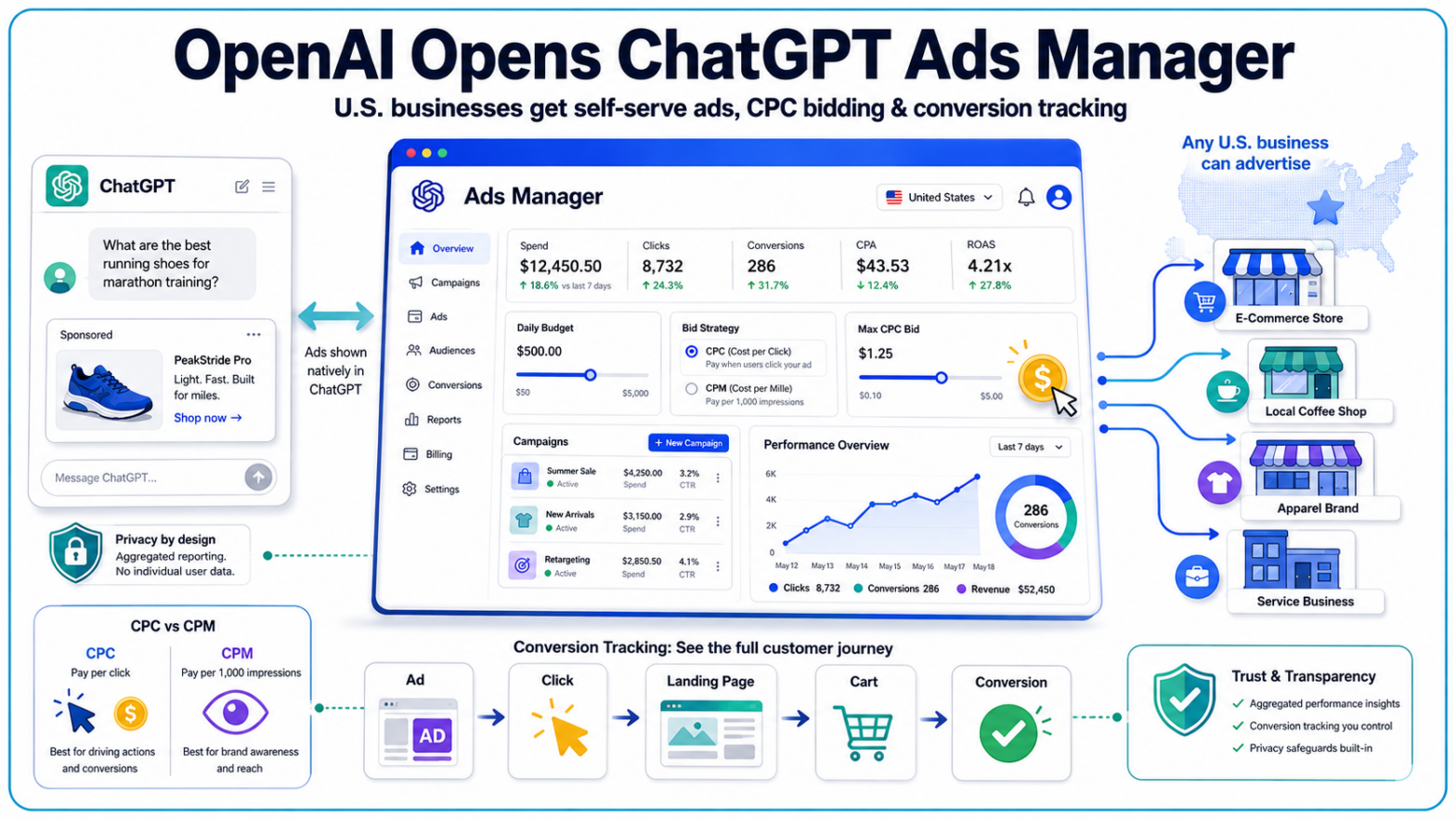
OpenAI rolled out a beta self-serve Ads Manager that allows businesses in the United States to sign up and purchase ad placements directly, without working through a holding company or agency partner. Through the platform, businesses can register as advertisers, add payment information, set budgets, bids and pacing, upload ads, launch and manage campaigns, and view performance in the portal.
OpenAI's VP of monetization, Benji Shomair, confirmed that as the Ads Manager becomes available to all advertisers, the minimum spend commitment will be removed altogether. The minimum had already dropped to $50,000 back in April. At launch in February, the pilot carried minimum spend thresholds as high as $250,000.
OpenAI is gradually opening Ads Manager to more businesses as it continues to test and refine the experience. The self-serve interface is available at ads.openai.com and is being opened gradually.
Agency and Ad Tech Partners Remain Part of the Ecosystem
The self-serve platform does not replace existing partner channels. Advertisers can still create ads through agency partners such as Dentsu, Omnicom, Publicis, and WPP. The Ads Manager is also available to several ad tech companies, including Adobe, Criteo, Kargo, Pacvue, and StackAdapt.
Through these partners, advertisers can access ChatGPT ads through tools and processes they already use to grow their businesses. Partners support campaign budgeting, bidding, and advertising creative, while OpenAI's ads system controls all delivery decisions.
So far, OpenAI has focused its pilot on a limited set of advertiser categories, including household and consumer goods, local services, travel and entertainment, and digital products and education, categories typically deemed low-risk from a regulatory or user harm standpoint. OpenAI's policy page states the company expects to expand eligible categories over time as its safeguards, review systems, and compliance infrastructure mature.
CPC Bidding Joins the Existing CPM Model
OpenAI added cost-per-click bidding to its existing cost-per-mille impressions model, allowing advertisers to pay based on user engagement rather than ad views. According to OpenAI's "Ads in ChatGPT: The Basics" documentation, advertisers choose a Reach objective to buy on a CPM basis or a Clicks objective to buy on a CPC basis. For CPC campaigns, OpenAI recommends a starting maximum bid of $3 to $5 USD per click.
According to Asad Awan, OpenAI's head of ads monetization, the introduction of CPC campaigns is intended to help prove the channel's ROI and encourage advertisers to keep buying ads within ChatGPT, while also incentivizing OpenAI to improve its relevance and targeting capabilities.
Awan noted that the ad a user sees in a given conversation is not determined by pure relevance alone. OpenAI takes into account the content of the conversation and the user's profile and preferences for logged-in users, as well as buy-side factors, including how much of an advertiser's daily budget has already been spent and the price of their bids.
OpenAI has confirmed it will continue supporting both CPM and CPC buying simultaneously, with plans to add further bidding models over time aligned with the outcomes advertisers want to optimize for.
Conversion Measurement Tools Now Live
OpenAI also announced a Conversions API (CAPI) alongside the public launch of the self-serve Ads Manager and new measurement tools. The Conversions API gives advertisers visibility into what happens after someone engages with an ad, including landing page views, product catalogue and page views, and add-to-cart events.
Jellyfish's chief solutions officer for media activation, Jai Amin, noted that OpenAI retains ownership of the pixel itself, meaning advertisers cannot create it independently. OpenAI sends it to advertisers based on what they are trying to track.
OpenAI continues to emphasize privacy protections around ChatGPT advertising. The company says advertisers will receive aggregated reporting and campaign insights without access to private conversations or personal user data. Users on the free tier and the $8-per-month Go plan see ads. Paid subscribers on the Plus, Pro, Business, Enterprise, and Education tiers do not.
Implications for Advertisers
For performance marketers evaluating ChatGPT as a new channel, the shift to CPC bidding alongside a self-serve interface brings the platform closer to familiar frameworks used on Google Search and Meta. Advertisers can now set per-click budgets, track post-click conversion events, and manage campaigns without requiring agency intermediaries, though benchmarks for click quality and conversion rates on a conversational AI platform remain early-stage. Brands in categories such as consumer goods, travel, education, and local services are currently eligible to participate; other categories remain restricted pending further policy development.
OpenAI's VP of monetization, Benji Shomair, confirmed that as the Ads Manager becomes available to all advertisers, the minimum spend commitment will be removed altogether. OpenAI has indicated plans to develop additional ad formats, bidding objectives, and platform capabilities as it continues to build out the ChatGPT advertising system.