ChatGPT ads are starting to look less like a brand experiment and more like a performance channel.
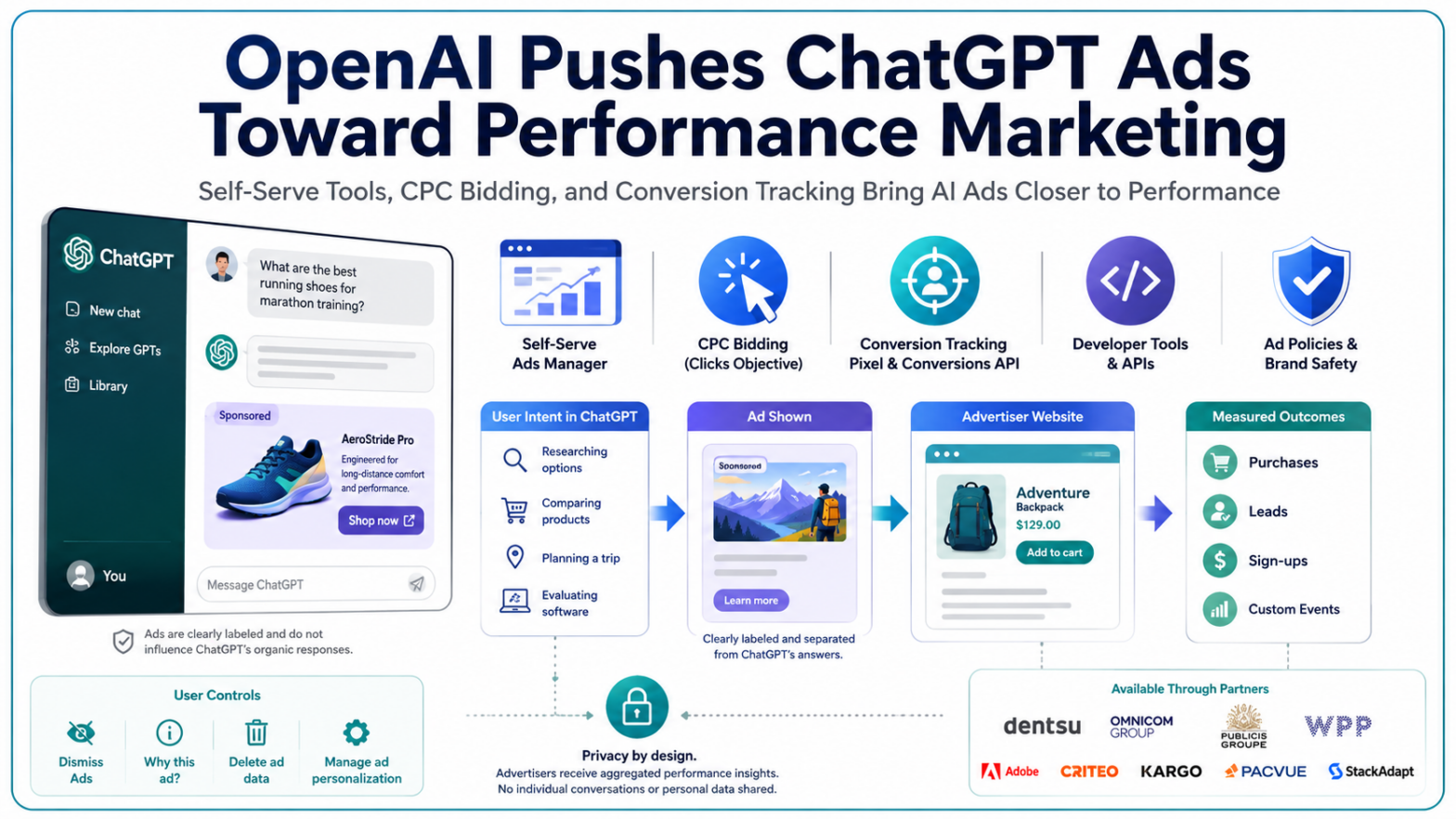
OpenAI is building the pieces advertisers expect before they commit serious budget: self-serve buying, cost-per-click bidding, conversion measurement, developer tools, and formal ad policies. The company is still calling the program a pilot, but the shape of the product is becoming clearer.
The question for marketers is no longer whether ads can appear in ChatGPT. They can. The sharper question is whether OpenAI can turn conversational intent into measurable business outcomes without damaging the trust that made ChatGPT valuable in the first place.
OpenAI’s latest public materials point in that direction. In its May 5 announcement on new ways to buy ChatGPT ads, the company said advertisers can now create campaigns through partners or a beta self-serve Ads Manager, use CPC bidding, and measure downstream actions through Conversions API and pixel-based tools.
The Ads Manager Is Where the Test Becomes a Platform
OpenAI began its ChatGPT ad pilot with a narrow group of advertisers. That kept the experiment controlled, but it also limited the product’s usefulness for the wider market.
That is changing.
The company says advertisers can now access ChatGPT ads through agency and technology partners, including Dentsu, Omnicom, Publicis, WPP, Adobe, Criteo, Kargo, Pacvue, and StackAdapt. More importantly for smaller advertisers, OpenAI has started rolling out a beta self-serve Ads Manager.
The portal allows businesses to register as advertisers, add payment information, set budgets, define bids and pacing, upload ads, launch campaigns, manage campaigns, and view performance.
That is basic ad-platform plumbing. It is also the difference between a limited media test and something that can eventually compete for recurring budget.
For marketers already familiar with ChatGPT ads, this is the stage where curiosity starts turning into channel evaluation. A platform cannot become part of a media plan until advertisers can buy it predictably, manage it without direct hand-holding, and compare results against other paid channels.
OpenAI is not there at full scale yet. But the interface, partner access, and campaign controls show the company is building toward that outcome.
CPC Buying Changes the Conversation
In the first phase of the pilot, OpenAI says advertisers could buy ChatGPT ads on a CPM basis. That made sense for an early test. Impressions are easier to sell when a company is still learning where ads fit inside a conversational product.
CPC bidding changes the buying logic.
OpenAI’s Help Center now says ChatGPT Ads supports both CPM and CPC buying options. Advertisers can choose a Reach objective for CPM campaigns or a Clicks objective for CPC campaigns. The same Help Center page says advertisers can set custom maximum bids for CPC campaigns, with OpenAI recommending a starting max bid of $3 to $5 USD per click.
That moves ChatGPT ads closer to PPC marketing, where advertisers expect spend to connect to user action rather than visibility alone.
The difference is context.
A search ad often appears when a user types a query with commercial intent. A social ad interrupts a feed. A ChatGPT ad may appear while a person is comparing options, planning a purchase, asking for recommendations, researching categories, or working through a decision.
That intent is potentially valuable, but it is also delicate. If the ad feels helpful, it may fit naturally into the session. If it feels like paid interference, it risks damaging the experience.
OpenAI appears aware of that tension. Its public ad materials repeatedly state that ads are clearly labelled, visually separated from answers, and do not influence ChatGPT’s organic response.
Conversion Tracking Brings the Hard Questions
Clicks are not enough.
OpenAI’s developer documentation now includes an Ads section that references a conversions pixel, Conversions API, and Advertiser API. The company says the conversions pixel and Conversions API provide visibility into advertising outcomes, while the Advertiser API supports programmatic ad creation and performance monitoring.
The Help Center also says Ads Manager Beta reporting currently includes impressions, clicks, spend, click-through rate, average CPC, average CPM, and conversions. Advertisers can set up conversion measurement in Ads Manager Beta and use static UTM parameters on landing page URLs to track traffic from ChatGPT Ads inside existing analytics tools.
That puts conversion tracking at the centre of the next phase.
Performance advertisers will want answers to familiar questions. Which conversations produce qualified clicks? Which categories convert? How does ChatGPT traffic behave after the click? How should attribution handle a user who uses ChatGPT for research, visits a site, leaves, and converts later through another channel?
OpenAI’s privacy position will shape how much detail advertisers can get. The company says advertisers do not receive individual conversations, chat history, memories, or personal details. Instead, they receive aggregated performance insights.
That privacy boundary is important. It also means advertisers may need to evaluate ChatGPT Ads with a different measurement mindset than traditional search or social campaigns.
Brand Safety Is Part of the Product, Not a Side Note
Ads inside a chatbot carry a different risk profile from ads beside a webpage.
A user may be asking about a sensitive medical issue, a financial hardship, a legal concern, or an emotionally vulnerable situation. In those moments, a poorly placed ad could feel intrusive in a way a display placement might not.
OpenAI’s ad policies address that directly. The company says ads should appear only near chats that are safe, appropriate, and consistent with user trust and brand safety. Its policy blocks ads from sensitive user contexts and brand-unsafe environments, including categories such as child safety, fraud, hate, misinformation, political content, regulated goods, self-harm, terrorism, and weapons.
The policy also says ads must be clearly distinguishable from the ChatGPT product experience. Ads that imitate ChatGPT’s interface, functionality, or voice may be removed or require modification.
That last point matters more than it may appear.
In a conversational interface, the line between assistant content and sponsored content has to stay visible. If users cannot tell where the answer ends and the ad begins, the ad product becomes a trust problem.
OpenAI’s May 7 update on testing ads in ChatGPT says ads are shown to logged-in adult users on Free and Go subscription tiers in supported test markets, while Plus, Pro, Business, Enterprise, and Education tiers do not have ads. The company also says users can dismiss ads, give feedback, learn why they are seeing a particular ad, delete ad data, and manage ad personalization.
Those controls are not cosmetic. They are part of whether ChatGPT can carry advertising without making the product feel less useful.
AI Advertising Is Moving Into the Budget Fight
For now, ChatGPT Ads remains an emerging channel. It does not have the maturity, inventory scale, reporting history, or advertiser muscle memory of Google Ads or Meta’s platforms.
But OpenAI is building the same core machinery advertisers use to judge paid media: buying tools, bid models, conversion reporting, APIs, ad policies, and partner access. That gives AI advertising a more concrete place in media planning than it had when the conversation was mostly theoretical.
Marketers should not treat ChatGPT Ads as a direct replacement for search, paid social, or display. The user behaviour is different. The ad environment is different. The trust constraints are different.
The better comparison is intent adjacent to decision-making. If users are asking ChatGPT to compare products, plan trips, evaluate software, find local services, or understand purchase options, advertisers will want a way to appear there. OpenAI is now giving them the early tools to test that presence.
The practical work is narrow and immediate: prepare landing pages, define clean conversion events, separate ChatGPT traffic with UTMs, compare CPC and conversion quality against existing channels, and watch placement policies closely. Early tests should be judged on lead quality, purchase behaviour, assisted conversion value, and post-click engagement rather than click volume alone.
A New Channel With an Old Burden
Every major ad platform eventually faces the same test.
Can it prove performance without overstepping the user experience?
OpenAI is now closer to that test than it was a few months ago. The company has moved beyond a simple sponsored placement model and into the mechanics of measurable advertising. CPC bidding and conversion tools make ChatGPT more legible to performance marketers. Privacy rules and ad placement limits make the product harder to scale recklessly.
That tension will define the next stage.
If advertisers get useful results and users continue to trust the product, ChatGPT Ads could become a serious new paid media environment. If relevance slips or measurement disappoints, it may remain a cautious pilot with limited budget share.
For now, OpenAI has made the direction plain: ChatGPT is not just testing ads. It is assembling an ad platform around them.