
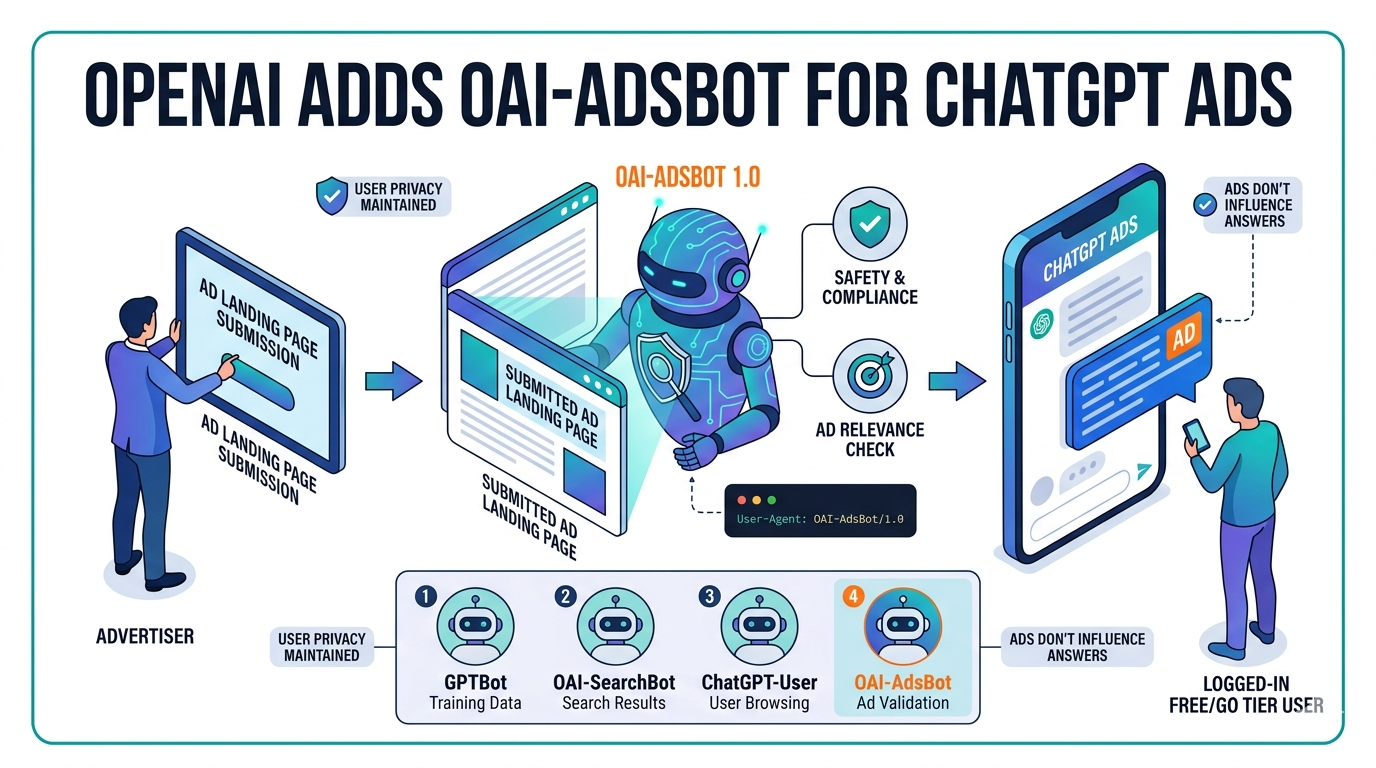
Advertisers running paid placements on ChatGPT now have a new crawler to account for in their technical setup. OpenAI has added OAI-AdsBot to its official crawler documentation, formally disclosing a fourth web agent that visits landing pages submitted as ChatGPT ads to verify policy compliance and assess relevance for ad display.
What OAI-AdsBot Does
According to OpenAI's crawler documentation, OAI-AdsBot is used to validate the safety of web pages submitted as ads on ChatGPT, and when an ad is submitted, OpenAI may visit the landing page to ensure it complies with its policies. The bot may also use content from the landing page to help decide when to show the ad to ChatGPT users.
The bot identifies itself with the user-agent string
Mozilla/5.0 AppleWebKit/537.36 (KHTML, like Gecko); compatible; OAI-AdsBot/1.0; +https://openai.com/adsbot
OAI-SearchBot and GPTBot are both at version 1.3 per OpenAI's documentation, while the new AdsBot crawler is at version 1.0 and only visits pages submitted as ad landing pages, not the broader web.
How OAI-AdsBot Differs from OpenAI's Other Crawlers
OAI-AdsBot's entry sits alongside OAI-SearchBot, GPTBot, and ChatGPT-User in OpenAI's crawler documentation, bringing the total number of documented bots to four. Each serves a distinct function. OAI-SearchBot surfaces content in ChatGPT search results, ChatGPT-User fetches pages during user-initiated browsing, and OAI-AdsBot is limited to ad validation.
Data collected by OAI-AdsBot is not used to train generative AI foundation models, which keeps it outside the scope of GPTBot, the crawler designated for training data collection.
OAI-SearchBot and GPTBot can be controlled independently through a site's robots.txt file, while ChatGPT-User is user-initiated, and OpenAI notes that robots.txt rules may not apply to it. OpenAI's documentation for OAI-AdsBot does not specify how the bot treats robots.txt directives.
No Published IP Range for Verification
OpenAI publishes IP range files for its three existing bots at openai.com/searchbot.json, openai.com/gptbot.json, and openai.com/chatgpt-user.json, but no equivalent file for OAI-AdsBot appears in OpenAI's documentation at the time of this reporting.
OpenAI does not publish a dedicated IP range list for OAI-AdsBot, meaning IP-based blocking is unreliable, though reverse DNS verification, checking that an IP resolves to an openai.com host, is one available method for confirming visits.
Context: ChatGPT Advertising Program
OpenAI began testing ads in ChatGPT in the U.S. on February 9, targeting logged-in adult users on the Free and Go subscription tiers, while Plus, Pro, Business, Enterprise, and Education tiers are excluded from ads.
As of March 26, 2026, update on OpenAI's advertising page, the company stated its ads pilot is focused on supporting broader access to ChatGPT while preserving consumer trust, and that early results are encouraging. In the coming weeks, OpenAI stated it would begin expanding the program beyond the U.S., starting with pilots in Canada, Australia, and New Zealand, with plans to roll out thoughtfully in each market.
OpenAI has stated that ads do not influence the answers ChatGPT gives users and that user conversations are kept private from advertisers.
Practical Implications for Advertisers and Technical Teams
Advertisers running or planning campaigns on ChatGPT should ensure OAI-AdsBot is not blocked in their robots.txt configuration. If a site is running ads through OpenAI's ad platform, blocking OAI-AdsBot may prevent ad landing pages from being validated, meaning ads are unlikely to be approved to serve. Strict bot-mitigation tools such as those offered by Cloudflare or Akamai may block OAI-AdsBot before it reaches a landing page, which could create validation friction for advertisers. Because OAI-AdsBot, OAI-SearchBot, and GPTBot each use separate robots.txt tokens, a rule targeting one does not affect the others; configurations should be reviewed individually for each agent.
OpenAI stated that protecting user privacy and safety will remain central to how it designs and scales its advertising program, including guardrails to prevent narrow ad targeting, and that it will continue to be deliberate about who it allows into the advertiser program.