ChatGPT advertising is moving past the novelty stage. OpenAI is now giving advertisers a familiar but important control: the ability to use their own customer and prospect lists inside ChatGPT Ads.
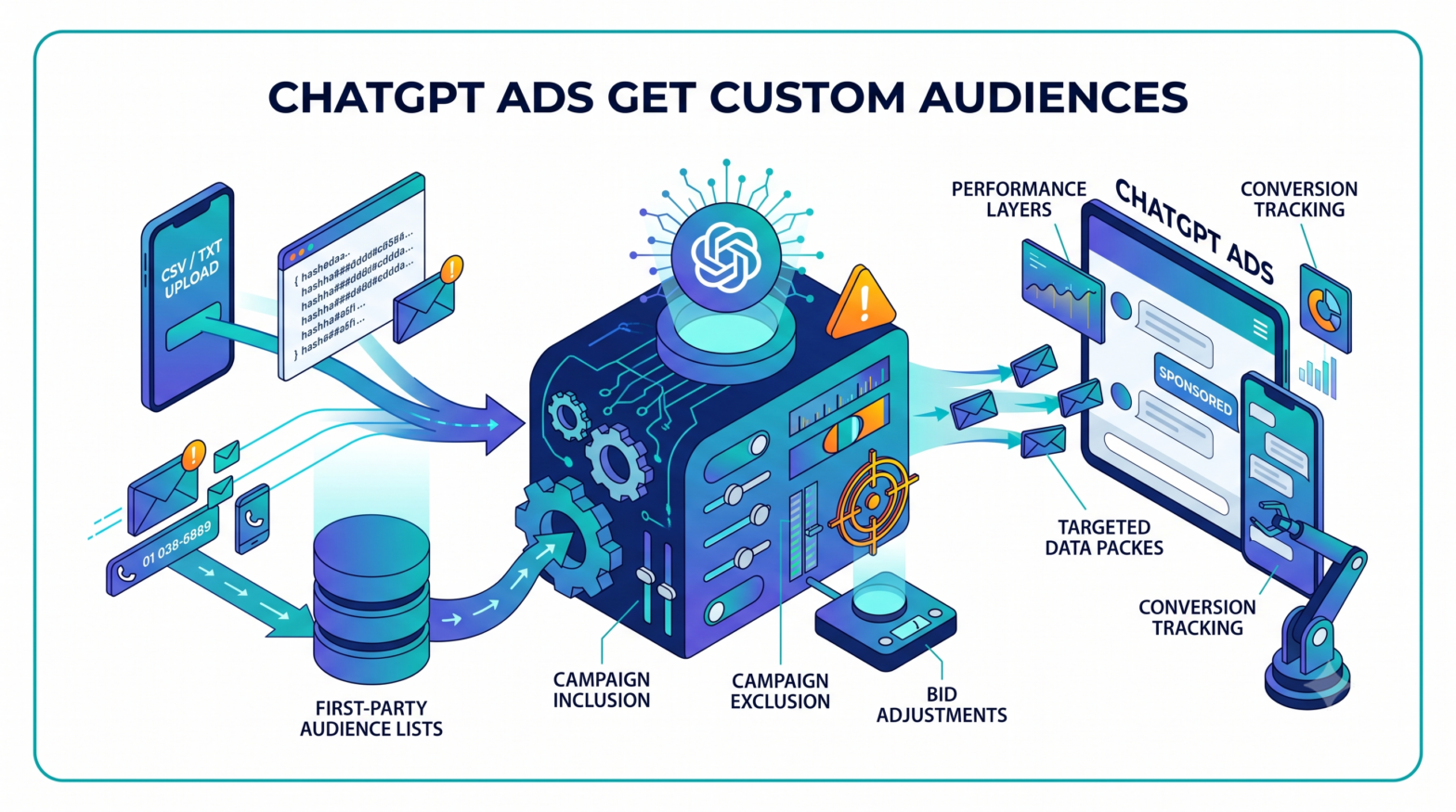
OpenAI’s Help Center now includes documentation for custom audiences in ChatGPT Ads, describing how advertisers can apply customer or prospect lists using email addresses or phone numbers. The feature supports campaign-level inclusion, campaign-level exclusion and ad-group audience bid adjustments.
That pushes ChatGPT Ads closer to the performance advertising systems marketers already know.
Not identical. Not mature yet. But closer.
Audience Lists Give ChatGPT Ads A Sharper Performance Layer
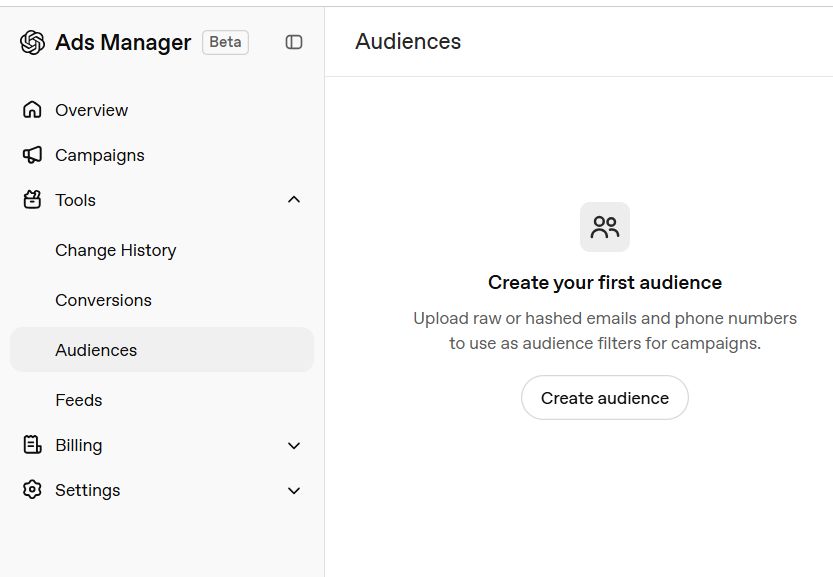
OpenAI describes custom audiences in plain terms: “Custom audiences let you apply your own customer or prospect lists in ChatGPT Ads.” Advertisers can create those audiences from email addresses or phone numbers, then use them to control who is eligible to see a campaign or who should be excluded from it.
That makes ChatGPT ads more recognizable to paid media teams.
Until now, the platform has been defined mainly by conversational intent. OpenAI’s ad system selects ads based on the context and intent of the active conversation, with advertisers using signals such as context hints, landing pages, titles and ad copy to guide matching.
Custom audiences add a different signal.
An advertiser can now limit a campaign to known customers or qualified prospects. Another can suppress recent purchasers. A third can raise or lower bids when a user matches a selected audience. OpenAI’s documentation says bid multipliers can be used to bid more competitively for high-value customers or more selectively for lower-priority audiences.
That is standard PPC logic entering a conversational ad environment.
OpenAI Is Keeping The Minimum Audience Threshold High
The feature is not built for tiny lists.
OpenAI says each custom audience must include at least 25,000 matched users before it can be used. The company recommends audiences of at least 100,000 users. Ads Manager does not show individual matched users or allow advertisers to select specific people from an audience.
That threshold matters.
Many small businesses have customer lists, but not all have lists that will match at that scale. A local service company, niche B2B vendor or early-stage ecommerce brand may not have enough matched identifiers to use custom audiences immediately. Larger retailers, subscription brands, marketplaces, financial services advertisers and app-based businesses are more likely to clear the bar.
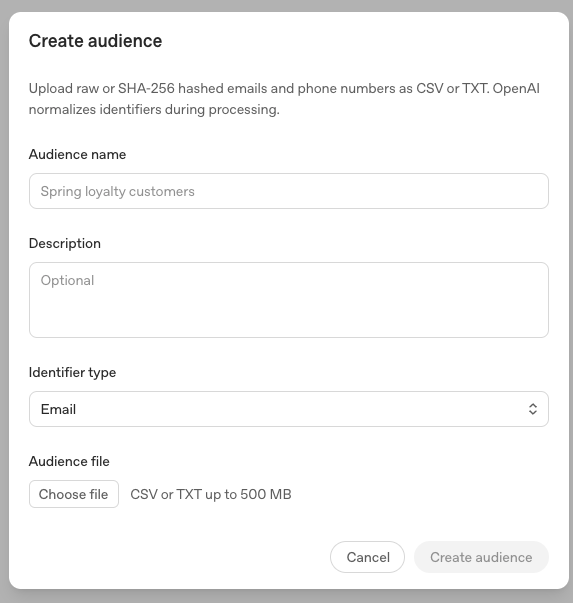
OpenAI also allows advertisers to upload CSV or TXT files up to 500 MB, with as many as 5 million identifiers per upload. The supported identifier types include email address, phone number, SHA-256 hashed email address and SHA-256 hashed phone number.
The audience cannot be edited after creation. To update a list, advertisers must create a new audience and archive the old one.
That gives the feature a structured, controlled feel. It also means list hygiene will matter from the start.
Exclusions May Be Just As Important As Targeting
The obvious use case is targeting known prospects.
The more useful one may be exclusion.
OpenAI’s documentation says advertisers can use exclusion audiences to prevent campaign delivery to selected groups, including existing customers, recent purchasers or audiences that should not see a specific campaign.
That matters because ChatGPT ads appear in a different context than search or social ads. Users may be comparing products, planning purchases, troubleshooting problems or asking for recommendations in one continuous conversation. A poorly timed ad shown to the wrong audience could feel more intrusive in that setting than it would on a results page.
For example, a subscription company may want to exclude active customers from acquisition campaigns. A retailer may suppress people who purchased in the last week. A B2B company may separate existing accounts from net-new prospecting.
These are ordinary media buying controls. Their arrival inside ChatGPT is still significant because conversational advertising has less room for sloppy targeting.
The ad sits below a response the user asked for. Relevance has to work harder.
ChatGPT Ads Are Becoming Easier To Buy, Track And Optimize
Custom audiences are arriving after several other pieces of ad-platform infrastructure.
In May, OpenAI said it was rolling out a beta self-serve Ads Manager, adding CPC bidding and expanding measurement tools for ChatGPT Ads. The company said advertisers could register, add payment information, set budgets and bids, upload ads, launch campaigns, manage campaigns and view performance in the portal.
OpenAI’s advertiser documentation now says ChatGPT Ads supports CPM and CPC buying options. Campaign reporting includes impressions, clicks, spend, click-through rate, average CPC, average CPM and conversions, with conversion measurement available through Ads Manager Beta.
That sequence is important.
First came the ad test. Then self-serve buying. Then CPC. Then conversion measurement. Now custom audiences.
The shape is familiar because most ad platforms mature in similar stages. They start with reach. They add buying controls. Then measurement. Then targeting and optimization layers. OpenAI is moving through that arc quickly.
TechWyse has already tracked how OpenAI pushed ChatGPT Ads toward performance marketing, including CPC bidding and conversion tracking. Custom audiences fit the same pattern: the company is making ChatGPT Ads easier to evaluate against other paid media channels.
The Privacy Framing Remains Central To The Rollout
OpenAI has repeatedly framed ChatGPT advertising around privacy, separation from answers and user control.
The company says ads do not influence ChatGPT’s answers, run on separate systems from the chat model and are clearly labelled. It also says advertisers cannot shape, rank or alter ChatGPT responses.
OpenAI’s broader advertising principles state that conversations are private from advertisers, user data is not sold to advertisers and users can control personalization.
That framing will face more scrutiny as the platform adds advertiser-uploaded lists.
Custom audiences are common in digital advertising, but ChatGPT is not a conventional feed or search results page. Users often treat conversations as more personal, exploratory and decision-oriented than a keyword search. OpenAI has said ads may appear for Free and Go users, while Plus, Pro, Business, Enterprise and Edu accounts will not have ads.
The line OpenAI is trying to hold is clear: advertiser data can help decide ad eligibility, but advertisers do not get access to conversations, individual users or the answer-generation process.
That distinction will be central to whether AI search ads can scale without damaging user trust.
Marketers Get A New Channel Test, Not A Finished Playbook
For marketers, the practical implication is straightforward: ChatGPT Ads are becoming testable in a more disciplined way. Audience lists make it easier to separate prospecting from retention, suppress customers who should not receive acquisition messaging and apply higher bids to higher-value segments. Teams evaluating the channel will need consent-aware first-party data, clean identifiers, clear audience naming, conversion tracking and campaign structures that reflect real customer segments rather than generic curiosity about AI ads.
There is still plenty the market does not know.
OpenAI has not turned ChatGPT Ads into a fully mature PPC advertising ecosystem overnight. Advertisers are still learning how conversational intent behaves, how clicks compare with search or social traffic, and how users respond to sponsored placements inside an AI assistant.
But custom audiences change the nature of the test.
The question is no longer whether OpenAI will build ad controls around ChatGPT. It is how quickly those controls become good enough for recurring media budgets.