
The next ChatGPT ad may not send anyone to a website.
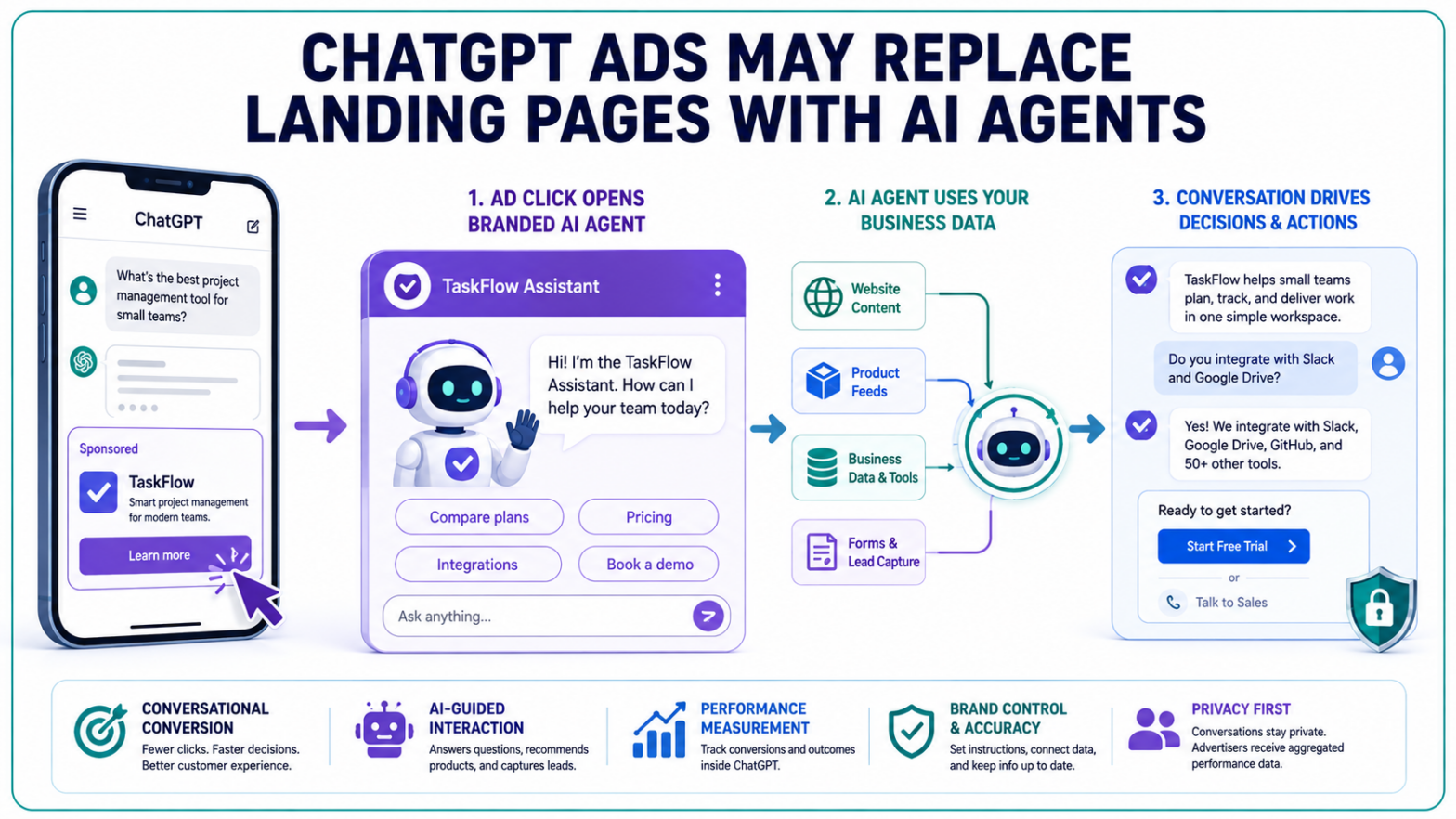
Evidence from a limited version of OpenAI’s Ads Manager suggests the company is developing sponsored placements that open branded AI agents inside ChatGPT. Instead of clicking an ad, loading a landing page, and searching for the right product or form, a user could move directly into a conversation configured by the advertiser.
That is a much larger change than another ad format.
It would give OpenAI control over the space between ad impression and conversion, replacing part of the traditional customer journey with an AI-guided interaction.
The Ad Click Could Become a New Conversation
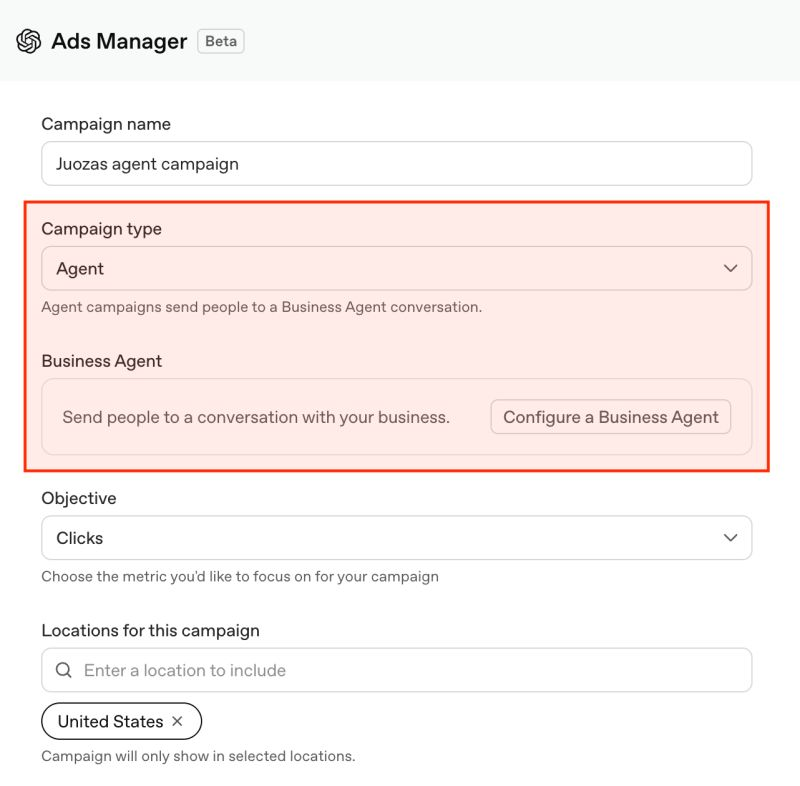
Details of the apparent test were shared by ecommerce intelligence company Marketplace Pulse founder Juozas Kaziukėnas, who said the tools are already visible in Ads Manager for select advertisers.
“Clicking on traditional online ads opens a website; these new ChatGPT ads will launch a business agent conversation configured with the context of the business,” Kaziukėnas wrote.
The reported workflow begins with OpenAI scanning an advertiser’s website to create a business profile. That profile may include common customer questions, support information and general context about the company.
Advertisers can then configure a business agent with their own instructions. According to Kaziukėnas, the agent may also connect to product feeds, use Model Context Protocol tools to retrieve business data and collect leads through custom forms.
The campaign destination is the agent itself.
Kaziukėnas cautioned that he had not seen the ads running publicly and was not certain how the final consumer interface would work. OpenAI has not publicly announced this specific format. The available evidence should therefore be treated as an early product test rather than a confirmed launch.
Still, the underlying pieces fit OpenAI’s current direction.
OpenAI describes ChatGPT advertising as an environment built around “conversation, context, and real-time decisions.” Its public advertising materials say users often arrive to compare products, weigh alternatives and take action, rather than simply retrieve information.
A sponsored business agent would keep that decision process inside the same interface.
OpenAI Is Building Beyond the Static Ad Card
ChatGPT’s current ad model remains relatively familiar.
OpenAI says advertisements appear below relevant responses and contain an advertiser name, logo, headline, description, image and landing-page link. Campaigns can be bought on cost-per-thousand-impressions or cost-per-click terms, with delivery influenced by conversational intent, ad copy, landing-page content and advertiser-provided context hints.
The platform has been adding conventional paid media infrastructure quickly.
OpenAI launched its self-serve Ads Manager beta in May 2026, alongside CPC bidding, conversion tracking and expanded measurement. The company said it planned to develop additional formats, objectives and capabilities as the platform matured.
TechWyse has tracked that progression through the rollout of ChatGPT Ads Manager and CPC bidding, product feed campaigns and custom audience lists.
Business agents would move the product into different territory.
A static ad asks the user to leave ChatGPT and navigate an advertiser-controlled destination. An agent destination could answer questions, narrow choices, retrieve inventory, recommend products and collect customer details without requiring that handoff.
The experience would look less like paid search and more like a sponsored sales assistant.
Websites May Supply the Data Without Owning the Visit
For advertisers, the most consequential part of the reported system may be OpenAI’s use of business websites to build agent profiles.
The website would still matter. Its product information, service descriptions, policies, FAQs and support content could provide the factual foundation for the agent.
But the website might no longer receive the visit.
That creates a new version of a problem already familiar to publishers and SEO teams. Content remains necessary to earn visibility, while the platform presenting that content captures more of the user interaction.
In an agent-based ad journey, a potential customer may ask about product compatibility, pricing, delivery options or appointment availability without opening the advertiser’s site. The agent could resolve those questions and present a lead form inside ChatGPT.
That would reduce the number of steps between discovery and conversion. It could also reduce the behavioural data advertisers currently collect through landing pages, including page depth, navigation paths, on-site search activity and form abandonment.
OpenAI says advertisers do not receive access to individual conversations. Its existing conversion tools provide aggregated performance information while keeping personal chats private.
How much interaction data business-agent advertisers would receive remains unknown. OpenAI has not disclosed reporting, attribution or conversation-insight controls for the apparent format.
Agent Accuracy Becomes an Advertising Requirement
A landing page displays content the advertiser has reviewed and approved.
An AI agent generates responses dynamically.
That difference introduces a new layer of risk. If OpenAI builds an initial business profile by scraping a company website, outdated service pages, inconsistent prices or unclear policies could become source material for customer-facing answers.
Advertiser instructions may reduce that risk, but they will not remove it. Product feeds can change. Inventory systems can return incomplete data. Connected tools can fail. A loosely written instruction may lead the agent to answer beyond the information available.
One response to Kaziukėnas’ post raised the concern directly: “Inaccurate scraped data could quickly produce agents that give customers misleading answers.”
That problem is more serious in a sponsored experience. Users are not simply asking a general-purpose chatbot what it knows about a company. They are entering an interaction created and paid for by that company.
OpenAI’s existing ad policies require consistency between ad creative and its destination. Ads cannot make one promise and direct users to a page containing unsupported or disallowed material. The same principle would likely need to extend to agent responses, though OpenAI has not published rules for business-agent ads.
Approval systems would also need to account for behaviour, not just assets.
A headline and image can be reviewed before a campaign launches. An agent may produce thousands of different responses depending on the user’s wording, context and follow-up questions.
OpenAI Already Has the Commerce Layer
The apparent format is not emerging in isolation.
OpenAI introduced Instant Checkout and the Agentic Commerce Protocol in September 2025, allowing eligible users to complete purchases inside ChatGPT. The protocol connects AI agents with merchant systems while leaving payments, fulfilment and customer relationships under merchant control.
OpenAI initially described those product results as organic and unsponsored. Business-agent ads could add a paid entry point to a similar conversational commerce journey.
An advertiser might use the ad to open a branded agent. The agent could identify the right product, retrieve current information from a feed, answer questions and eventually connect the user to a purchase or lead action.
The landing page would no longer be the default bridge between media and transaction.
That would make ChatGPT ads structurally different from search ads, even where both use CPC pricing. Google Ads usually send traffic to an advertiser-owned webpage or app. A business-agent campaign could keep the entire consideration process within OpenAI’s environment.
The closer OpenAI gets to handling research, qualification and conversion, the more advertisers will need clarity on attribution, data access and ownership of the customer relationship.
Marketers Will Need to Optimize the Agent, Not Just the Ad
In practical terms, marketers testing any future business-agent format would need to treat website accuracy, structured product data and agent instructions as campaign inputs.
Ad creative would still determine whether someone enters the experience. Performance after that point could depend on whether the agent understands the business, retrieves correct information and knows when to ask for a lead rather than continue the conversation.
Landing-page optimization would not disappear. Some users will still want to visit the company’s site, check detailed policies or verify information independently. OpenAI’s current ad units also continue to use standard destination URLs.
But a chatbot-native campaign would add another conversion surface.
OpenAI is still presenting ads as separate from ChatGPT’s answers, clearly labelled and subject to user controls. A sponsored agent would test how that separation works once the advertisement stops being a card beneath the answer and becomes a conversation of its own.
For now, the format remains unannounced and appears limited to selected advertiser accounts. The infrastructure visible inside Ads Manager suggests OpenAI is at least exploring a future where clicking an ad does not take the user somewhere else.
It gives them someone else to talk to.