
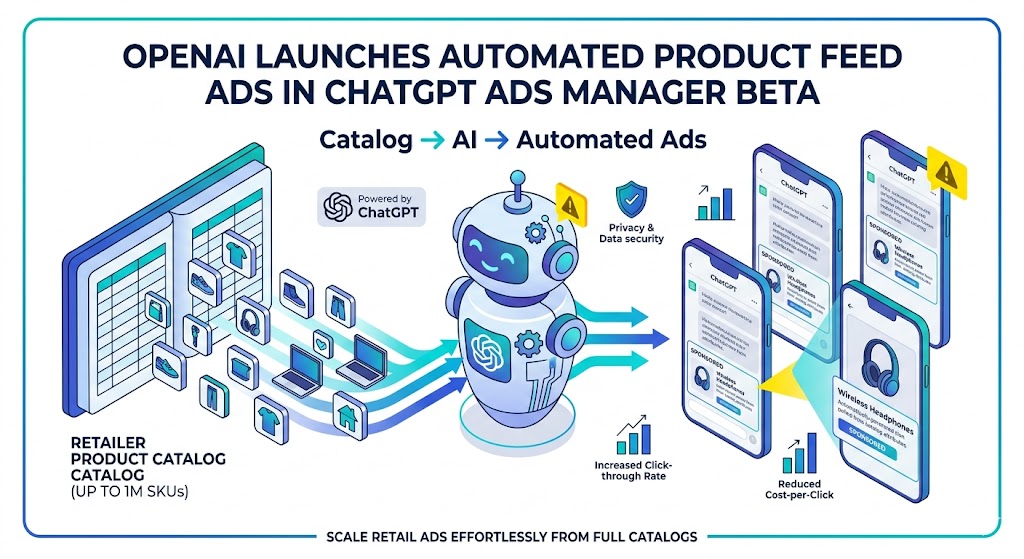
Retail advertisers using ChatGPT's advertising platform can now generate ads automatically from their full product catalogues, removing the requirement to build individual campaigns for each item. OpenAI confirmed the capability in its Ads Manager Help Center documentation, describing product feed campaigns as a feature that lets retail advertisers upload a product feed in Ads Manager and create ads based on that catalogue.
How the Product Feed Campaign Type Works
According to OpenAI's Ads Manager documentation, product feeds make it easier to bring more of a retailer's catalogue into ChatGPT ads, create ads at scale, and connect relevant products with users during high-intent conversations. The ad title and description are pulled directly from the product feed.
Feed-based campaigns are designed for retail advertisers with broad or frequently changing product catalogues. The platform can handle up to one million SKUs per advertiser, according to an ad executive briefed on the update.
The ads continue to appear below ChatGPT responses and are labelled as sponsored. According to Digiday, the change applies to the campaign setup process rather than the ad placement itself.
Products from the feed will not appear in organic ChatGPT conversations during the beta period, though OpenAI noted it may offer that capability in the future.
Onboarding Process and Feed Requirements
OpenAI is currently asking new e-commerce partners to submit a sample of 100 products before sharing their full catalogue. If the sample fails, the advertiser cannot run product feed ads at all until the underlying data is cleaned up.
That review step is unusual in paid shopping. Google does not gate Merchant Center this way. Meta does not gate the Shop catalogue this way. Amazon does not gate seller listings this way. All three platforms have post-submission review that disapproves individual items, but none refuse to onboard a brand because the first 100 SKUs read like noise.
Feeds created through Ads Manager default products are ads-eligible unless an item is explicitly marked false for ad eligibility. After the feed is created, Ads Manager generates the SFTP connection details needed to upload the feed. Processing can take anywhere from a few minutes to a few hours, depending on the size of the feed.
Compatibility with Existing Shopping Feed Infrastructure
The setup will be familiar to anyone running shopping campaigns on Google. Retailers largely repurpose the same structured product file they already send Google, lowering the barrier to entry considerably.
At least one retail brand has already gone through the process via Criteo, OpenAI's first ad tech partner, and found it more straightforward than expected, according to an ad buyer running those campaigns. StackAdapt co-founder and CTO Yang Han told Digiday that once OpenAI supports the feed format, his platform can post feeds directly to OpenAI, describing it as "a seamless connection."
Performance Data and Advertiser Claims
OpenAI's Ads Manager documentation states that ads created from product feeds have been among the strongest-performing ads in its program to date. An email sent to advertisers by OpenAI cited one global DTC brand that doubled its click-through rate and reduced its cost-per-click by 50% after moving from standard ChatGPT ads to feed ads.
Context Within OpenAI's Broader Advertising Rollout
OpenAI opened its self-serve Ads Manager beta to all US businesses on May 5, 2026, dropping the minimum spend threshold entirely and introducing CPC bidding with a recommended starting bid of $3 to $5. Ads Manager Beta is currently available to advertisers in the United States, Australia, New Zealand, and Canada, with plans to expand to the United Kingdom in the coming weeks.
Debra Aho Williamson, founder and chief analyst at Sonata Insights, noted that the key difference is ChatGPT serving ads based on conversational intent rather than signals from search behaviour, social engagement, or browsing in a marketplace environment.
OpenAI launched cost-per-click buying earlier this year, letting advertisers pay per click rather than per impression. Cost-per-action models, where payment is tied to an actual purchase, are in development.
For retail marketers, the practical implication is that existing Google Shopping feed infrastructure can be redirected toward ChatGPT ad campaigns with minimal reformatting. Catalogue data quality, including attribute completeness across fields such as product title, image, price, and availability, determines both eligibility for the 100-product sample review and the quality of auto-generated ad creatives. Brands managing large inventories should treat feed hygiene as a prerequisite for participation, not a post-onboarding task.
OpenAI has stated that ChatGPT's responses are driven by what's objectively useful and never by advertising, and that user conversations are kept private from advertisers with no data sold to third parties.