
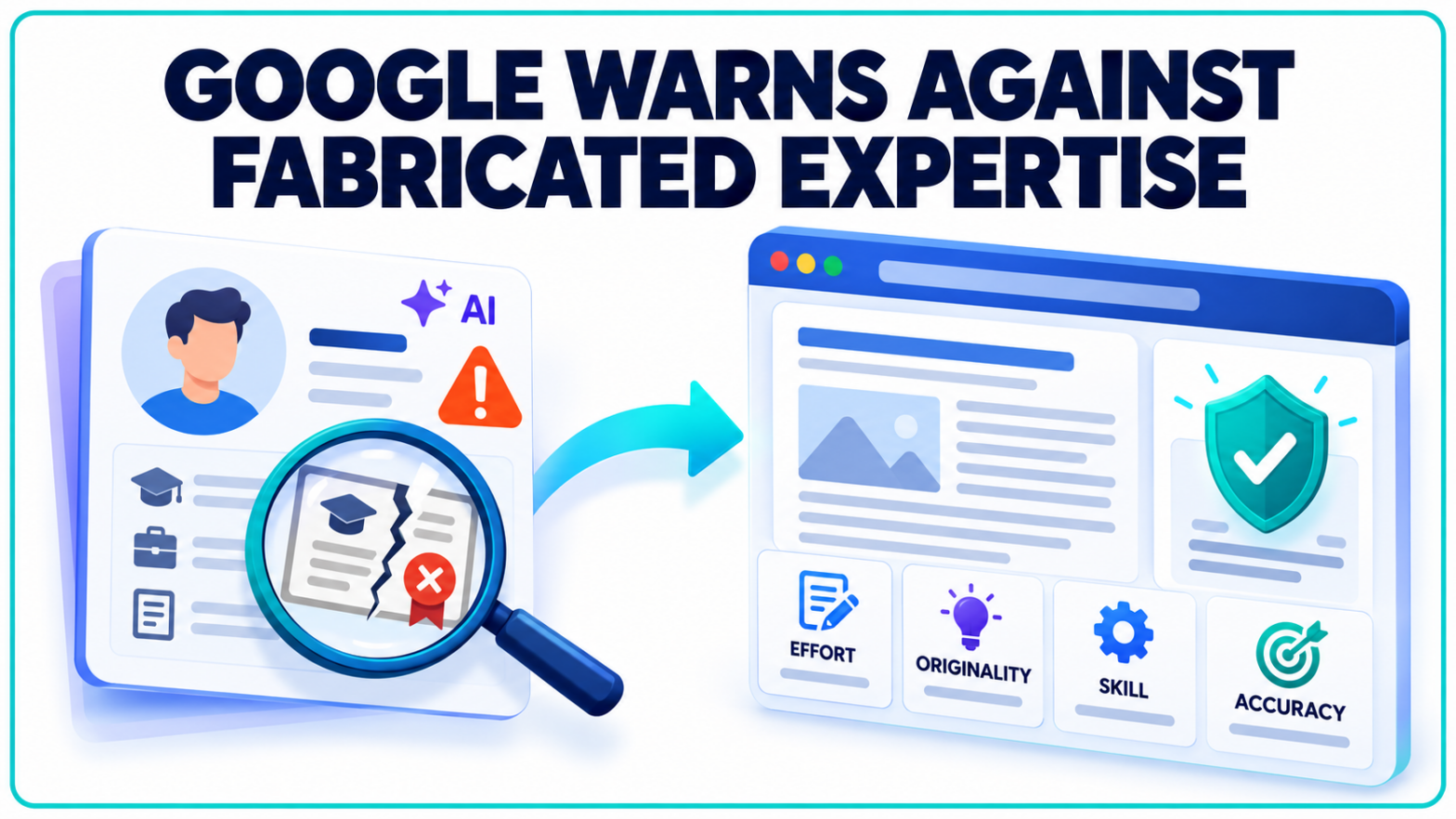
A convincing author biography can still describe someone who doesn’t exist. Google’s updated publisher guidance now explicitly identifies fabricated expertise as deception, bringing the people presented behind a page into sharper focus.
The helpful-content documentation, dated October 1, names invented creator profiles and sets out four attributes for evaluating main content. Publishers, agencies and businesses using automated production have more explicit guidance on both authorship and the work they publish.
The distinction matters: Google describes quality evaluation, not a newly announced four-factor ranking formula.
Helpful Content Cannot Borrow Credibility From an Invented Author
Google identifies AI-generated headshots, fictional names and false credentials used to make material appear written by human experts as examples of “a form of deception.” It says deception undermines trust among readers and its automated quality systems.
The warning concerns fabricated authorship. Reading it as a blanket prohibition on every AI-generated portrait would extend the wording beyond its stated context.
The paragraph does not explain how Google detects false profiles or specify a standalone penalty. Its placement beside guidance on accurate bylines makes the immediate issue clear: the identity and expertise presented to readers must be truthful.
Four Content Quality Attributes Go Beyond the Byline
The four attributes are effort, originality, talent or skill, and accuracy. Google’s Search Quality Evaluator Guidelines explain how these considerations apply to the substance of a page.
Effort can include building useful functionality or the systems behind it. It is not confined to typing an article manually. A tool can reflect considerable human work, while thousands of automatically transformed pages may show little oversight.
Originality concerns what a page contributes beyond material available elsewhere. Talent or skill concerns how effectively its creator delivers a satisfying experience. Accuracy becomes particularly consequential for information that can affect health, finances or safety, where consistency with established expert consensus matters.
Those distinctions make helpful content broader than polished prose or a detailed biography. The appropriate standard depends on what the page is meant to accomplish.
A short social post and a documentary do not require identical production effort. Both need enough work to serve their audience. The rater framework therefore supports a contextual assessment, rather than treating every page as the same kind of publishing assignment.
AI-Generated Content Remains Eligible for Search
Google’s position on automation predates this documentation change. In its February 2023 explanation of AI content, the company said its focus was the quality of published material, rather than the production method alone.
That guidance recognized useful automated publishing, including weather forecasts, sports scores and transcripts. It also distinguished those uses from automation intended primarily to manipulate search rankings.
For an SEO strategy, the distinction is substantive. AI use does not confer a ranking advantage, and human authorship does not establish quality by itself. Google’s explanation says useful, original material can perform well; the tool used to produce it is not sufficient evidence either way.
The same guidance discusses accurate bylines where readers expect them and disclosures where readers would reasonably want to understand the production process. These are explanations of accountability and method. Listing an AI system as the author is not presented as a substitute for explaining how automation contributed.
Editorial Review Extends Beyond the Article
Google’s separate guidance on using generative AI content makes the review obligation more concrete. It recognizes research and organizing original material as useful applications, while warning that generated outputs can contain inaccuracies.
Google calls for manual fact-checking and review before publication.
That review extends to elements readers may encounter before opening the page: title elements and meta descriptions, along with structured data and image alternative text. An accurate article can still be accompanied by an inaccurate description or misleading markup.
The document also encourages context about how automated content was made, presented in a way that suits the audience. It directs publishers to consider accuracy, quality and relevance throughout the finished work.
In practice, marketing teams and agencies reviewing AI-generated content have several connected editorial responsibilities: verifying claims, confirming who wrote or reviewed the material, and checking that metadata reflects the page. Approval records can identify the actual reviewer and supporting evidence. Those records support publishing accountability; they are not a Google ranking submission or a guaranteed route to better visibility.
Scaled Content Abuse Has a Separate Policy Test
The authorship warning sits alongside an existing policy against producing large amounts of material primarily to manipulate rankings. Google’s scaled content abuse policy focuses on purpose and user value, regardless of how pages are created.
Its examples include generating many pages with AI without adding value, combining material from other websites without a useful contribution, and transforming scraped content through techniques such as synonym replacement.
Spreading that production across multiple sites to conceal its scale is another listed example. A network of differently branded websites does not, by itself, change the underlying activity.
The policy also distinguishes scraping from useful publishing. Republishing another site’s work with minor wording changes can remain abusive; acknowledging the source does not automatically supply original value. A genuine byline cannot resolve that separate content problem.
The timing of the documentation changes needs equal care. Google’s October 1 documentation log records an update to its generative-AI guide, explaining that information from the rater guidelines was added to align the documentation with developer-event presentations.
That entry describes a documentation revision. It does not announce a new ranking-system rollout, an enforcement start date or a recovery timetable for affected websites.