
Google has deployed an automated system capable of investigating coordinated networks of AI-generated content without human reviewers. Google Research published the paper describing the system, titled The Synthetic Gap: Automating Forensic Investigation of "AI Slop" with the Scaled Abuse Forensics Examiner (SAFE), with document metadata dated May 28, 2026, according to records on ResearchGate and the Google Research author profile for Abhinav Mathur.
What SAFE Is and How It Works
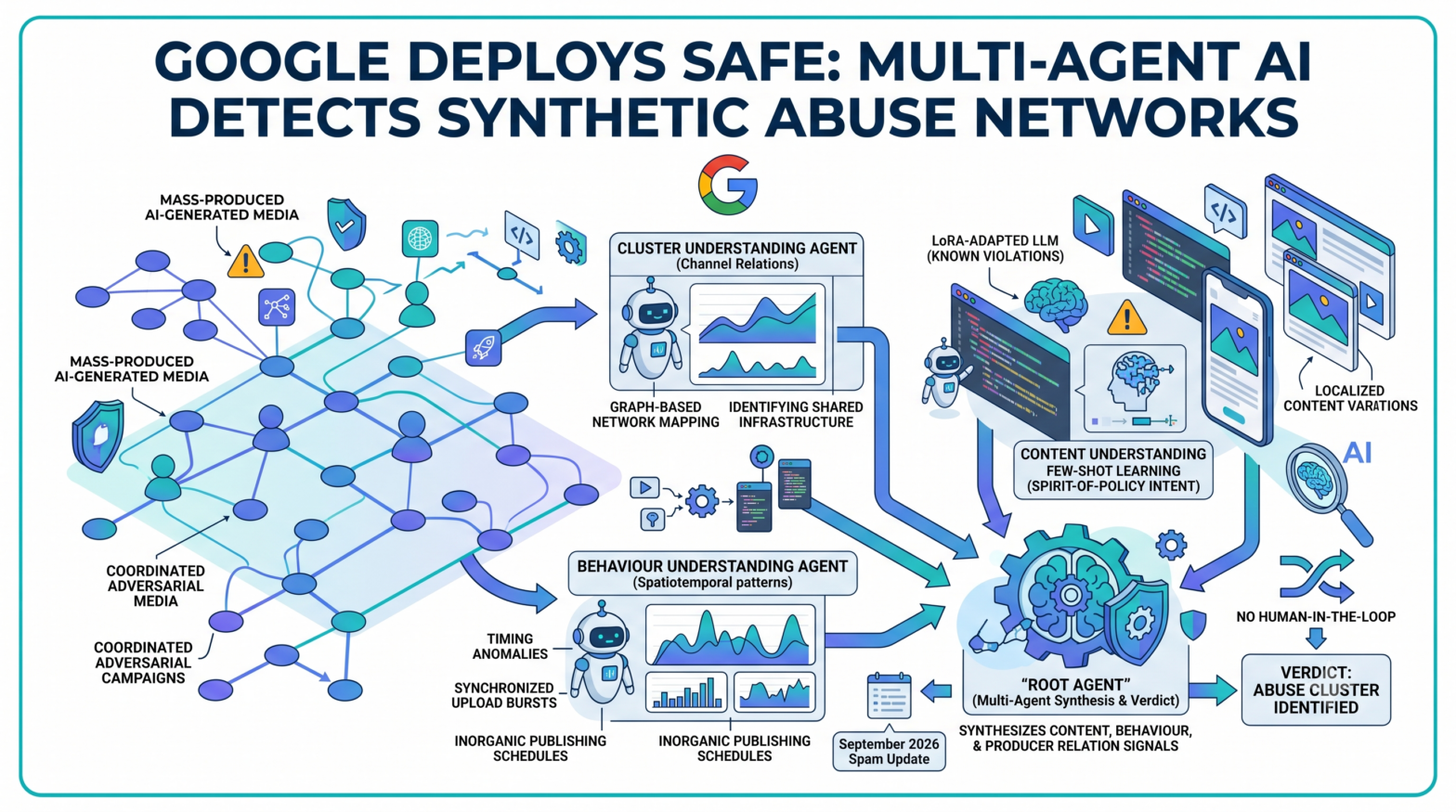
SAFE, Scaled Abuse Forensics Examiner, is described in the paper as an automated multi-agent architecture designed for the scalable forensics of adversarial synthetic media. The system does not evaluate individual pieces of content in isolation. According to the paper's abstract, generative AI has enabled malicious actors to flood online platforms with mass-produced synthetic media, and adversarial campaigns typically use coordinated networks to distribute localized variations of that content, making static detection methods ineffective.
The system decomposes the investigation process into specialized agents: a Cluster Understanding Agent specialized in analyzing relations between channels, a Behaviour Understanding Agent that identifies inorganic spatiotemporal patterns, and a Content Understanding Agent that uses LoRA-adapted Large Language Models and few-shot learning to detect existing policy violations and spirit-of-the-policy violations. A Root Agent synthesizes these multimodal signals to render a final verdict.
The Content Understanding Agent operates across two modes. It uses a LoRA-adapted model to identify known violations and a few-shot-trained model to identify content that may not match any existing rule but still violates the intent of a platform policy, what the paper calls "spirit of policy" violations. This distinction matters because it allows SAFE to act on content that conventional classifiers and fine-tuned detection models would not flag.
The Scale Problem SAFE Is Designed to Address
The paper frames SAFE as a direct response to a detection gap it calls the "synthetic gap." According to the paper, manual forensic investigations cannot scale to match the velocity of generative attacks. These adversarial campaigns utilize coordinated networks to distribute unique, localized variations of synthetic content, rendering static detection methods ineffective.
The Behaviour Understanding Agent addresses this by scanning for timing anomalies, synchronized uploads, burst publishing schedules, and infrastructure patterns that deviate from normal human activity. The Channel Cluster Understanding Agent maps relationships across content producer networks using a graph-based system, identifying shared infrastructure to surface the full scope of a coordinated operation rather than treating individual accounts as unrelated cases.
Early Deployment Confirmed, Results Not Disclosed
The paper claims early deployment results show faster investigations but publishes no figures. The document carries a creation date of May 28, 2026, publishes no test results, and does not mention Google Search anywhere in its text. The three-page paper is unusually brief for a systems research document and withholds methodology details that would typically appear in published academic work.
The paper does confirm active use of the system, stating that SAFE "significantly accelerates the identification of novel synthetic threats, reducing forensic investigation time compared to human-in-the-loop workflows."
SAFE as Google's Second AI Spam System Published in 2026
SAFE is the second system identified in 2026 that Google has developed to detect AI-generated spam. The first, called the Scalable Cluster Termination System (S-CTS), was described in a separate Google Research paper. S-CTS comes from a paper titled "Scalable Detection of Adversarial Synthetic Slop and Coordinated Media Abuse: A LoRA-Enabled Multimodal Defence System." Over six months of operation, S-CTS terminated 50,000 clusters, including 130,000 channels generating synthetic spam.
S-CTS detects AI spam by analyzing groups of related accounts together, using Sentence-BERT text embeddings and infrastructure signals rather than judging one page at a time. Where S-CTS focuses on cluster-level pattern matching and termination, SAFE adds a forensic investigation layer with specialized agents capable of reasoning about content, behaviour, and producer relationships simultaneously.
Context: Google's September 2026 Spam Update
The circulation of the SAFE paper among search marketers coincided with the launch of Google's September 2026 spam update. Google kicked off the September 2026 spam update on September 24, 2026, per its Search Status Dashboard, beginning at 9:15 a.m. Pacific, covering every country and language, with a rollout window of up to two weeks.
The September 2026 spam update is the fourth spam update released this year, making 2026 the most active year for Google spam updates since 2021. Google released spam updates in March, June, August, and September, compared with three updates in 2024 and only one in both 2023 and 2025.
The September 2026 update may affect sites that rely on large volumes of low-quality automated content, although Google has not confirmed that AI-generated content is a specific target of this rollout. Google has not said whether this update targets a specific spam policy or tactic.
What This Means for Publishers and Content Teams
The paper's framing, and the architecture it describes, has implications that extend beyond video platforms. SAFE's logic evaluates content, behavioural patterns, and producer infrastructure together. Publishers operating at high content velocity with shared hosting, common publishing automation, or templated content structures across multiple properties could fall within the scope of cluster-level analysis, regardless of whether each individual piece of content would pass a standalone quality review.
Google's policy still targets scaled, low-value content built to manipulate rankings, not AI use itself. The distinction matters practically: the policy does not ban AI-assisted writing; it targets pages published in bulk with no editorial value, whether a person or a tool created them.
The SAFE paper's abstract states that signals to detect coordination often have recall gaps: the content is not exactly duplicative enough to fall into the same repetitive cluster, but abusers show similar patterns of behaviour that require forensics. SAFE is designed to close that gap through agent-based investigation rather than classifier-based filtering alone.