
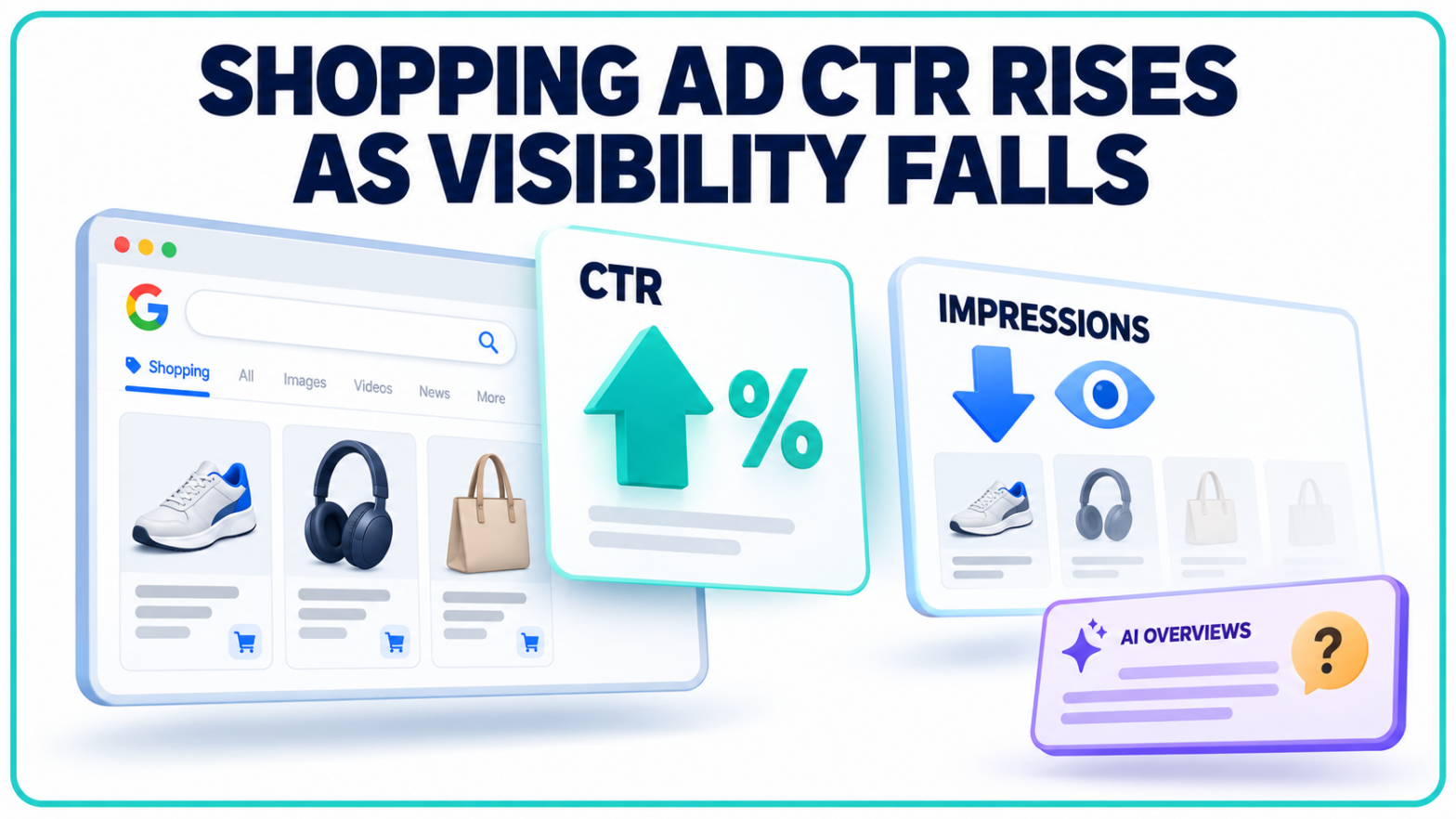
A higher Shopping ad click-through rate can arrive with fewer clicks. That distinction is central to an analysis finding that retail campaigns are losing impressions faster than they are losing traffic.
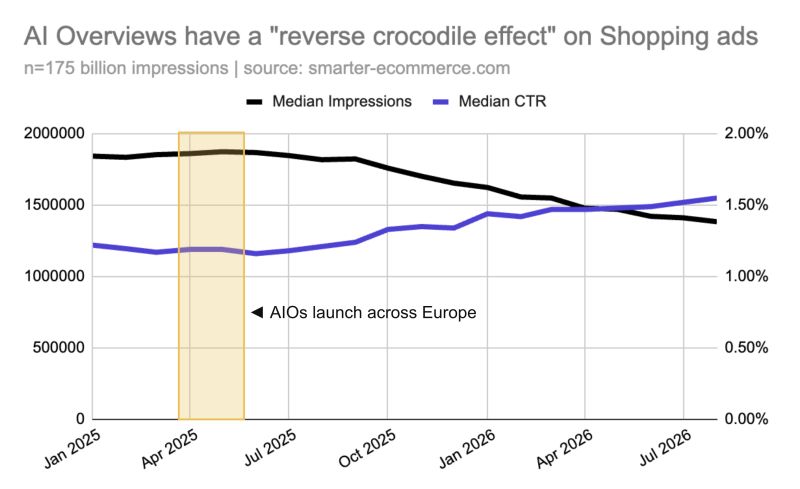
Mike Ryan, head of ecommerce at Smarter Ecommerce, examined thousands of Shopping and Performance Max campaigns across hundreds of advertiser accounts. Clicks were often broadly unchanged or slightly lower, while impressions declined more sharply. His public explanation of the pattern proposes a possible connection to Google's AI Overviews, though the evidence does not establish causation.
For retailers, the immediate question is whether an improving percentage reflects stronger commercial performance or simply fewer occasions on which an ad appears.
Shopping Ad CTR Can Rise Without Another Click
The arithmetic is straightforward. Google's definition of click-through rate divides clicks by impressions. Either side of that calculation can change the percentage displayed in an account.
Consider a hypothetical campaign with 100,000 impressions and 2,000 clicks. Its CTR is 2%. If impressions fall to 80,000 while clicks stay at 2,000, CTR reaches 2.5%: a 25% relative increase without any additional traffic.
Even a decline to 1,900 clicks would leave CTR at approximately 2.38%. A report focused on the rate would show an improvement while the business received fewer ad clicks.
CTR remains useful for understanding engagement. It does not measure the total traffic delivered, the number of purchases completed or the revenue those purchases generated. For Shopping ads, a stronger rate and a smaller volume of activity can coexist in the same reporting period.
Earlier Shopping Data Shows Why Sales Need a Separate Reading
Smarter Ecommerce's earlier Q1 2026 European ecommerce benchmark report provides a concrete example of those metrics moving apart. The report covers more than €650 million in European advertising spend across Search, Shopping and Performance Max.
It reported Shopping impressions down approximately 17% year over year, with clicks down about 6.5%. Performance Max impressions fell roughly 11%, compared with a 1.5% decline in clicks.
Yet the same report put Shopping conversion growth at approximately 32%, with spending broadly flat. Falling impressions did not coincide with falling conversion volume in that dataset.
Those are earlier, geographically defined benchmarks, not measurements of the latest week or a finding about Canadian retailers. They illustrate why neither a higher CTR nor a lower impression count can settle the performance question alone.
Separately, Optmyzr's Q2 2026 CTR benchmark analysis reported a median account CTR of 4.64%, up 8.62% year over year. That figure covers Google Ads accounts across campaign types; it is not a Shopping-specific target.

The AI Overviews Explanation Still Needs Evidence
Ryan's hypothesis concerns which search experience Google serves. He suggests Google may favour AI Overviews on queries with a lower predicted probability of an ad click, retaining advertising opportunities on searches more likely to generate one.
Under that proposed mechanism, the remaining impressions would attract clicks at a higher rate. It is an explanation for the pattern, not a demonstrated account of Google's selection process.
Google's documentation on ads and AI Overviews confirms that ads can appear above, below or within an overview. Shopping and Performance Max campaigns can qualify, and placements inside the answer require relevance to both the query and the generated content.
The documentation does not confirm Ryan's proposed use of predicted CTR to choose between experiences. Nor does the analysis isolate AI Overviews from other influences on campaign delivery.
Eligibility also differs from frequency. The fact that AI Overviews can contain Shopping ads does not establish how often that happens for a particular retailer, product category or set of searches.
Performance Max Reporting Has Another Comparison Problem
There is a separate measurement change to account for when reviewing historical product data.
Google says its expanded product reporting, introduced in June 2026, includes all Performance Max networks. Previously, product metrics covered Performance Max ads on Search networks and Standard Shopping campaigns. Google warns that the expansion may produce a one-time increase in impressions, clicks and other Performance Max metrics.
That documented increase does not explain Ryan's reported decline. It does establish a reason to check whether historical comparisons use the same reporting scope.
Product impressions also differ from campaign impressions. Google counts each product shown within an ad separately at product level: an ad containing five products can generate five product impressions from one ad appearance. Mixing those totals would distort an assessment of visibility.
For Performance Max reporting, Google's channel performance report provides channel breakdowns and segments for ads using product data. Those views help distinguish changes in where a campaign serves from changes in its overall results.
They do not identify the specific contribution of ads inside AI Overviews.
Revenue Remains Outside the CTR Calculation
In practical reporting, impressions, clicks, purchase conversions and revenue are assessed together over comparable periods, alongside spend. A review also checks product eligibility, budget and bidding changes, seasonality and conversion tracking before assigning a cause to a movement in CTR. For ecommerce accounts, conversion value represents sales revenue only when the tracked purchase values support that interpretation.
Two campaigns can post the same CTR increase and produce different commercial outcomes. One may generate more purchases from fewer clicks; another may lose both traffic and sales. The percentage alone cannot distinguish them.
Google currently says advertisers cannot directly target or opt out of placements within AI Overviews, and it does not offer segmented reporting for those placements. Account reports can show how clicks and sales changed. They cannot currently provide a separate AI Overviews performance line to establish its contribution.