

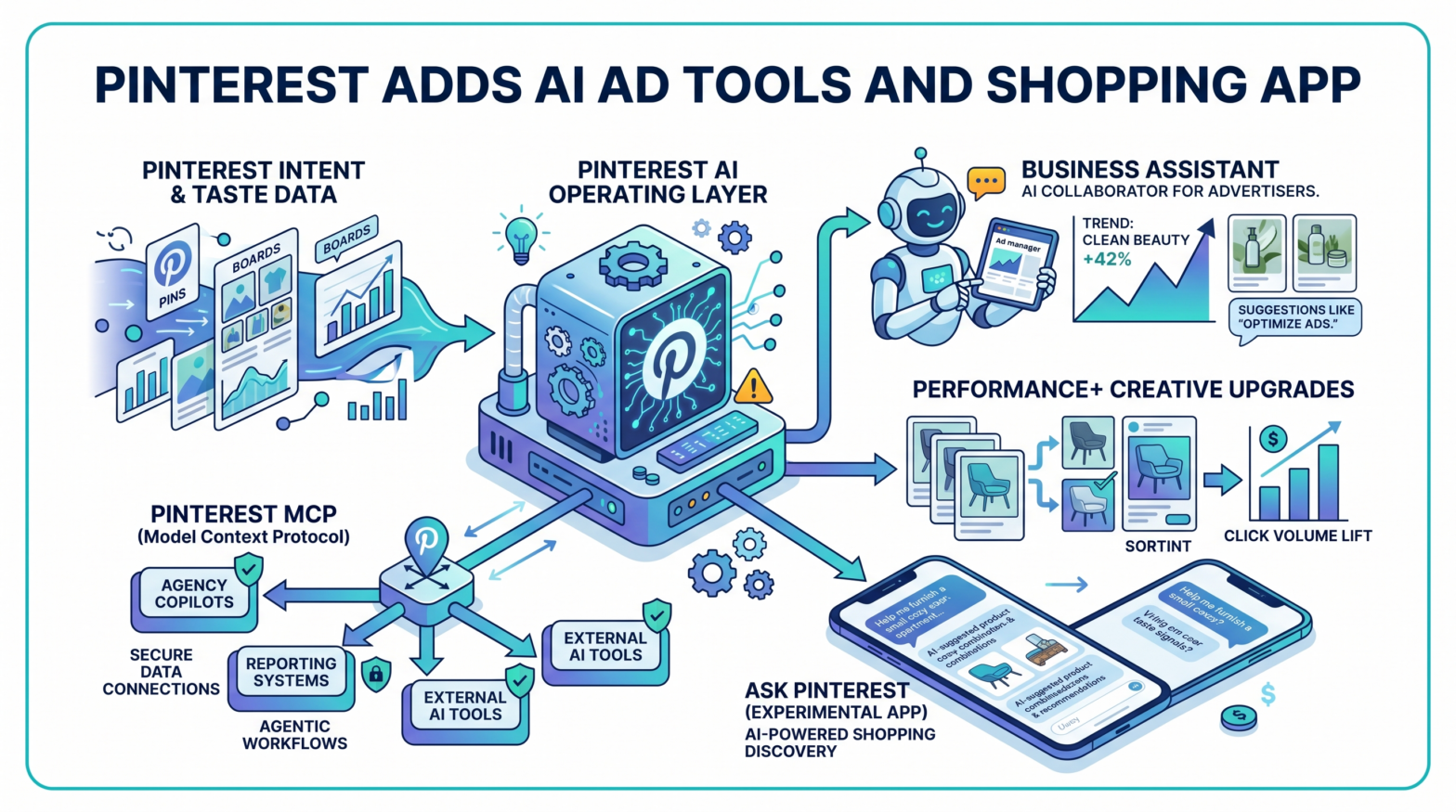
Pinterest is turning its intent data into an AI operating layer.
The company introduced a new set of AI tools on June 17, 2026, aimed at advertisers, agency partners, and shoppers as visual discovery moves away from simple keyword searches and toward more personalized, conversational recommendations.
The rollout includes Business Assistant, a new AI collaborator for advertisers; Pinterest MCP, an infrastructure layer for connecting Pinterest data to external AI tools; expanded Pinterest Performance+ creative capabilities; and Ask Pinterest, a limited-access experimental app for AI-powered shopping.
The timing is deliberate. Cannes Lions has become a battleground for platforms trying to define what advertising looks like when search, social, commerce, and AI assistants begin to overlap. Pinterest is positioning itself less as a social feed and more as a decision engine built around taste, planning, and commercial intent.
Pinterest Wants AI To Understand Taste, Not Just Queries
Pinterest’s pitch starts with a simple distinction: people do not use the platform only to find information. They use it to plan what to buy, cook, wear, decorate, visit, and build.
That matters in an AI discovery environment.
Traditional search advertising is built around declared intent. A user types something, an auction runs, and a result appears. Pinterest’s argument is that its data is richer because users save, organize, and revisit ideas over time. The platform can see not just what someone searched for once, but what they are considering across a longer decision cycle.
Pinterest Chief Business Officer Lee Brown framed the shift around “context, taste, and trusted recommendations,” according to the company’s announcement.
That phrase explains the larger strategy. Pinterest is not trying to bolt a chatbot onto an ad product and call it innovation. It is trying to make its taste graph available across ad creation, campaign reporting, creative testing, and shopping discovery.
That puts Pinterest in the same broader competitive field as Google, Meta, TikTok, Microsoft, and OpenAI, all of which are using AI to reduce manual campaign work while creating new surfaces for commerce. TechWyse recently covered similar movement in Google Marketing Live 2026, where Google introduced AI-driven ad and commerce tools designed for longer, more complex consumer journeys.
Pinterest is now making its own version of that bet.
Business Assistant Brings Campaign Guidance Into Ads Manager
Business Assistant is Pinterest’s new AI collaborator for advertisers, currently in a closed beta in the United States.
The tool is being built into Pinterest Ads Manager and mobile workflows. Rather than functioning as a generic help bot, it is designed to understand an advertiser’s business, campaign context, and Pinterest platform signals. Pinterest says it can surface trend data, show campaign opportunities, and recommend optimizations in a more visual format than a standard text assistant.
That visual layer matters.
Pinterest gave the example of a trend such as “clean beauty routine” rising 42% in a week. Instead of returning a written explanation alone, Business Assistant can display the trend in a graph and show top Pins associated with that behaviour. The advertiser gets both the signal and the creative context surrounding it.
For performance teams, that changes the role of trend monitoring. Instead of manually checking reports, scanning Pinterest Trends, and deciding which Pins to promote, the assistant can bring relevant opportunities into the campaign workflow.
Pinterest is also bringing Business Assistant to mobile, with proactive notifications about performance status, trends, and optimization openings. That turns the tool from a passive query interface into something closer to an always-on campaign monitor.
Meta has moved in a similar direction with AI business tools across messaging and commerce. TechWyse recently reported on Meta Business Agent’s global launch, which brought automated sales, lead qualification, and customer support into WhatsApp, Instagram, and Messenger. Pinterest’s version is more advertiser-facing, but the direction is familiar: AI is being embedded where business decisions already happen.
Pinterest MCP Opens The Door To Agentic Ad Workflows
The more technical part of Pinterest’s announcement is Pinterest MCP, built on the Model Context Protocol.
MCP is designed to let AI systems connect securely to external tools and data sources. For Pinterest advertisers, that could allow agency copilots, reporting systems, and agentic marketing tools to access Pinterest campaign data, analytics, and keyword insights without forcing teams to switch platforms.
Pinterest says the MCP layer can ground external AI workflows in its platform-specific signals, including taste, trends, and intent.
That is important because generic AI campaign advice is often too thin to be useful. A model can explain what good creative looks like in theory. It cannot reliably tell a team which Pinterest trends are rising, which campaign assets are underperforming, or which keyword clusters are generating momentum unless it has controlled access to platform data.
Pinterest is developing MCP with alpha partners including PMG, Pacvue, Dentsu, Havas, Innovid by Mediaocean, and Omnicom’s Jump450. The early focus spans reporting, analysis, campaign planning, and execution.
TikTok has also moved in this direction. Its 2026 advertising update included an MCP server for connecting TikTok marketing data to AI workflows, as TechWyse reported in its coverage of TikTok World 2026. Pinterest’s entrance confirms that MCP is becoming more than a developer-side AI standard. It is becoming part of the ad platform stack.
For agencies, the practical value is straightforward. Reporting and campaign planning can move closer to natural language interfaces, but the quality of output will depend on the depth, freshness, and permissions around the underlying data.
Performance+ Creative Moves Optimization To The Asset Level
Pinterest is also expanding Pinterest Performance+ creative with a new AI model for dynamic creative selection.
The model evaluates a broader set of ad variations and selects the creative most likely to perform for each impression. Pinterest says the upgrade shifts optimization from the ad level to the asset level, giving the system more room to match specific creative variants to individual moments.
In testing, Pinterest said the new model increased click volume by 7.5% compared with its previous single-variant model.
That number should be read carefully. It is a platform-reported test result, not a universal performance guarantee. Still, it points to a clear direction in paid media: creative variation is becoming a machine-learning input, not just a design task.
Advertisers are being pushed to produce more modular creative assets, test more combinations, and rely on platform systems to match the right variation to the right user. Pinterest’s added ad review tools and creative reporting breakouts are meant to give advertisers more visibility into how those variations appear and perform.
The shift echoes what is happening across search and social. Google is folding Gemini deeper into campaign creation and measurement, while Meta has been advancing multimodal creative systems for ad-supported environments. TechWyse previously covered Meta’s Muse Spark AI model, which connects visual search, shopping intelligence, and creative workflows across Meta’s platforms.
Pinterest’s advantage, if it can sustain it, is that its creative context is already visual and commercial. A Pin is not just an image. It is often a saved intention.
Ask Pinterest Tests Shopping Outside The Main App
Ask Pinterest is the most consumer-facing piece of the rollout.
The limited-access app is designed to test conversational, visual-first, and agentic shopping experiences outside Pinterest’s core app. Pinterest says it will use the company’s Taste Graph and proprietary signals around intent, preference, and taste to produce more personalized recommendations.
The use cases Pinterest highlighted are not simple product searches. They involve multi-step decisions: planning a dinner party on a budget, finding a personal gift, or furnishing a room over time.
That is where AI shopping tools are trying to move next.
A single search query can answer “black dining chair.” It is much harder to answer “help me furnish a small apartment over the next six months without making everything look mismatched.” Pinterest already has years of behaviour around exactly those messy, visual, preference-heavy decisions.
Ask Pinterest gives the company a separate testing ground for that behaviour. Lessons from the app are expected to inform future AI-powered experiences inside Pinterest’s main product.
For marketers, the practical implication is that Pinterest advertising may become more dependent on feed quality, creative variation, product context, and platform-readable brand signals. Campaign teams will still need clear objectives and measurement discipline, but AI-assisted discovery rewards assets that can be interpreted, matched, and recommended across longer decision paths.
Pinterest is not alone in trying to own that path. Google is building AI into search and commerce. Meta is building agents into messaging and shopping. TikTok is pushing entertainment closer to transaction. Pinterest’s move is narrower, but also cleaner: discovery, taste, planning, and purchase intent are already part of the same user behaviour.
The company will showcase the updates around Cannes Lions 2026, where the industry’s biggest platforms are competing to define the next interface for advertising. For Pinterest, that interface is no longer just the search bar or the feed. It is the layer between inspiration and action.