
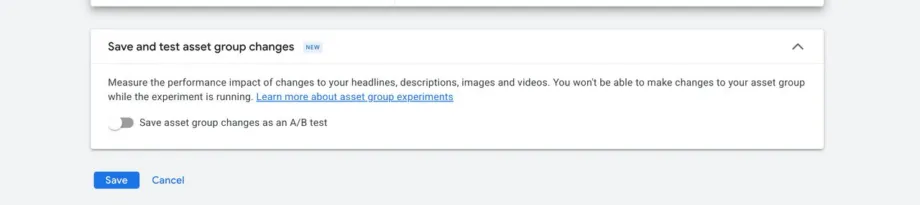
Performance Max creative testing may be moving into the place where advertisers actually build their ads. An A/B testing toggle has appeared inside a live asset group, suggesting Google is testing a more direct route into its existing experiment system.
The sighting does not introduce an entirely new testing method. Google already documents a beta for comparing two creative sets within one Performance Max asset group. The potential change is access: advertisers may be able to begin that comparison without first navigating through the separate Experiments section.
A Testing Shortcut Appears Beside the Creative
Google Ads coach Joey Bidner shared the account-level sighting on October 20. The interface showed an A/B testing toggle inside an asset group, where Performance Max advertisers manage headlines, descriptions, images and other creative material.
That location matters.
Google’s documented setup currently sends advertisers through Experiments, where they select Assets, advertiser-provided assets, Performance Max and the appropriate experiment type. Placing a toggle inside the asset group could shorten that route and make experimentation feel like part of routine creative management.
The observed screen does not establish whether the toggle changes eligibility, traffic allocation or reporting. Google has not published an announcement confirming universal availability or explaining whether the interface is a limited test.
For now, it is best understood as a possible new entry point into Performance Max A/B testing, rather than a separate experiment product.
Google’s Existing Beta Defines the Test Mechanics
Google’s official documentation already describes how Performance Max asset A/B testing works.
The beta divides creative into three categories:
- Control assets are the existing “A” set used as the reference point.
- Treatment assets form the alternative “B” set and may include existing or newly uploaded creative.
- Common assets are not assigned to either set and continue serving across all experiment traffic.
Advertisers choose how traffic is divided between the control and treatment arms. Both operate inside one campaign and one asset group, avoiding the need to duplicate an entire Performance Max campaign and divide its budget between two separate builds.
Google sets the experiment to begin the following day. Its guidance system estimates the duration required to gather sufficient data, although Google recommends allowing at least four to six weeks.
That timing is important because Performance Max does not serve a fixed advertisement. Google combines creative assets dynamically across Search, YouTube, Display, Discover, Gmail, Maps and other eligible inventory. The experiment therefore compares how two asset sets perform within that automated system, not two static ads appearing in identical placements.
Distinct Creative Sets Produce a More Useful Answer
The toggle could make launching a test easier. It cannot decide what question the test should answer.
A useful asset group experiment begins with a defined creative hypothesis. One treatment might emphasize speed and convenience while the control focuses on expertise and service quality. Another could compare product-led imagery with customer-focused lifestyle creative.
Changing one headline while leaving a large pool of common headlines, descriptions and images available to both arms may produce a result that is difficult to interpret. Google can continue combining those shared assets with the control and treatment material, reducing the separation between the two creative approaches.
A complete alternative set creates a clearer comparison, but it also changes several variables at once. If new headlines, images and descriptions collectively outperform the control, the advertiser learns that the treatment package performed better. The result does not identify which individual asset caused the difference.
That distinction is particularly important as Google expands the automation applied to Performance Max creative assets. Advertiser-supplied material may be resized, assembled into different formats or combined according to the placement and predicted user response. The experiment measures the package operating within that environment.
Asset Groups Are Locked While the Test Runs
Google imposes several restrictions intended to preserve the validity of its asset group experiments.
Once a test begins, advertisers cannot edit, add or remove assets in the participating asset group. Its editing pages switch to a view-only state until the experiment ends. Both the control and treatment material also count towards the asset group’s normal limits.
New treatment assets must pass the standard Google Ads policy review before they can serve. Each experiment is limited to one asset group, and a campaign with an overlapping experiment or unsupported configuration may be ineligible.
Google’s broader Performance Max experiment documentation also separates asset testing from other experiment types. Uplift experiments measure the incremental contribution of Performance Max alongside other campaigns. Upgrade experiments evaluate a shift from an existing campaign type into Performance Max. Asset experiments answer the narrower question of whether a creative or asset-setting change improves results.
A test can still finish without producing a clear winner. Low traffic, insufficient conversions, a small difference between variants or a short testing period can leave the experiment without enough evidence for a conclusion.
For marketers, the practical requirement is to choose the success metric before launching the test. Conversion value, cost per acquisition and click-through rate answer different questions. Reliable conversion tracking and an agreed business objective matter more than the convenience of the new toggle.
The Toggle’s Availability Remains Unconfirmed
Google continues to label its asset comparison capability as beta. It has not published a universal availability date for the feature or confirmed how many accounts can access the newly observed asset-group toggle.
That leaves two separate rollout questions.
The first is whether an advertiser can run an asset comparison experiment at all. The second is whether the test can be initiated directly from the asset group rather than through the main Experiments workflow. An account may receive one interface without establishing that the other has reached general availability.
The sighting nevertheless reflects a broader shift in Google Ads experiments. Testing tools are being attached more closely to the campaign settings, assets and measurement questions they are designed to evaluate.
When a Performance Max asset test ends, advertisers can apply the treatment assets to the original group or end the experiment without making changes. Google keeps the control assets by default when the treatment is applied; removing them requires a separate selection. Ending the test without applying it discards newly uploaded treatment assets and returns the asset group to its original state.