

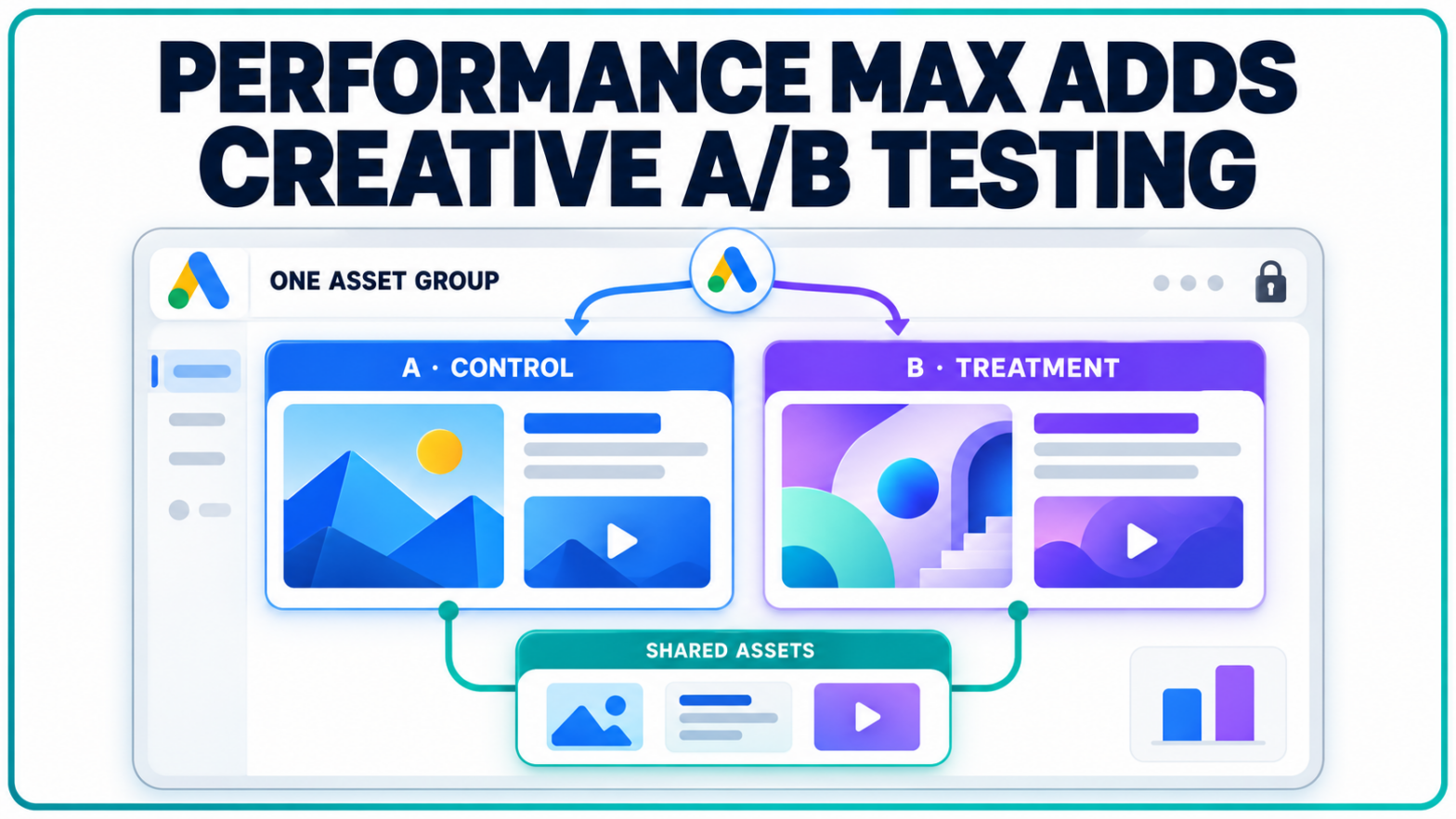
Performance Max advertisers can compare creative alternatives without building a second campaign. Google’s documented asset A/B testing beta compares two sets within one asset group.
The feature addresses a familiar measurement problem: a campaign improves after new creative arrives, but the timing alone does not establish that the creative caused the improvement. A concurrent comparison gives advertisers a more structured way to evaluate that change.
For agencies and in-house teams, the central question shifts from which asset accumulated the most activity to whether an alternative creative set improves the campaign's measured outcome.
Creative Testing Keeps a Shared Starting Point
Google’s A/B testing documentation separates existing control assets, treatment assets and common assets that serve alongside both. Advertisers choose the traffic split.
Setup runs through Experiments, Assets, Assets provided by you, Performance Max and Any assets. Each experiment covers one asset group.
Tests start the following day. Google’s guidance system estimates an end date and recommends four to six weeks. Asset editing is locked during testing; both sets count towards limits, and new uploads require policy approval.
Common assets make the scope of the comparison important. The experiment evaluates the selected difference within a shared creative environment; it does not automatically isolate every component of a finished ad.
In practical creative testing, changing several elements together can answer whether a new creative package performs better. It cannot identify which individual change caused the difference without further testing. That is an experimental-design limit, even when the platform handles traffic allocation.
Performance Max Experiments Already Answered Other Questions
Google’s existing asset-testing guide describes two other comparisons: adding text, images and video to a product-feed-only campaign, and measuring the incremental effect of video.
Those tests also operate within one campaign. For the video comparison, the control traffic receives no video assets, including automatically generated videos, while the treatment receives video. Text and image assets remain available to both sides.
That answers a format question: what changes when video is available?
Comparing alternative creative sets addresses a different decision. A team can be satisfied that a format contributes value and still need evidence about the material supplied within it.
The broader Performance Max experiments framework also includes uplift tests and campaign-upgrade comparisons. Those assess matters such as adding PMax alongside other campaign types or shifting from an existing campaign to PMax.
Asset testing therefore expands the decisions advertisers can examine inside Performance Max. It should not be described as the first time the campaign type has supported controlled experiments.
Asset Performance Reports Cannot Establish Isolated Impact
The distinction between reporting and experimentation is particularly relevant to automated ad assembly.
Google’s asset-level metrics guidance warns that figures such as click-through rate, cost per click, cost per acquisition and return on ad spend are directional at the individual-asset level. Assets serve in combinations, so those ratios do not accurately describe one element operating alone.
The totals require care too. If an ad impression includes three assets, each asset can record an impression. Adding their figures together does not necessarily reproduce the asset-group total.
Those limitations do not make asset performance data irrelevant. They define what it can support: evidence about delivery and performance in the combinations that actually ran, rather than proof that one headline caused a conversion.
Google’s separate asset-reporting guide provides views across individual assets, groups and campaigns. It also exposes recent asset changes through the Last updated column. That history can help teams identify candidates for a test and understand when their creative inventory changed.
A Higher Result Still Needs Enough Evidence
An experiment can finish without establishing a winner.
Google’s experiment-monitoring guidance distinguishes the observed performance difference from the confidence interval around it. The reporting also identifies statistical significance and can show insufficient data instead of a usable comparison.
Low traffic, a small experimental traffic share, limited duration or an undetectable performance difference can all leave a result inconclusive. A positive percentage on its own is not the same finding as a clear improvement.
The general experiment scorecard supports different metrics, with availability depending on the experiment and tracking setup. Conversion-based measures require conversion tracking. The selected measure therefore determines the question being answered: more clicks and a lower acquisition cost are different outcomes.
For campaign teams, that creates a reporting obligation as well as a testing opportunity. A result needs its metric, comparison period and uncertainty attached. Reporting only the largest favourable percentage removes information necessary to judge whether the apparent gain supports a change.
Applying a Test Changes the Creative Inventory
For marketers and account managers, the practical implication is a more deliberate creative approval cycle. A defined hypothesis, an agreed success metric and approved alternatives establish what is being tested before launch. Recording the decision afterwards separates a completed experiment from a routine asset refresh and preserves the reasoning for future account reviews.
Other reports still provide context. Google’s Performance Max evaluation guidance describes channel summaries, format breakdowns and diagnostics that expose serving constraints. These can help explain the campaign environment without replacing the experimental comparison.
A channel distribution table, for example, reports activity such as clicks, cost and conversions. It answers where performance occurred. The creative experiment answers a narrower question about the alternatives selected for comparison. Neither view, by itself, describes every reason a campaign's results changed.
Applying the experiment adds treatment assets to the original group. Keeping control assets is selected by default; removing them requires changing that selection. Ending without applying discards new treatment assets and restores the original state.
Google’s documentation still labels this capability beta and provides no universal availability date.