
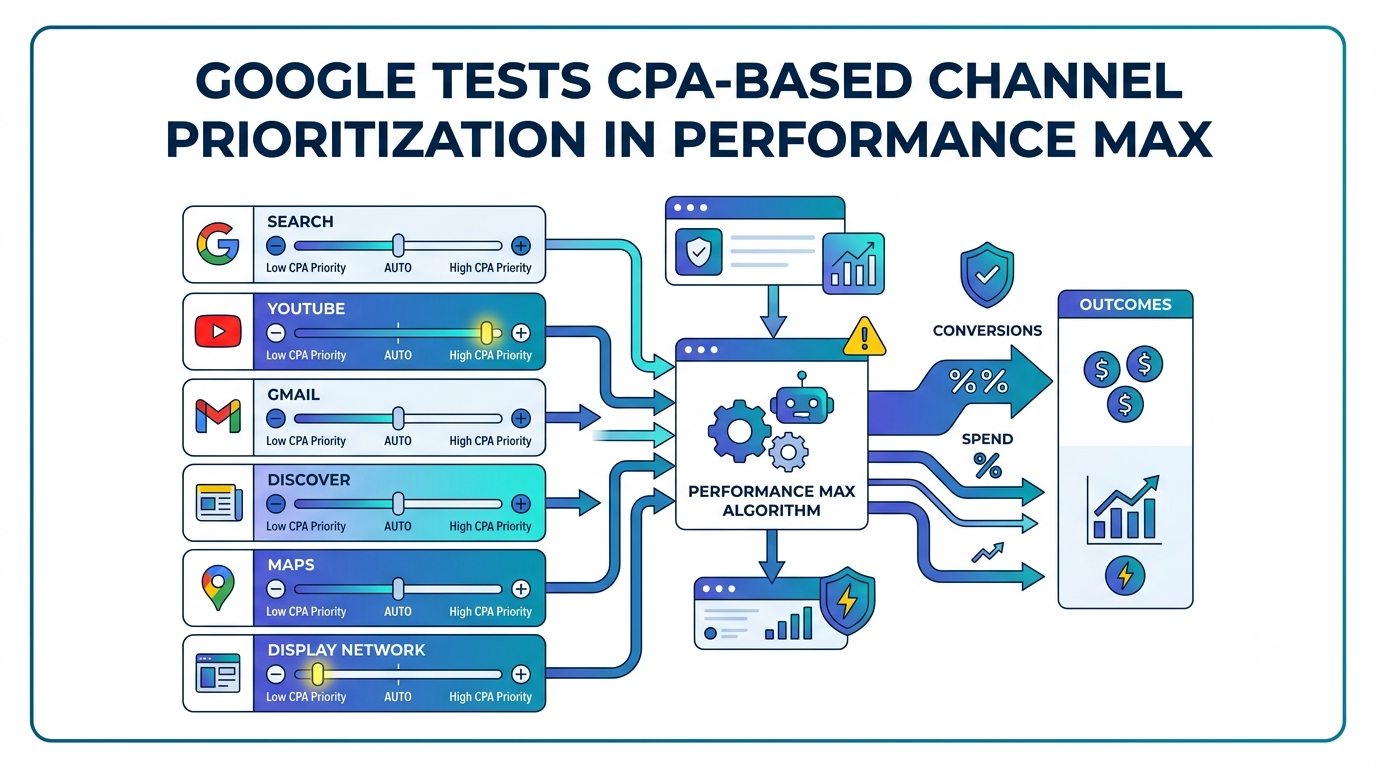
Performance Max advertisers may soon be able to tell Google's algorithm which channels to favour and which to deprioritize. An experimental "Channels" setting, observed in alpha testing inside Google Ads accounts and first reported by Search Marketing Advisor Heidi Sturrock via LinkedIn on August 25, 2026, introduces per-channel adjustment controls for the campaign type for the first time.
Google has not made a formal announcement about the feature, and no timeline for broader availability has been communicated.
What the Alpha Setting Does
The experimental interface includes a slider for each of Google's ad channels, Search, Google Partners, Discover, Maps, YouTube, the Display Network, and Gmail, allowing advertisers to adjust how much each channel is prioritized for conversions.
A positive adjustment relaxes a channel's CPA threshold, signalling to the algorithm that the advertiser places greater value on conversions from that placement. A negative adjustment tightens it, with a scale running from lower prioritization at the left through an "Auto" midpoint to higher prioritization at the right. Google's own in-product description of the feature states: "Adjust channel settings if you value a channel more or less based on its importance to your business."
The feature carries an "Alpha" label, placing it at an earlier stage than a beta release. Google has made no public announcement about the feature, and no rollout timeline has been communicated.
How This Differs From Budget Allocation Controls
The mechanism is not a direct budget split. Rather than letting advertisers assign a fixed percentage of spend to a given channel, the setting works by adjusting the economics the algorithm uses when deciding where to pursue conversions. Raising the effective CPA ceiling on a channel makes it easier for the system to buy there; lowering it makes the system less likely to commit spend.
This distinction matters because Performance Max campaigns use AI to automatically allocate budget across all Google channels to maximize conversions, with the system prioritizing channels it predicts will deliver the best performance, and, per Google's current documentation, advertisers cannot directly control budget allocation per channel. The alpha setting would be the first mechanism inside Performance Max to give advertisers a direct input into that process.
The Transparency Context
The test does not arrive in isolation. Google has been expanding Performance Max transparency incrementally since April 2025, when it announced channel-level performance reporting, full search terms reporting, and enhanced asset metrics. That reporting rollout reached accounts on May 30, 2025, following the Google Marketing Live presentation on May 21.
In January 2026, Google activated account-level placement exclusions applying simultaneously across Performance Max, Demand Gen, YouTube, and Display campaigns. In March 2026, Google added the ability for advertisers to exclude specific first-party customer lists from Performance Max campaigns, giving acquisition-focused campaigns a way to reduce spend on audiences that may already have converted.
The channel prioritization controls, if released broadly, would mark a further step: moving from reporting and exclusions into active steering of channel-level optimization behaviour.
The Attribution Complication
The controls carry a caveat that Google's in-product description itself flags. Performance Max automatically optimizes for total conversions across all channels, and adjusting these settings will directly impact overall campaign performance.
The practical risk is that channel-level attribution does not equal channel-level contribution. A user may encounter an ad on YouTube and convert days later through a Search placement. Tightening the CPA on YouTube based on its directly attributed conversion volume could reduce activity that was generating demand earlier in the customer journey, with the impact showing up as a decline in Search conversions rather than a YouTube-specific metric.
Practical Implications for Advertisers
Advertisers with access to the alpha would need to approach channel adjustments with an understanding of their full conversion path, not only last-touch data. Tightening a channel that appears to underperform on attributed CPA alone risks cutting off top-of-funnel activity that feeds downstream conversions. The appropriate use case is one where channel reporting has already identified a channel with consistently poor performance across multiple attribution windows, not a single period of weak directly-attributed results. Advertisers without access to the alpha can contact their Google Ads representative to request eligibility.
Access and Status
Sturrock noted on LinkedIn that the setting allows advertisers to "control how much you prioritize conversions across different channels" and to "guide the algorithm to invest more heavily into the specific channels you find most valuable." She advised that the feature is not yet universally available and that advertisers should contact their Google representative if they do not see it in their accounts.
Google's existing support documentation, as of August 2026, continues to state that advertisers cannot directly control per-channel budget allocation inside Performance Max and lists assets, audience signals, search themes, and conversion tracking as the available levers for influencing channel mix.