
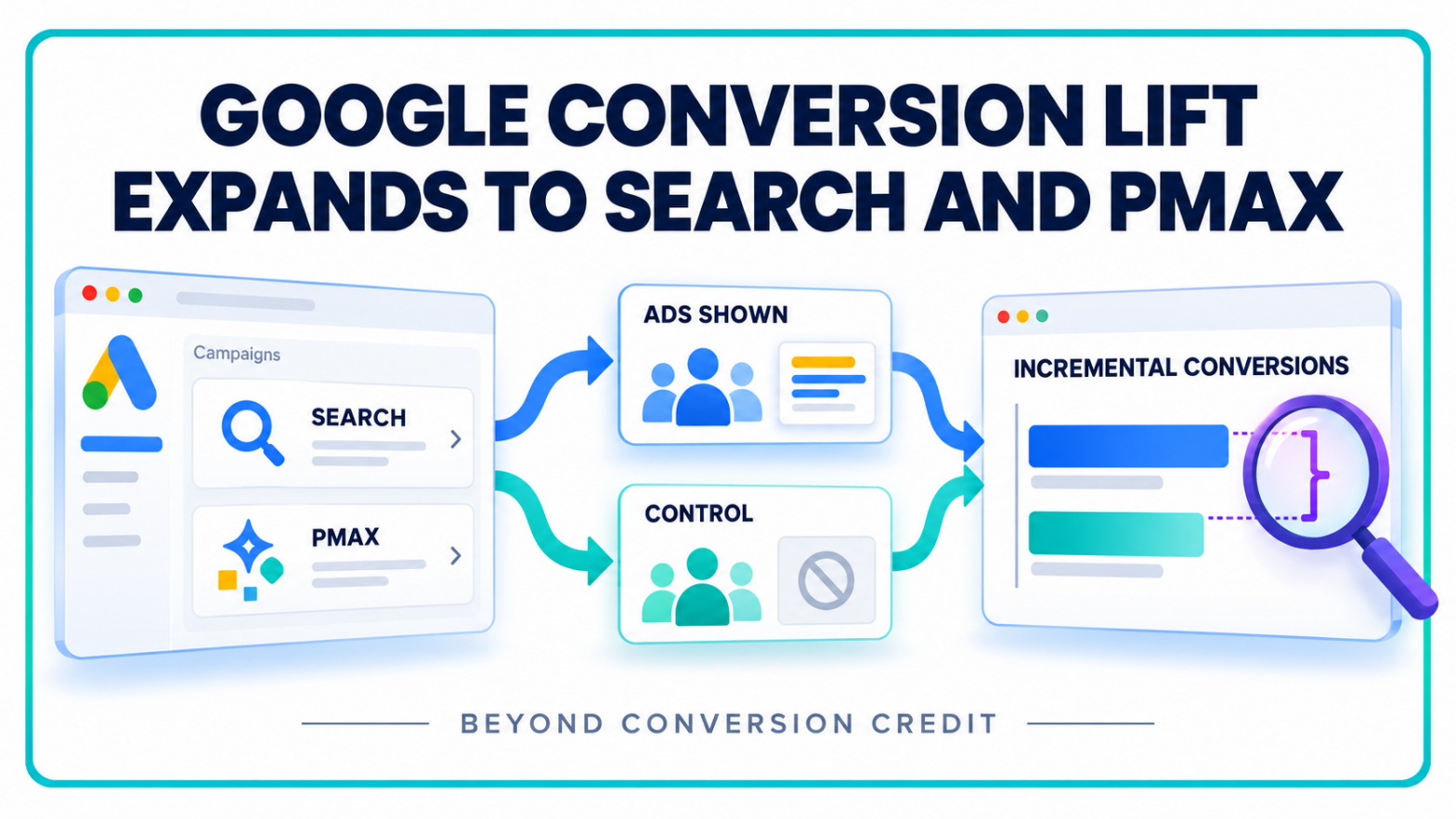
A campaign can receive credit for a sale without proving it caused that sale. Google’s expanded user-based Conversion Lift support gives eligible Search and Performance Max advertisers a way to examine that gap.
Google’s current documentation lists both campaign types among those supported for user-based studies. The measurement compares conversion outcomes between an audience exposed to the campaigns under examination and a control audience held back from those ads.
The question reaches beyond the conversion column: how many additional outcomes occurred because the advertising ran?
Search and Performance Max Support Comes With an Eligibility Gate
Google’s user-based Conversion Lift setup guide includes Search and Performance Max alongside Display, Video, Demand Gen and App campaigns.
Account requirements include at least 1,000 observed conversions, a minimum campaign budget of US$5,000 and a compatible conversion action. Conversions supplied through supplementary reporting do not count towards the observed-conversion minimum.
Eligible advertisers can configure studies through the Lift studies area under Campaigns and Experiments, choosing campaigns, conversion goals and study dates. A campaign can participate in only one lift study at a time.
Those requirements put a boundary around the expansion. A business running Search ads does not automatically have enough measured activity to conduct the experiment.
Google also continues to state that Conversion Lift is unavailable to some accounts and directs advertisers to their account representative for access. Support for a campaign type does not guarantee access for every advertiser using it.
Conversion Attribution Answers a Different Question
Standard Google Ads reporting assigns conversion credit according to tracking configurations and attribution rules. Those settings determine which interactions qualify and how conversions appear against campaigns.
Conversion Lift examines the difference between treatment and control outcomes over the study period. Its incremental conversion count is separate from attributed conversions in routine reporting. Google explains that distinction in its measurement documentation.
A hypothetical purchase illustrates the issue. A customer already intending to buy might click a search ad before completing an order. An attribution report can credit the interaction. An experiment asks whether advertising increased purchases compared with an audience from which the tested ads were withheld.
The same distinction applies to revenue. Ordinary return on ad spend compares attributed conversion value with advertising cost. Incremental ROAS uses the additional conversion value measured through the experiment.
Changing conversion attribution settings can alter how campaign credit is recorded. It does not create a control group.
For marketers, the practical use is an additional basis for budget evaluation: campaign reports describe credited performance, while lift studies estimate additional outcomes under the conditions tested. Both remain relevant to account management.
User-Based Conversion Lift Holds Back Ads Rather Than Entire Markets
Google’s Conversion Lift overview describes a controlled comparison between people who see the ads and people who do not. The difference estimates conversions generated by advertising exposure.
Reports can include incremental conversions, relative lift, incremental conversion value, incremental cost per action and incremental ROAS. Revenue-based reporting depends on assigning values to conversion actions.
The approach differs from Google’s geographic Conversion Lift studies, which divide comparable regions into areas where campaigns run and areas where they are withheld.
Search and Performance Max are also supported in the geographic workflow. The user-based expansion therefore broadens the available method; it is not the first opportunity to test incrementality for either campaign type.
For Performance Max, the measurement question also differs from inventory control. Choosing where ads may serve changes campaign delivery. A lift experiment evaluates additional outcomes associated with the campaigns selected for testing.
There is another naming distinction. Google’s Search Lift product measures changes in search behaviour after advertising exposure. It is separate from Conversion Lift applied to Search campaigns.
Conversion Tracking Still Determines What Can Be Measured
An experimental design does not remove gaps in the underlying data.
Google’s enhanced conversions documentation explains how first-party customer information captured during a conversion is hashed and matched with signed-in Google accounts that interacted with advertising. The process can recover conversions that would otherwise go unmeasured.
Separately, Google uses conversion modelling when links between ad interactions and outcomes cannot be directly observed. Browser restrictions, cross-device journeys and consent choices can affect those links. Observed behaviour helps estimate activity within groups where measurement is incomplete.
Those estimates make the reporting more than a count of individually traceable purchases.
The distinction matters when discussing improvements to conversion tracking. Recovering a missing transaction improves the record of what happened. Establishing whether advertising caused additional transactions requires the experimental comparison.
Recent Google Ads reporting changes have brought more conversion information into shared reporting tools. Lift measurement addresses a separate question about advertising effectiveness, even when the underlying business action is the same purchase or lead.
A Lift Result Needs Its Uncertainty Attached
Google’s certainty guidance distinguishes stronger evidence from directional findings. Lower certainty can reflect limited conversion volume or an effect that is difficult to detect.
A result labelled as showing no lift does not necessarily establish that advertising was ineffective. The study may lack enough evidence to distinguish an effect from measurement noise.
Google also documents Bayesian methodology for Conversion Lift, combining experiment data with historical campaign information to strengthen analysis. Where that methodology applies, credible intervals describe uncertainty around the estimated result. A reported lift percentage needs to be read alongside that range.
A larger point estimate is not automatically stronger evidence. The size of the measured effect and the certainty attached to it describe different aspects of the finding.
Early numbers can move as conversions accumulate. Google recommends waiting until the study ends for the most accurate user-based lift results.
Its current reporting documentation limits delayed incremental conversion estimates—the projections for outcomes arriving after a study finishes—to Demand Gen-only studies. That feature is not documented as part of the expanded Search and Performance Max support.